Commercial paintingOutbound BDR
How Our Client Painted Their Way to $280K in Proposals
The client is a full-service commercial and industrial painting contractor based out of Charlotte, North Carolina.
- $280K
We connect commercial painting contractors with the property managers, facility managers and engineers who budget repaints and coatings. Our U.S.-based sales professionals prospect, qualify and book site walks so your team can focus on estimating and winning the work.
Ask Ava anything about the information on this page.
Real activity and outcomes logged on painting programs. Each figure carries its definition, and the panel below says exactly what it covers.
Approved painting client stories, closed business and testimonials. Every figure says what it is and the period it covers. See every painting result.
The client is a full-service commercial and industrial painting contractor based out of Charlotte, North Carolina.
Start with the property or facility manager who sees the building every day, then confirm the owner or asset manager who approves the budget.
Repaint budgets, turnover vendors and contracts for the building
Gets involvedBudget season, acquisitions and lease-up
Vendor selection and maintenance priorities for owned buildings
Gets involvedCapital planning and before planned shutdowns
Room maintenance, renovation execution and vendor scheduling
Gets involvedAhead of a renovation plan and during off-peak occupancy
Coating specifications, shutdown windows and maintenance budget
Gets involvedBefore planned shutdowns and after audit findings
Capital approvals for exteriors and major refreshes
Gets involvedWhen preparing to lease, refinance or sell
Fewest dials per appointment first, so the list starts where meetings come easiest. Rows with fewer than 30 opportunities are left out.
Titles
Prospect industries
Dials per appointment, national. Source: Abstrakt sales center, Performance Intelligence, cumulative through October 2026.
These are reasons a buyer may be open to a conversation, not proof that anyone is buying. Some we can see before the first call; the rest only the buyer can confirm.
Vacant space needs to show well, and managers need a painter who can move quickly.
New owners refresh the look and bring in new vendors.
Peeling, fading and chalking tell you the cycle is due. When they last painted is a fact you can learn on a call.
Repaints are budgeted before they are bid. Getting into the conversation during planning beats answering a bid later.
Hotels, dealerships and retail chains repaint on brand schedules, often across many sites.
Industrial coating work happens when the line is down, and the window is set months ahead.
Owners repaint to improve appearance before a transaction.
Why "not now" is still a prospect. Most buildings are not ready to repaint on the day you call, and that is fine. The useful outcome of a first call is when the building was last painted, what the surfaces need, who decides and when the budget is set. Recorded and revisited, a not-this-year turns into an invitation to price the job when the budget opens, and a first project often leads to the turnover and touch-up work that follows.
The same six steps run on every program. What changes for commercial painting contractors is who we call, the reason we give them, and the repaint cycle and budget year we track. It is our appointment setting for commercial contractors, with the phone work done by our cold calling services team.
Owned or long-managed buildings with appearance standards or regular turnover, inside the range your crews can staff. We start with the prospect industries and titles that have booked fastest on our painting programs.
How Abstrakt Intelligence builds the listYour SDR works phone, email and LinkedIn under your company's name, so the prospect knows the name before the call.
The team and technology behind itStart with the property or facility manager who sees the building every day, then confirm the owner or asset manager who approves the budget.
What "Right Contact" meansVisible wear, a brand standard, tenant turnover or a renovation program. Right building, right person, a known need or repaint timing, and an agreed site visit.
The 5 Star quality processRe-contact before the budget is set; check in when tenants turn over. The repaint cycle and budget year go in the record so the next call lands on time.
Our process, stage by stageA confirmed site walk with facility and property teams, checked for right company, right contact and right timing, and graded on our 25-point 5 Star Scorecard before it reaches your calendar. You receive the surface notes, last repaint, current painter, budget timing, decision process and the exact reason they agreed to meet. Every call and booked meeting is visible to you in the Results Portal.
What happens after a meeting is booked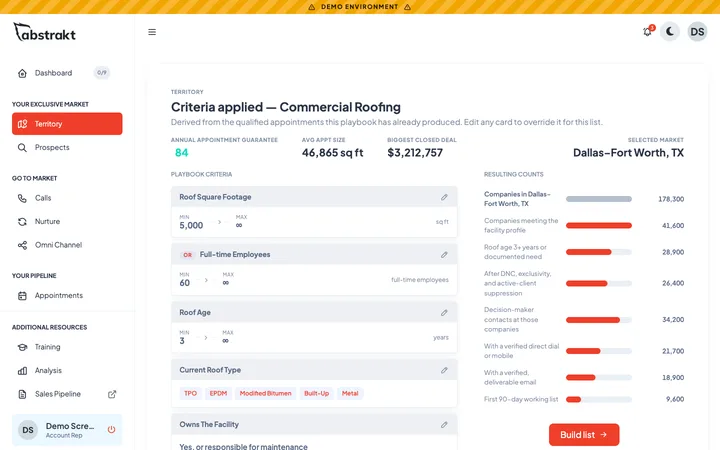
Real platform screen. Companies and contacts are fictional.
Set a monthly site walk goal and your own conversion rates. Green tags are Abstrakt history, gray tags are your inputs. Contract value appears once you enter your own average: we never fill one in.
Illustrative math from your inputs. It updates as you type.
Enter your average project value to see contract value. We do not fill in a number for you.
Project value won each month
Project value from 12 months of wins
How this works: appointments x dials per appointment = outreach, spread over 21 working days. Appointments x your proposal rate x win rate = wins. Wins x your value = contract value: what signed work is worth, not revenue recognized. Fractions are monthly averages. Not a forecast, a quote or a promise.
Search 100 metros for the local numbers: how many painting companies compete, how many larger buildings buy the work, and which account types to call first. Most larger buildings per contractor in the data: Central Valley, New York, San Francisco, Albany, West Palm Beach.
Type a city or state, then pick a market.
painting market snapshot
Account types to call first: Retail stores, Manufacturing plants, Apartment and multifamily management companies
Contractors: U.S. Bureau of Labor Statistics, Quarterly Census of Employment and Wages, private ownership, 2026 Q1, nonresidential painting contractors (NAICS 238322). Larger buildings: U.S. Census Bureau, County Business Patterns 2023, establishments with 20 or more employees in the categories that buy painting work. These are establishment counts, not qualified prospects: qualification happens on the call. Territory availability is not shown here because it changes as programs start; a strategist confirms it against current territory records.
| Market | Contractors | Larger buildings | Per contractor | Largest category |
|---|---|---|---|---|
| Birmingham, AL market page | 38 | 1,413 | 37.2 | Retail stores |
| Huntsville, AL market page | 10 | 601 | 60.1 | Retail stores |
| Phoenix, AZ market page | 91 | 5,962 | 65.5 | Retail stores |
| Tucson, AZ market page | 13 | 1,100 | 84.6 | Retail stores |
| Little Rock, AR market page | 16 | 892 | 55.8 | Retail stores |
| Central Valley, CA market page | 16 | 3,048 | 190.5 | Retail stores |
| Los Angeles, CA market page | 199 | 19,849 | 99.7 | Retail stores |
| Oxnard, CA market page | 9 | 1,139 | 126.6 | Retail stores |
| Riverside, CA market page | 61 | 5,035 | 82.5 | Retail stores |
| Sacramento, CA market page | 41 | 2,850 | 69.5 | Retail stores |
| San Diego, CA market page | 51 | 4,909 | 96.3 | Retail stores |
| San Francisco, CA market page | 60 | 6,456 | 107.6 | Retail stores |
| San Jose, CA market page | 32 | 2,730 | 85.3 | Retail stores |
| Santa Cruz, CA market page | 3 | 357 | 119.0 | Retail stores |
| Santa Rosa, CA market page | 12 | 812 | 67.7 | Retail stores |
| Stockton, CA market page | 6 | 853 | 142.2 | Retail stores |
| Colorado Springs, CO market page | 10 | 838 | 83.8 | Retail stores |
| Denver, CO market page | 75 | 4,097 | 54.6 | Retail stores |
| Bridgeport, CT market page | 18 | 1,301 | 72.3 | Retail stores |
| Hartford, CT market page | 30 | 1,709 | 57.0 | Retail stores |
| Washington, DC market page | 163 | 7,173 | 44.0 | Retail stores |
| Cape Coral, FL market page | 20 | 1,009 | 50.5 | Retail stores |
| Daytona Beach, FL market page | 13 | 794 | 61.1 | Retail stores |
| Jacksonville, FL market page | 31 | 2,017 | 65.1 | Retail stores |
| Miami, FL market page | 119 | 9,251 | 77.7 | Retail stores |
| North Port, FL market page | 22 | 1,178 | 53.5 | Retail stores |
| Orlando, FL market page | 76 | 3,839 | 50.5 | Retail stores |
| Tampa, FL market page | 88 | 3,983 | 45.3 | Retail stores |
| West Palm Beach, FL market page | 22 | 2,216 | 100.7 | Retail stores |
| Atlanta, GA market page | 131 | 7,688 | 58.7 | Retail stores |
| Honolulu, HI market page | 48 | 1,138 | 23.7 | Retail stores |
| Boise City, ID market page | 31 | 1,109 | 35.8 | Retail stores |
| Chicago, IL market page | 185 | 12,417 | 67.1 | Retail stores |
| Indianapolis, IN market page | 54 | 2,839 | 52.6 | Retail stores |
| South Bend, IN market page | 4 | 479 | 119.8 | Retail stores |
| Des Moines, IA market page | 27 | 976 | 36.1 | Retail stores |
| Wichita, KS market page | 21 | 934 | 44.5 | Retail stores |
| Lexington, KY market page | 14 | 733 | 52.4 | Retail stores |
| Louisville, KY market page | 35 | 1,902 | 54.3 | Retail stores |
| Baton Rouge, LA market page | 37 | 958 | 25.9 | Retail stores |
| New Orleans, LA market page | 32 | 1,330 | 41.6 | Retail stores |
| Portland, ME market page | 14 | 1,012 | 72.3 | Retail stores |
| Baltimore, MD market page | 77 | 3,461 | 44.9 | Retail stores |
| Boston, MA market page | 101 | 7,519 | 74.4 | Retail stores |
| Springfield, MA market page | 9 | 686 | 76.2 | Retail stores |
| Worcester, MA market page | 12 | 1,138 | 94.8 | Retail stores |
| Detroit, MI market page | 95 | 5,517 | 58.1 | Retail stores |
| Grand Rapids, MI market page | 32 | 1,967 | 61.5 | Manufacturing plants |
| Saginaw, MI market page | 1 | 253 | 253.0 | Retail stores |
| Minneapolis, MN market page | 78 | 5,773 | 74.0 | Retail stores |
| Kansas City, MO market page | 39 | 3,044 | 78.1 | Retail stores |
| St. Louis, MO market page | 70 | 3,694 | 52.8 | Retail stores |
| Omaha, NE market page | 32 | 1,267 | 39.6 | Retail stores |
| Las Vegas, NV market page | 39 | 2,630 | 67.4 | Retail stores |
| Manchester, NH market page | 8 | 706 | 88.3 | Retail stores |
| Albuquerque, NM market page | 17 | 1,063 | 62.5 | Retail stores |
| Albany, NY market page | 11 | 1,144 | 104.0 | Retail stores |
| Buffalo, NY market page | 22 | 1,637 | 74.4 | Retail stores |
| New York, NY market page | 231 | 26,974 | 116.8 | Retail stores |
| Poughkeepsie, NY market page | 7 | 835 | 119.3 | Retail stores |
| Rochester, NY market page | 21 | 1,596 | 76.0 | Retail stores |
| Syracuse, NY market page | 15 | 847 | 56.5 | Retail stores |
| Charlotte, NC market page | 45 | 3,820 | 84.9 | Retail stores |
| Greensboro, NC market page | 15 | 1,211 | 80.7 | Retail stores |
| Raleigh, NC market page | 30 | 1,812 | 60.4 | Retail stores |
| Akron, OH market page | 15 | 1,114 | 74.3 | Manufacturing plants |
| Cincinnati, OH market page | 36 | 2,932 | 81.4 | Retail stores |
| Cleveland, OH market page | 45 | 3,411 | 75.8 | Manufacturing plants |
| Columbus, OH market page | 43 | 2,780 | 64.7 | Retail stores |
| Dayton, OH market page | 9 | 1,090 | 121.1 | Retail stores |
| Oklahoma City, OK market page | 41 | 1,799 | 43.9 | Retail stores |
| Tulsa, OK market page | 30 | 1,402 | 46.7 | Retail stores |
| Portland, OR market page | 42 | 4,216 | 100.4 | Retail stores |
| Allentown, PA market page | 17 | 1,176 | 69.2 | Retail stores |
| Harrisburg, PA market page | 10 | 796 | 79.6 | Retail stores |
| Philadelphia, PA market page | 112 | 8,156 | 72.8 | Retail stores |
| Pittsburgh, PA market page | 55 | 3,385 | 61.5 | Retail stores |
| Providence, RI market page | 32 | 2,494 | 77.9 | Retail stores |
| Charleston, SC market page | 25 | 1,179 | 47.2 | Retail stores |
| Columbia, SC market page | 19 | 961 | 50.6 | Retail stores |
| Greenville, SC market page | 15 | 1,345 | 89.7 | Retail stores |
| Chattanooga, TN market page | 9 | 787 | 87.4 | Retail stores |
| Knoxville, TN market page | 14 | 1,172 | 83.7 | Retail stores |
| Memphis, TN market page | 21 | 1,604 | 76.4 | Retail stores |
| Nashville, TN market page | 35 | 2,956 | 84.5 | Retail stores |
| Austin, TX market page | 34 | 3,224 | 94.8 | Retail stores |
| Dallas, TX market page | 130 | 10,474 | 80.6 | Retail stores |
| El Paso, TX market page | 8 | 907 | 113.4 | Retail stores |
| Houston, TX market page | 90 | 8,643 | 96.0 | Retail stores |
| McAllen, TX market page | 5 | 728 | 145.6 | Retail stores |
| San Antonio, TX market page | 38 | 2,743 | 72.2 | Retail stores |
| Provo, UT market page | 8 | 927 | 115.9 | Retail stores |
| Salt Lake City, UT market page | 25 | 2,086 | 83.4 | Retail stores |
| Richmond, VA market page | 42 | 1,768 | 42.1 | Retail stores |
| Virginia Beach, VA market page | 38 | 2,208 | 58.1 | Retail stores |
| Seattle, WA market page | 81 | 5,353 | 66.1 | Retail stores |
| Spokane, WA market page | 19 | 858 | 45.2 | Retail stores |
| Charleston, WV market page | 5 | 229 | 45.8 | Retail stores |
| Madison, WI market page | 14 | 1,182 | 84.4 | Retail stores |
| Milwaukee, WI market page | 35 | 2,739 | 78.3 | Manufacturing plants |
This is the path our SDRs follow on a good call in facility trades. Each line is tagged with its step in the ENGAGE Sales Process: a specific reason to talk, a pushback handled without arguing, the qualifying and decision questions, the differentiator, and a clear ask for the meeting. It earns every point on our 5 Star Scorecard.
Dramatized example.Written from our facility trades talk track and voiced by AI. Names and figures are samples. This is not a recording of a real call.
The research our SDRs train on for painting programs. Open any section. The same material, with sales center data, is in The State of Commercial Painting Business Development, 2026.
Commercial painting is project work that behaves like a cycle. Exteriors, corridors, hotel rooms and retail interiors all get repainted on a rhythm set by wear, brand standards and tenant turnover, and the money is approved in a budget year before the first coat goes on. The outbound job is to find out where each building sits in that cycle, get your name into the budget conversation, and turn one good project into the painter they call for every turnover and touch-up after.
Every building with a painted exterior is on a cycle someone can describe. The decision is budgeted ahead, so outbound that learns the budget month catches it before bids go out.
Property and apartment managers need a painter who can turn a space fast. Steady, repeat work that comes from one relationship.
Brand standards and renovation programs set the schedule. Fewer decision-makers, defined windows, and night or phased work that not every painter can staff.
Floor coatings, structural steel, tanks and equipment in plants and warehouses. Bigger tickets and specification-driven, so the conversation starts with the plant engineer, not purchasing.
Bought by general contractors through bid lists. Worth pursuing as a GC relationship, but a building owner call does not create it.
Curb appeal and turnover speed. Ask when the exterior was last done and what tenants comment on.
Turn time on vacant units and exterior appearance for leasing. Regional managers can approve across communities.
Protecting the asset. Ask what the exterior looked like at the last repaint and what has changed since.
Brand standards and keeping rooms in service. Ask about the renovation calendar and phased floor-by-floor work.
Night work that does not close the store. Chains often run repaints as multi-site programs from regional facilities.
Coating performance and shutdown windows. Ask what surfaces are failing and when the next shutdown is.
Working around shifts and traffic. Ask who owns the building and who pays for which surfaces.
Manufacturer image standards and staying open during the work.
Working around residents with low-odor products and tight scheduling. Regional operators often buy across communities.
The summer window. Projects are chosen in winter and spring for work when students are gone.
A repaint schedule they can put in the budget and a crew that turns spaces fast.
Phased, night or weekend work and a written warranty.
Floor-by-floor phasing that keeps inventory available.
The right coating system for the surface and a schedule that fits the shutdown.
A repaint that protects the building and supports leasing.
Age and visible wear tell you whether this is a project for this budget year or next.
Interior comments point to a refresh that can be sold faster than a full exterior.
Turnover painting is steady work, and slow turns are a pain point you can solve.
Painting projects that are not in the budget wait, so this tells you when to deliver a price.
Larger exteriors usually need owner approval, which changes who you present to.
New properties often get a paint assessment and a vendor review.
In-house painters who fall behind during busy turnover months are the usual opening.
Paint delays cost leasing time, which gives you a business reason beyond price.
Exterior programs are larger projects that usually follow acquisitions or rebrands.
Renovations bring defined scopes and timelines you can price.
Regional approval means one good community can lead to the portfolio.
Peeling, fading and failing caulk show how urgent the work is and what prep it needs.
Asset events create a deadline and a reason to repaint now.
Substrates decide the coating system, the price and whether you are the right fit.
This tells you whether you are pricing a project or helping them plan one.
Occupied work affects schedule, odor and access planning.
Brand deadlines set the schedule and usually the scope.
Phased floor-by-floor work changes crew planning and pricing.
Hotel decisions are often made above the property, so you need to reach the right level.
Exterior condition is often a separate project from interior renovation.
Brand and management changes almost always come with paint and finish requirements.
Program work needs a different contact and often a vendor registration process.
Night work capability is often the deciding factor for retail painting.
Planned programs give you a timeline and a defined scope.
This shows whether the person on the phone can say yes.
In many centers the storefront is the tenant's and the shell is the landlord's, which splits the opportunity.
Failing coatings define the scope and show whether this is a specialty coatings job.
Shutdown windows decide when the work happens and when you need to have the job won.
Audit findings create urgency and a clear reason to fund the work.
Coating history tells you about surface prep, product choice and the plant's tolerance for failures.
Plant requirements affect cost and tell you whether EHS needs to be in the conversation.
New space needs coatings and striping before it can run.
Lease terms split the work between landlord and tenant, which decides who you sell to.
Tenant changes are when floors, striping and offices get refreshed.
Shift and traffic windows shape the schedule and the price.
Audit findings create a deadline.
Office painting is a smaller add-on that can round out the job.
Brand programs set the scope, the spec and the deadline.
Floor coatings are a separate, high-value scope that wears out under daily traffic.
Staying open to sell is the dealer's main concern, so scheduling answers matter.
Group buying can open several rooftops after one job.
Ownership changes and remodels bring painting work with them.
Turn speed affects move-ins, which makes room painting a business issue for the executive director.
Occupied-space requirements show whether your crews and products fit the setting.
Appearance during tours ties painting to occupancy.
Renovations and new owners bring defined projects and budgets.
Regional approval can open multiple communities.
Summer work is usually decided in winter and spring, which tells you when to price.
Age and wear point to which spaces are on the list next.
Campaign-funded projects bring larger scopes and a longer timeline.
Approval path decides who needs to see your proposal and when.
Exterior work may have a different window than interior summer projects.
Useful: now you know the cycle. Ask what was painted, the interior or the exterior, and whether turnover or touch-up work is handled separately.
Next step: Record the repaint date and surfaces; offer turnover or touch-up work in the meantime.
In-house staff often handles touch-ups and small rooms but not exteriors, lifts, coatings or large phased jobs.
Next step: Ask what they send out or keep putting off. That is the opening.
They have told you the planning cycle. Ask when next year's budget is set and who builds it.
Next step: Calendar the follow-up before the budget is finalized and offer a scope or estimate they can use to plan.
Ask how the last job went and how they get scheduled. Painters lose accounts over missed schedules, mess and failed finishes.
Next step: Record the incumbent; ask to be included on the next bid or a smaller project.
Painting cannot be priced without seeing the surfaces. A pricing request often means a project is being scoped.
Next step: Ask what the project is and book a site visit to measure and inspect.
Most buildings are not ready to repaint on the day you call, and that is fine. The useful outcome of a first call is when the building was last painted, what the surfaces need, who decides and when the budget is set. Recorded and revisited, a not-this-year turns into an invitation to price the job when the budget opens, and a first project often leads to the turnover and touch-up work that follows.
Exterior painting follows temperature: coatings have minimum application temperatures, so exterior work is concentrated in the warmer months. The selling runs every month, keyed to each building's budget date and repaint cycle, and interior, turnover and industrial coating work is bought all year.
Send a recap within a day with photos of the surfaces you looked at, the condition you saw and the scope you heard. Confirm the timing they need, such as a budget date, shutdown window or summer break, and when you will deliver pricing. If the owner or a regional manager approves, ask to include them.
Avoid: Do not quote a number on the walk before you have confirmed surfaces, prep and access.
Book a short review call and walk through prep, product, schedule and how you will work around tenants, guests or residents, since those are where bids differ. Ask what they will compare it against and what would make it an easy approval. Offer options if the scope can be phased across budget years.
Avoid: Do not let the follow-up become a string of emails asking if they have any questions.
Find out whether the project is waiting on budget, an owner, a sale, a brand deadline or a season. Set your next contact around that date and send something useful meanwhile, such as a phased option or a priority list for the worst surfaces. Log the last paint date and the budget timing in the CRM.
Avoid: Do not discount the job to create urgency the building does not have.
Ask what decided it and whether there is other work coming, like unit turns, touch-ups or another building. Offer to be the backup for turnover or small projects. Check back after the job is done to see how it went.
Avoid: Do not treat one lost project as a lost account.
Call before budgets are built, not after they are approved, and ask what is on next year's list. Offer to walk the building again and price the priority items so your number is the one in the budget. For schools and plants, work backward from the summer break or shutdown.
Avoid: Do not wait until the work is already scheduled with another contractor.
You receive the surface notes, last repaint, current painter, budget timing, decision process and the exact reason they agreed to meet.
Commercial painting is project work that behaves like a cycle. Exteriors, corridors, hotel rooms and retail interiors all get repainted on a rhythm set by wear, brand standards and tenant turnover, and the money is approved in a budget year before the first coat goes on. The outbound job is to find out where each building sits in that cycle, get your name into the budget conversation, and turn one good project into the painter they call for every turnover and touch-up after. Most of these buyers already have a contractor, so new accounts come from a target list built around the right buildings, contact with the people who sign, and follow-up timed to their repaint cycle and budget year. An outsourced sales development team runs that work as an extension of yours and puts qualified meetings on your calendar.
Property managers, facility managers, hotel directors of engineering, plant engineers and maintenance managers, and owners or asset managers. They know when the building was last painted, which budget the work comes from and who signs.
Commercial and multifamily property portfolios, owner-occupied buildings, hotels, retail, manufacturing plants and warehouses, dealerships, senior living and private schools. We weight the list toward the work you want: exterior repaints, interior refreshes, turnover painting or industrial coatings.
Painting is budgeted before it is bid. The SDR asks when the building was last painted, when next year's budget is set, and whether a shutdown, renovation or sale is coming, then books a site walk while the scope is still being shaped. Work that is a year out is logged and followed up at budget season.
Yes. One client per trade per territory: we will not run painting appointment setting for your direct competitor in your territory. Whether your territory is open is confirmed by a strategist against current territory records, so ask for an availability review.
Inside your crew range and in a building type you want; The person in the meeting approves or shapes the painting budget; Surfaces and coatings you can do well, at a scale you can staff; A stated need, a known repaint cycle, or budget timing; Surface notes and the current painter captured; A confirmed date and time for a site visit or sales conversation. Every meeting is graded on our 25-point 5 Star Scorecard before it reaches your calendar.
Yes. The target list is built to your footprint, from one metro to several states, and stays inside the area your painting crews can serve. Each territory is exclusive, and each one is reviewed for availability separately.
Yes. Approved painting client stories: Commercial Painting. Each figure is labeled with what it is (appointments, closed business and so on) and the period it covers, and the full library is on our Success page. You can also ask for an introduction to a current painting client; we ask the client first.
Program expectations and commitments are defined in your agreement. Before launch we agree on what a qualified painting meeting is, who we call and how results are reported. Outbound BDR programs are priced from a starting point (starting at $5,000 per month).
Explore commercial painting client results · Hear a dramatized sample call · Watch a client testimonial
Abstrakt at a Glance answers the five questions buyers ask before they sign: how it works, what clients got, what calls sound like, what reviewers say and what it costs. It opens with commercial painting selected where we have it.
Program commitments
Program expectations and commitments are defined in your agreement. Before launch we agree on what a qualified site walk is, who we call and how results are reported.
Exclusive to your territory
One client per trade per territory: we will not run painting appointment setting for your direct competitor in your territory.
Pricing
Outbound BDR programs: starting at $5,000 per month. See what a program includes.
Our SDRs open the door. Our creative and inbound teams make sure what a buyer finds next, your website and the material your reps send, closes the gap.
Individually powerful. Better together. Our four solutions work together to find your buyers, book meetings with them and help your team close more of them.
All three together: Get Outbound BDR, Inbound SDR and Brand Boost together, starting at $6,500 per month ($5,000 + $1,000 + $500 = $6,500). Enterprise SDR/BDR is custom.Build my program

Getting Ava ready…
AI video guide. Your voice is processed by Tavus to run this conversation; we never use your camera. Calls end after 5 minutes. Privacy
New playbooks, benchmarks and guides from our sales floor, for owners and sales leaders who sell to businesses. One email a month. See past issues.