Agree that they should, then point to the part their team cannot do and why it matters.

The ENGAGE Sales Process
ENGAGE: the inside sales system behind every Abstrakt call
ENGAGE is our proprietary inside sales system, a talk track that takes a cold dial to a qualified meeting, built on our founders' 35+ years of sales scripting. Abstrakt Intelligence tells us who to call. ENGAGE decides how the call goes, and every rep is trained, certified and role-played on it before they dial for you.
Ask Ava anything about Abstrakt Sales, out loud or by typing.
Targeting, then the talk track
Who to call is solved. How you handle the call decides the meeting.
Abstrakt Intelligence picks the right company and the right contact before anyone dials, from 14M+ U.S. commercial buildings mapped and 200+ intent triggers. That gets the right person on the phone.
What happens in the next two minutes is ENGAGE. A great list with an unprepared rep still burns the conversation: the prospect hears a pitch, says "send me something," and the account goes cold. ENGAGE is the talk track our founders built from 35+ years of sales scripting, so the right conversation ends in a meeting.
01 · Target Abstrakt Intelligence Who to call
- The account that fits your qualifiers
- The contact who owns the decision
- The trigger that makes now the time to call
- A specific reason to talk
- Qualifiers confirmed by the prospect
- Pushback handled, the meeting asked for
= A qualified meeting, graded on 25 points before it reaches your calendar.
The ENGAGE steps
Eight steps from the dial to the meeting
Each step has a job, a line the rep says and a reason it works. The example lines are dramatized from our sample calls, not recordings. Every program gets its own talk track, written around your buyers.
- Step 01
Prepare before the dial
The SDR never dials blind. The dialer shows who they are calling, the title and direct line, why that person is the right contact, and what we already know about the account: facility data, past conversations and engagement on email and LinkedIn.
Why it works. A rep who knows the building and the history sounds like someone with a reason to call, not someone working down a list. It is also what makes a specific reason for the call possible in step four.
On the SDR's screen before the dial
- Contact, title and direct line
- Why this person is the right contact
- Facility data on the account
- Past calls, emails and LinkedIn touches
- Step 02
Open with honesty
A short, direct introduction: who we are, who we represent, and that the line is recorded. No tricks, no pretending to be someone else. It earns the next thirty seconds.
Why it works. Prospects decide in the first seconds whether this is a pitch or a person. Naming the company and the recorded line up front removes the guessing, and a nod to their time buys the next sentence.
Dramatized example · Commercial HVAC and mechanical sample call SDRHi Dana, this is Chris with Northline Mechanical on a recorded line. I know I'm catching you in the middle of the day, so I'll keep this short. How are you today?
ProspectAlright. What can I do for you?
- Step 03
Get past the gatekeeper to the right person
When someone else answers, the SDR asks for the role that owns the decision rather than guessing at names, and turns "not available" into a callback time instead of a dead end.
Why it works. Asking for the role gets the person at the front desk helping instead of screening. A set callback time keeps the account moving instead of starting over next week.
Example line · sample commercial roofing talk track SDRI'm trying to reach whoever handles roof maintenance for the building. Is that you?
- Step 04
Give a real reason for the call
The reason is specific to the prospect: their building, their market, what we know about their situation. A generic pitch gets a generic no. A specific reason gets a conversation.
Why it works. A fact about their building or their contract proves the call is not random. It turns "what is this about?" into a question about their own situation, which they can answer.
Dramatized example · IT and managed services sample call ProspectOkay. What's this about?
SDRThe reason for my call, we support companies across the metro running somewhere around 80 workstations, and your support agreement came up as due for review around the first of the year. I wanted to see how support and security are being handled right now.
- Step 05
Qualify while you talk
Two or three natural questions confirm the fit and who signs off: the qualifiers we agreed with you, the decision-making process and the timeline. Every qualifier is confirmed by the prospect, not assumed from a list.
Why it works. A qualifier the prospect says out loud holds up in the meeting. The decision question is asked open, never "you're the decision-maker, right?", so the answer is real and the right people end up in the room.
Dramatized example · Commercial cleaning sample call SDRTwo quick things so I send the right person out. Is the building at about 60,000 square feet of cleanable space, and are you the one who signs off on the janitorial contract, or does that go somewhere else?
ProspectAbout that, yeah. And the janitorial contract comes to me.
SDRBesides you, who else is usually involved when a decision like this gets made?
ProspectHR has opinions. Lots of opinions. But the budget and the decision are mine.
- Step 06
Show why you are different
One clear differentiator or a result from a company like theirs. Not a feature list: the one thing that makes a meeting with you worth their time.
Why it works. One concrete difference gives the prospect a reason to meet you instead of a reason to compare prices. If they cannot say why you are different, they show up out of politeness, or not at all.
Dramatized example · Fire protection and security sample call SDRWhat we do differently is the inspection itself. We walk the alarm, sprinklers, and access control against current code and hand you a written deficiency report at no charge either way. And it's logged the way the fire marshal and your insurance carrier ask for it.
ProspectThat would make the renewal a lot easier.
- Step 07
Handle pushback without arguing
Every talk track has a pushback guide for the objections we actually hear. The SDR acknowledges the concern (feel), shows others felt the same (felt), and shares what they found (found), then steers back to the meeting.
Why it works. Arguing makes a prospect defend their vendor. Agreeing, then offering something that adds to what they already have, keeps the door open. The answers are prepared, so nobody improvises under pressure.
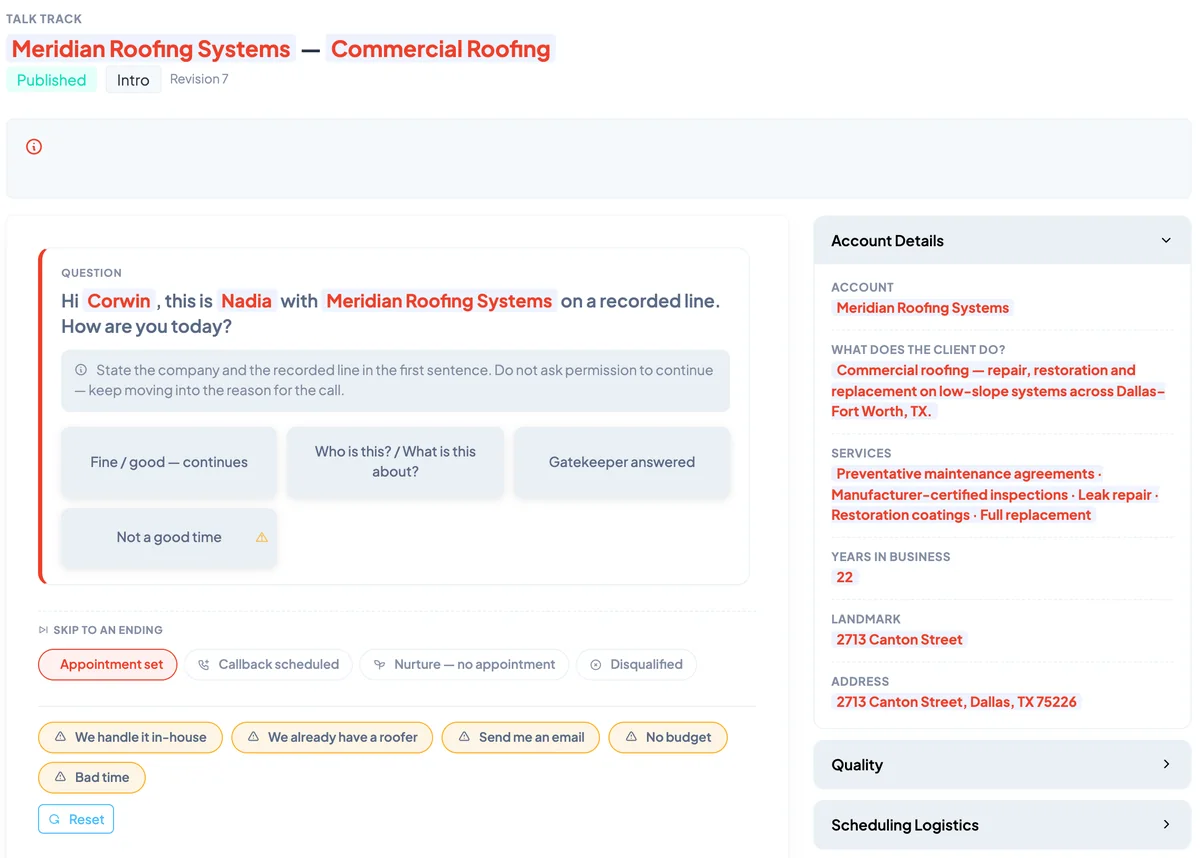
Dramatized example · Commercial roofing sample call ProspectWe already have a roofer. Honestly, he's fine.
SDRI understand. A lot of the people I talk to felt the same way at first, and what they found is that a second look cost them nothing. When the management company's vendor files an inspection, it covers their scope. Ours is a second document at no cost, and if they've got everything handled it will say so.
ProspectOkay, that makes sense.
- Step 08
Close for the meeting
A clear ask with two specific times, the reason to meet recapped, the calendar invite sent while the prospect is still on the line, and the right attendees added.
Why it works. Two specific times are easier to pick from than "when works for you?". Recapping the agenda and sending the invite on the line make the meeting real before the call ends.
Dramatized example · Commercial HVAC and mechanical sample call SDRLet's put it on the calendar. I have Tuesday the 15th at 10, or Thursday the 17th at 2. Which is better? I'll send the invite while we're on the line, and I'll add Warren Doyle's mobile to it.
ProspectTuesday at ten.
SDRGreat. So that's Tuesday the 15th at 10 o'clock, in person at your building, and we'll keep it to thirty minutes. Warren Doyle, our project manager, will walk the equipment with you, document its condition and age, and leave you the written report. When he gets there, where should he check in?
Names, companies and figures in the examples are samples. Hear every line in context in a full call below.
A talk track, not a script
The call follows what the prospect actually says
Our talk tracks are interactive. The SDR picks the answer they actually heard, and the track moves to the right next line: past a gatekeeper, into qualifying, or to the matching pushback answer and back. Nobody reads a wall of text, and every path is recorded.
Coaching notes sit under each line, like "state the company and the recorded line in the first sentence," so the standard is on screen during the call, not in a binder.
Answers ready for the objections we actually hear
Feel, felt, found: acknowledge the concern, show it is common, share what others found. Then steer back to the meeting.
Never ask them to fire anyone. Offer a second opinion that costs them nothing and either confirms their vendor or finds a gap.
Happy to, but tie the email to something only a meeting can produce, then offer two times.
Separate the meeting from the purchase: the first conversation costs nothing, and the decision comes later.
Ask for ninety seconds, or set a specific callback time rather than "call me later."
Every call ends in one of four logged outcomes
- Appointment setA qualified meeting on your calendar, graded on the 5 Star Scorecard before you see it.
- Callback scheduledA specific date and time to reach the right person, logged and kept.
- NurtureInterested but not yet: they stay in front of us until the timing is right.
- DisqualifiedNot a fit. Removed from the list and suppressed on every channel.
Hear the process
Pick your industry and hear a call
The same eight steps, run on a dramatized call in your industry. Each line is tagged with its step, so you can follow the process as it happens.
- OpenerSDRHi Dana, this is Chris with Northline Mechanical on a recorded line. I know I'm catching you in the middle of the day, so I'll keep this short. How are you today?
- ProspectAlright. What can I do for you?
- Reason for the callSDRThe reason for my call, we service commercial HVAC across the metro, and your building came up as about 40,000 square feet of conditioned space with the maintenance agreement due for review around the first of the year. I wanted to see how maintenance and repairs are being handled right now.
- PushbackProspectWe already have an HVAC company.
- Feel, felt, foundSDRI understand. A lot of the people I talk to felt the same way at first, and what they found is that a second look cost them nothing. When your current vendor comes out for a repair, that covers the repair. Ours is a second document on the whole system at no cost, and if they've got everything handled it will say so.
- ProspectOkay, that makes sense.
- QualifySDRTwo quick things so I send the right technician out. Is the building at about 40,000 square feet of conditioned space, and are you the one who signs off on mechanical work, or does that go somewhere else?
- ProspectThat's about right. Most of the units went in around twenty twelve. And mechanical work comes to me.
- Decision-making questionSDRBesides you, who else is usually involved when a decision like this gets made?
- ProspectOur controller sees the number. But I make the decision.
- TimelineSDRAnd when are you looking to have this sorted out?
- ProspectProbably by the end of the year, before it rolls over.
- DifferentiatorSDRWhat we do differently is the inspection itself. We open up every unit, document age and condition, and you get the written report at no charge either way. And because every visit is logged against the equipment, it keeps your manufacturer warranty intact.
- ProspectThat would actually help. I don't have a clean list of what's up there.
- Consideration questionSDRIf what we show you makes sense, is Northline Mechanical a company you'd consider working with down the road?
- ProspectYeah, I'd consider it.
- Close for the meetingSDRLet's put it on the calendar. I have Tuesday the 15th at 10, or Thursday the 17th at 2. Which is better? I'll send the invite while we're on the line, and I'll add Warren Doyle's mobile to it.
- Meeting setProspectTuesday at ten.
- Recap the agendaSDRGreat. So that's Tuesday the 15th at 10 o'clock, in person at your building, and we'll keep it to thirty minutes. Warren Doyle, our project manager, will walk the equipment with you, document its condition and age, and leave you the written report. When he gets there, where should he check in?
- ProspectLoading dock side. Have them call me from the lot and I'll come down.
- Confirm detailsSDRLet me confirm your details: your title, the best email for the invite, and that we're meeting at your building address.
- ProspectFacilities manager. Email's dana dot ellis at our company dot com. And yes, main building.
- Invite sentSDRPerfect. I'm sending the invite now. Could you accept it when it comes through, so the time is held? Thanks, Dana. Warren will see you Tuesday.
Dramatized example written from our talk tracks and voiced by AI. Names and figures are samples, not a recording of a real call. Grade it on our 5 Star Scorecard.
The people on your calls
Trained, certified and role-played before your first call
ENGAGE only works if the rep can run it under pressure, so nobody learns it on your prospects. Here is the path every rep takes before they dial for you.
01Before the floor
Two weeks of extensive training
Every rep completes two weeks of extensive training before taking a call on the floor. They learn ENGAGE step by step: the opener, the reason for the call, qualifying, pushback and the close.
Nobody learns the job on your prospects.
2 weeksof extensive training before a rep takes a call on the floor
02Your company
Then they learn your company
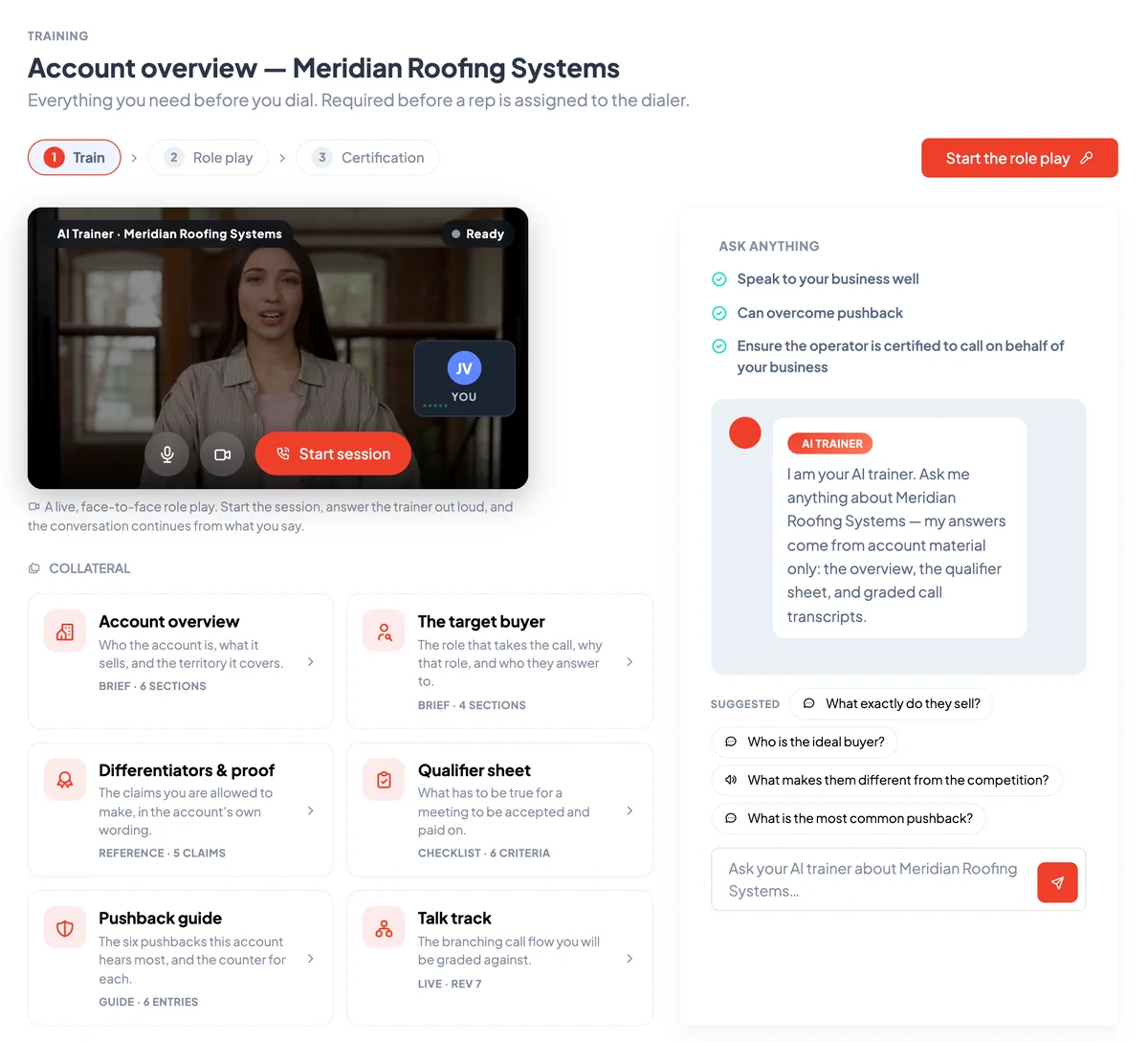
Each program has its own material: who you are and what you sell, the buyer who takes the call and why, the claims we are allowed to make in your words, the qualifier sheet, the pushback guide and your talk track.
The rep can question an AI trainer that answers from that material only, so what they learn is what you approved.
03AI role plays
Role-played against an AI prospect
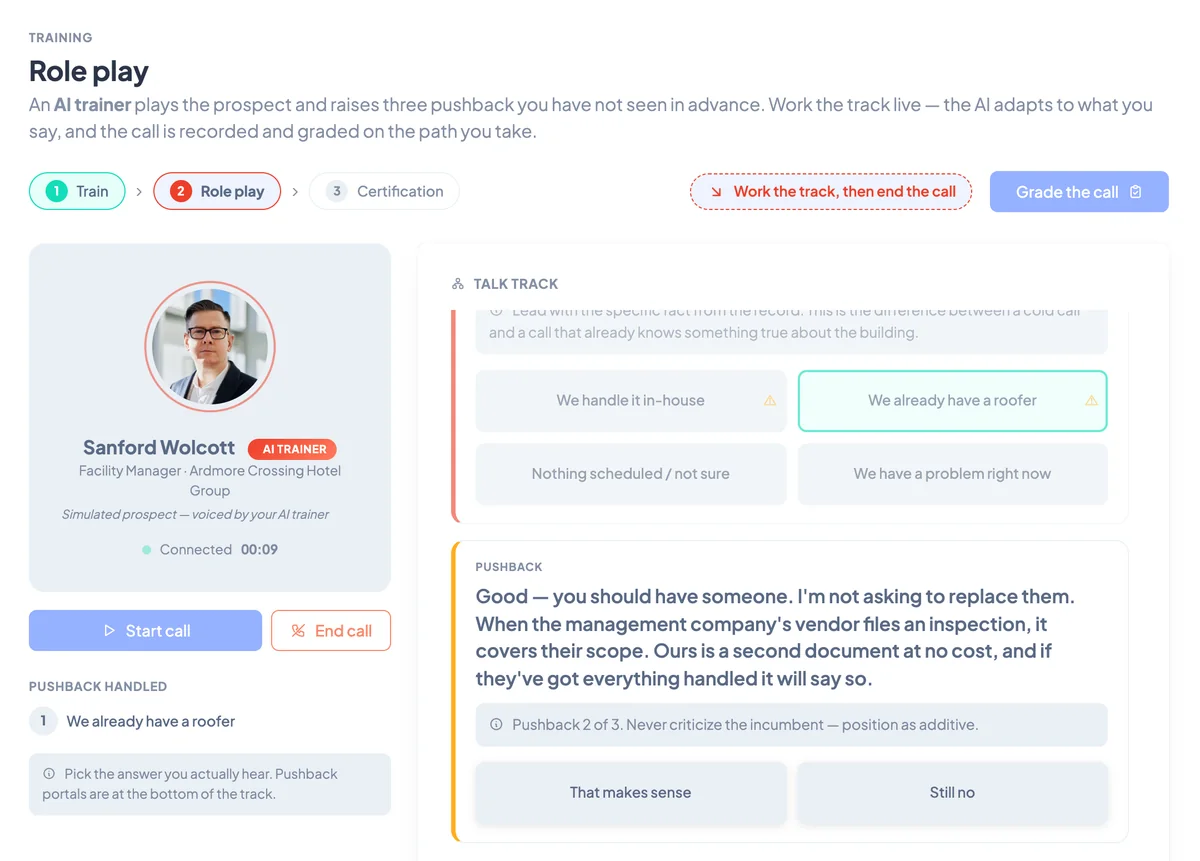
An AI trainer plays your prospect and raises pushback the rep has not seen in advance. The rep works your talk track live, and the AI adapts to what they say.
The role play is recorded and graded on the path the rep took, the same way a live call is.
04Certification
Certified on your company, or not dialing
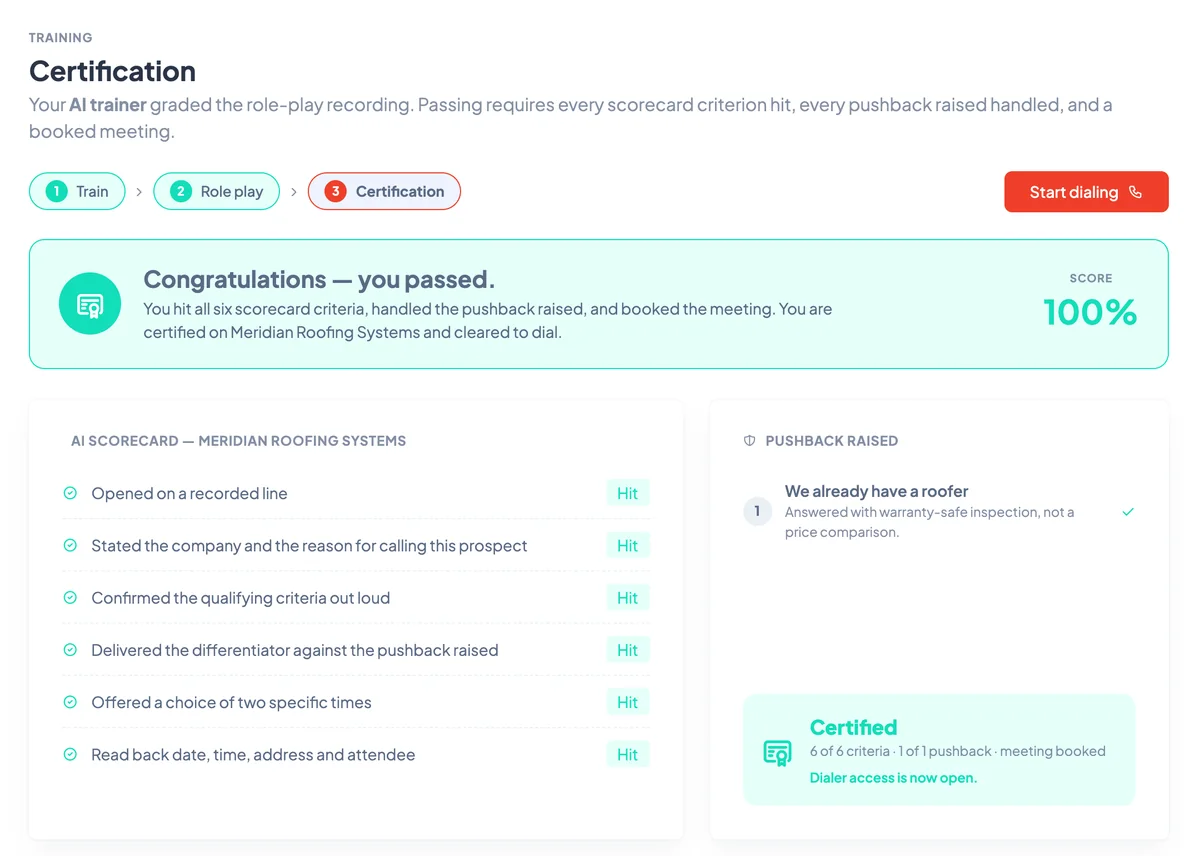
Every rep is certified on a client, including AI role plays, before representing that client. Passing means every scorecard criterion hit, every pushback handled and the meeting booked.
Certification is what opens the dialer for your program.
05On your calls
Live calls, graded and coached
On the floor, every call is recorded and every booked meeting is graded on the 25-point 5 Star Scorecard by a reviewer who did not make the call.
Coaching works from those recordings, not from memory, so the next call is better than the last.
25 pointson every booked meeting, scored by a reviewer who did not make the call
Why it wins
Conversations are scarce. ENGAGE makes each one count.
125 dials per appointment, on average
Across 3,140,107 calls and 25,151 appointments in our sales center, it ran from 78 dials per appointment in commercial fire protection to 169 in LED lighting. Most dials never reach a decision-maker. When one does, the talk track decides whether all that work becomes a meeting.
Source: Abstrakt sales center, Performance Intelligence, national, as of 2026-10, 15 verticals with at least 100 appointments. See the full benchmarks.
- 100,000+meetings booked a year
- 25points on the scorecard every booked meeting is graded on
- 17+years on the phones
- 1client per trade per territory
Company-wide figures across all Abstrakt programs, as of October 2026.
| Part of the call | Reps without a system | ENGAGE-trained reps |
|---|---|---|
| Getting ready | Learns on your live prospects | Two weeks of training, then certified on your company with AI role plays before the first dial |
| The opener | Changes with the rep and the day | Company, recorded line and a nod to their time, on every call |
| Reason for the call | A generic pitch | A fact about the prospect's building, contract or market |
| Qualifying | Assumed from the list | Confirmed by the prospect, out loud |
| Pushback | Improvised, or argued | Prepared answers for the objections your buyers raise |
| The ask | "When works for you?" | Two specific times, invite sent on the line |
| Quality check | Whatever the rep says happened | Recorded and graded on 25 points before it reaches you |
Every booked meeting goes through the 5 Star Quality Process. ENGAGE runs inside Outbound BDR, where the appointment guarantee is based on your industry and the exact number is in your agreement. If we miss the number by the end of the year, we work for free until we hit it.
The ENGAGE sales process, answered
What is the ENGAGE sales process?
ENGAGE is Abstrakt's proprietary inside sales system: the talk track every Abstrakt SDR runs on every call. Prepare before the dial, open honestly, reach the right person, give a specific reason for the call, qualify while you talk, show what makes you different, handle pushback without arguing, and close for a meeting with two specific times.
Who built ENGAGE?
Abstrakt's founders, who have more than 35 years of experience in sales scripting. It has been refined over 17+ years of calls for B2B companies and commercial trades, and it is the standard every booked meeting is graded against.
How are your reps trained on it?
Every rep completes two weeks of extensive training before taking a call on the floor. Then every rep is certified on a client, including AI role plays, before representing that client. Certification means every scorecard criterion hit, every pushback handled and the meeting booked.
Is it a script?
It is a talk track, not a script read word for word. The SDR follows the branch that matches what the prospect actually says, with prepared answers for the pushback we hear most, so every call sounds like a conversation.
Is the talk track built for my company?
Yes. Each program gets its own talk track: your reason for the call, your qualifiers, your differentiators and the objections your buyers raise. The SDR trains and is certified on it before dialing.
How does ENGAGE work with Abstrakt Intelligence?
Abstrakt Intelligence decides who we call: the account that fits your qualifiers, the contact who owns the decision and the reason to call now. ENGAGE decides how that call goes once they pick up. The talk track, the training, the role plays and the certification all run inside Abstrakt Intelligence.
How do you know the calls are done right?
Every call is recorded. Every booked meeting is graded on the 5 Star Scorecard, which checks script adherence, appointment commitment and qualifiers before the meeting reaches you, and you can listen to the calls yourself.
Our four solutions
Four Solutions. One Team.
Individually powerful. Better together. Our four solutions work together to find your buyers, book meetings with them and help your team close more of them.
- Outbound BDR A full BDR team for local or national selling Pricing starting at $5,000 per month
- Target list built for your trade and territory
- Phone, email, direct mail and LinkedIn run as one campaign
- Every meeting graded on a 25-point scorecard before it reaches you
- Every dial, email and recorded call in your Results Portal
- Enterprise SDR/BDR Fortune 1000 and large-enterprise revenue development Custom pricing
- Dedicated SDR/BDR teams for named accounts and new markets
- Inbound conversion and customer expansion programs
- Dealer, distributor and channel partner recruitment
- Market intelligence from Abstrakt Intelligence and research calls
- Inbound SDR SEO and AI search: found on Google and cited in AI answers Packages starting at $1,000 per month
- A website of up to 100 pages
- Local SEO and your Google Business Profile
- A new blog every business day
- Every blog posted to up to 3 social platforms, chosen from LinkedIn, Facebook, Instagram, TikTok, YouTube and X
- Brand Boost Video, sell sheets, case studies, decks, direct mail Packages starting at $500 per month
- Sell sheets and one-page case studies
- Pitch decks and infographics
- Trade show materials
- Video and direct mail that match the call




All three together: Get Outbound BDR, Inbound SDR and Brand Boost together, starting at $6,500 per month ($5,000 + $1,000 + $500 = $6,500). Enterprise SDR/BDR is custom.Build my program

Getting Ava ready…
- Secure line
- Session
- Joining
- On camera
AI video guide. Your voice is processed by Tavus to run this conversation; we never use your camera. Calls end after 5 minutes. Privacy
Photos on this page: Vitaly Gariev (opens in a new tab) (Unsplash License (opens in a new tab)); Tim van der Kuip (opens in a new tab) (Unsplash License (opens in a new tab)); Annie Spratt (opens in a new tab) (Unsplash License (opens in a new tab)); Austin Distel (opens in a new tab) (Unsplash License (opens in a new tab)); Hero photo: Abstrakt team members on our St. Louis campus. Abstrakt's own image.
