Commercial constructionOutbound BDR
How a design-build GC won a $900K project by month three
A design-build general contractor in Texas and Oklahoma won a $900,000 project from an outbound-set appointment in month three.
- $900K project won

We connect commercial builders with the owners, developers and facility leaders planning buildouts, renovations and capital projects. Our U.S.-based sales professionals prospect, qualify and book meetings while projects are still being planned, so your team can focus on estimating and winning work.
Ask Ava anything about the information on this page.
We do not have enough construction history to publish an industry rate yet, so this is the cross-industry figure from our sales center, labeled as such.
Approved construction client stories, closed business and testimonials. Every figure says what it is and the period it covers. See every construction result.
A design-build general contractor in Texas and Oklahoma won a $900,000 project from an outbound-set appointment in month three.
See how Noble Building & Development generated $40M in pipeline, 297 qualified appointments, and $18.9M closed revenue.
Despite tripling their company revenue in recent years, our construction partner wanted to grow even further to cement their presence across the Mid-Atlantic…
Dave Lagorio explains why Diede Construction brought in Abstrakt to set appointments for its private-sector work. It cost less than hiring a full-time salesperson, and it put Diede in front of projects it had been missing.
Start with the facilities or construction lead for project plans and selection process, then the owner, executive or finance lead who approves the builder.
Whether the project happens, the budget and the final choice of builder
Gets involvedEarly, when the project is still being planned and financed
Project scope, builder shortlists and day-to-day management of construction
Gets involvedCapital planning and builder selection
Capital budget approval and contract terms
Gets involvedCapital planning, fiscal year budgeting and contract approval
Strong influence on which builders are invited, especially before an owner has a GC
Gets involvedEarly design phases
Tenant improvement builder selection for the buildings they run
Gets involvedLease signings and tenant turnover
These are reasons a buyer may be open to a conversation, not proof that anyone is buying. Some we can see before the first call; the rest only the buyer can confirm.
Added capacity, new markets and enrollment or patient growth turn into building projects.
New owners renovate and reposition. Sellers sometimes fix deferred items before sale.
Schools, churches and nonprofits build after fundraising. Developers build after financing closes.
Tenant improvements follow lease commitments, usually on a short schedule.
New leaders often reopen the builder list.
Projects are funded before they are designed. Knowing when an owner sets its capital plan tells you when to be in the room.
Hotel brands and auto manufacturers set renovation and image requirements with deadlines.
Why "not now" is still a prospect. Most owners who build regularly already have builders they trust, so a no is usually a timing or relationship answer. The useful outcome of a first call is what is in the capital plan, when budgets are set, how builders are selected and who is on the current list. Recorded and revisited, that turns a no into a scheduled conversation before the next capital cycle, with a better chance of being invited to pre-construction or the private bid list.
The same six steps run on every program. What changes for commercial general contractors is who we call, the reason we give them, and the capital plan and project start window we track. It is our appointment setting for commercial contractors, with the phone work done by our cold calling services team.
Private owners and developers who build or renovate repeatedly, in building types and project sizes that match your portfolio, inside the area your superintendents can cover.
How Abstrakt Intelligence builds the listYour SDR works phone, email and LinkedIn under your company's name, so the prospect knows the name before the call.
The team and technology behind itStart with the facilities or construction lead for project plans and selection process, then the owner, executive or finance lead who approves the builder.
What "Right Contact" meansA planned project, growth that will need space, an aging facility, or frustration with a past builder. Right owner, right project type and size, a real project or capital plan with timing, the person who influences builder selection, and an agreed meeting time.
The 5 Star quality processRe-contact ahead of budget cycles and after milestones like financing or campaign goals; share relevant project experience; offer early budgeting help. The capital plan and project start window go in the record so the next call lands on time.
Our process, stage by stageA confirmed meeting with owners and their project teams, checked for right company, right contact and right timing, and graded on our 25-point 5 Star Scorecard before it reaches your calendar. You receive the project scope, timing, delivery method, current builders, the selection process and the exact reason they took the meeting. Every call and booked meeting is visible to you in the Results Portal.
What happens after a meeting is booked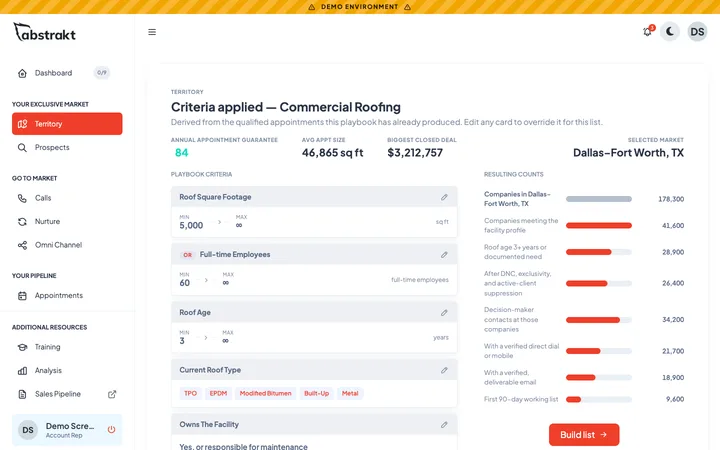
Real platform screen. Companies and contacts are fictional.
Set a monthly meeting goal and your own conversion rates. Green tags are Abstrakt history, gray tags are your inputs. Contract value appears once you enter your own average: we never fill one in.
Illustrative math from your inputs. It updates as you type.
Enter your average project value to see contract value. We do not fill in a number for you.
Project value won each month
Project value from 12 months of wins
How this works: appointments x dials per appointment = outreach, spread over 21 working days. Appointments x your proposal rate x win rate = wins. Wins x your value = contract value: what signed work is worth, not revenue recognized. Fractions are monthly averages. Not a forecast, a quote or a promise.
Search 100 metros for the local numbers: how many construction companies compete, how many larger buildings buy the work, and which account types to call first. Most larger buildings per contractor in the data: Milwaukee, South Bend, Buffalo, Allentown, Worcester.
Type a city or state, then pick a market.
construction market snapshot
Account types to call first: Manufacturing companies, Senior living operators, Churches and religious organizations
Decision-maker records on file: 6,110 (Abstrakt territory record counts, 2026-10; estimated, some territories span more than one metro)
Contractors: U.S. Bureau of Labor Statistics, Quarterly Census of Employment and Wages, private ownership, 2026 Q1, commercial and institutional building contractors (NAICS 236220). Larger buildings: U.S. Census Bureau, County Business Patterns 2023, establishments with 20 or more employees in the categories that buy construction work. These are establishment counts, not qualified prospects: qualification happens on the call. Territory availability is not shown here because it changes as programs start; a strategist confirms it against current territory records.
| Market | Contractors | Larger buildings | Per contractor | Records on file | Largest category |
|---|---|---|---|---|---|
| Birmingham, AL market page | 247 | 846 | 3.4 | 3,450 | Manufacturing companies |
| Huntsville, AL market page | 118 | 349 | 3.0 | 1,746 | Manufacturing companies |
| Phoenix, AZ market page | 912 | 2,980 | 3.3 | 9,985 | Manufacturing companies |
| Tucson, AZ market page | 109 | 549 | 5.0 | 2,231 | Manufacturing companies |
| Little Rock, AR market page | 126 | 551 | 4.4 | 2,077 | Manufacturing companies |
| Central Valley, CA market page | 325 | 1,401 | 4.3 | 4,443 | Manufacturing companies |
| Los Angeles, CA market page | 1,693 | 10,927 | 6.5 | 32,337 | Manufacturing companies |
| Oxnard, CA market page | 118 | 590 | 5.0 | 1,961 | Manufacturing companies |
| Riverside, CA market page | 494 | 2,252 | 4.6 | 7,670 | Manufacturing companies |
| Sacramento, CA market page | 381 | 1,301 | 3.4 | 5,159 | Manufacturing companies |
| San Diego, CA market page | 512 | 2,385 | 4.7 | 7,465 | Manufacturing companies |
| San Francisco, CA market page | 570 | 3,316 | 5.8 | 12,683 | Manufacturing companies |
| San Jose, CA market page | 237 | 1,444 | 6.1 | 4,712 | Manufacturing companies |
| Santa Cruz, CA market page | 37 | 174 | 4.7 | 1,382 | Manufacturing companies |
| Santa Rosa, CA market page | 80 | 462 | 5.8 | 2,570 | Manufacturing companies |
| Stockton, CA market page | 77 | 403 | 5.2 | 2,218 | Manufacturing companies |
| Colorado Springs, CO market page | 132 | 434 | 3.3 | 1,838 | Manufacturing companies |
| Denver, CO market page | 521 | 2,014 | 3.9 | 9,352 | Manufacturing companies |
| Bridgeport, CT market page | 132 | 727 | 5.5 | 5,158 | Manufacturing companies |
| Hartford, CT market page | 165 | 991 | 6.0 | 4,015 | Manufacturing companies |
| Washington, DC market page | 1,305 | 3,521 | 2.7 | 15,949 | Commercial building owners and developers |
| Cape Coral, FL market page | 207 | 387 | 1.9 | 2,853 | Manufacturing companies |
| Daytona Beach, FL market page | 109 | 384 | 3.5 | 8,134 | Manufacturing companies |
| Jacksonville, FL market page | 336 | 996 | 3.0 | 4,334 | Manufacturing companies |
| Miami, FL market page | 1,399 | 4,639 | 3.3 | 14,580 | Commercial building owners and developers |
| North Port, FL market page | 193 | 580 | 3.0 | 2,780 | Manufacturing companies |
| Orlando, FL market page | 711 | 1,729 | 2.4 | 8,134 | Manufacturing companies |
| Tampa, FL market page | 749 | 2,038 | 2.7 | 8,151 | Manufacturing companies |
| West Palm Beach, FL market page | 360 | 1,064 | 3.0 | 5,503 | Commercial building owners and developers |
| Atlanta, GA market page | 1,336 | 4,041 | 3.0 | 16,580 | Manufacturing companies |
| Honolulu, HI market page | 277 | 570 | 2.1 | 2,742 | Commercial building owners and developers |
| Boise City, ID market page | 235 | 558 | 2.4 | 1,733 | Manufacturing companies |
| Chicago, IL market page | 1,182 | 7,296 | 6.2 | 22,975 | Manufacturing companies |
| Indianapolis, IN market page | 357 | 1,684 | 4.7 | 6,305 | Manufacturing companies |
| South Bend, IN market page | 30 | 290 | 9.7 | 2,273 | Manufacturing companies |
| Des Moines, IA market page | 164 | 532 | 3.2 | 2,194 | Manufacturing companies |
| Wichita, KS market page | 122 | 577 | 4.7 | 1,624 | Manufacturing companies |
| Lexington, KY market page | 131 | 413 | 3.2 | 1,898 | Manufacturing companies |
| Louisville, KY market page | 254 | 1,171 | 4.6 | 3,646 | Manufacturing companies |
| Baton Rouge, LA market page | 247 | 560 | 2.3 | 1,947 | Manufacturing companies |
| New Orleans, LA market page | 261 | 765 | 2.9 | 3,686 | Manufacturing companies |
| Portland, ME market page | 88 | 581 | 6.6 | · | Manufacturing companies |
| Baltimore, MD market page | 510 | 1,720 | 3.4 | 6,861 | Manufacturing companies |
| Boston, MA market page | 557 | 4,037 | 7.2 | 13,068 | Manufacturing companies |
| Springfield, MA market page | 50 | 405 | 8.1 | 1,591 | Manufacturing companies |
| Worcester, MA market page | 82 | 705 | 8.6 | · | Manufacturing companies |
| Detroit, MI market page | 566 | 3,328 | 5.9 | 12,967 | Manufacturing companies |
| Grand Rapids, MI market page | 176 | 1,382 | 7.9 | 3,800 | Manufacturing companies |
| Saginaw, MI market page | 20 | 146 | 7.3 | 1,779 | Manufacturing companies |
| Minneapolis, MN market page | 424 | 3,478 | 8.2 | 11,074 | Manufacturing companies |
| Kansas City, MO market page | 442 | 1,775 | 4.0 | 6,176 | Manufacturing companies |
| St. Louis, MO market page | 416 | 2,237 | 5.4 | 7,870 | Manufacturing companies |
| Omaha, NE market page | 189 | 725 | 3.8 | 2,452 | Manufacturing companies |
| Las Vegas, NV market page | 454 | 1,074 | 2.4 | 3,821 | Manufacturing companies |
| Manchester, NH market page | 53 | 389 | 7.3 | 2,747 | Manufacturing companies |
| Albuquerque, NM market page | 247 | 563 | 2.3 | 2,385 | Manufacturing companies |
| Albany, NY market page | 109 | 637 | 5.8 | 2,359 | Manufacturing companies |
| Buffalo, NY market page | 105 | 1,012 | 9.6 | 3,180 | Manufacturing companies |
| New York, NY market page | 2,483 | 13,834 | 5.6 | 49,623 | Commercial building owners and developers |
| Poughkeepsie, NY market page | 82 | 417 | 5.1 | · | Manufacturing companies |
| Rochester, NY market page | 116 | 984 | 8.5 | 3,081 | Manufacturing companies |
| Syracuse, NY market page | 112 | 497 | 4.4 | 1,896 | Manufacturing companies |
| Charlotte, NC market page | 539 | 2,127 | 3.9 | 6,945 | Manufacturing companies |
| Greensboro, NC market page | 91 | 746 | 8.2 | 4,411 | Manufacturing companies |
| Raleigh, NC market page | 317 | 841 | 2.7 | 5,416 | Manufacturing companies |
| Akron, OH market page | 93 | 717 | 7.7 | 10,665 | Manufacturing companies |
| Cincinnati, OH market page | 335 | 1,826 | 5.5 | 5,907 | Manufacturing companies |
| Cleveland, OH market page | 303 | 2,285 | 7.5 | 10,665 | Manufacturing companies |
| Columbus, OH market page | 299 | 1,425 | 4.8 | 5,977 | Manufacturing companies |
| Dayton, OH market page | 91 | 714 | 7.8 | 2,970 | Manufacturing companies |
| Oklahoma City, OK market page | 571 | 1,069 | 1.9 | 3,522 | Manufacturing companies |
| Tulsa, OK market page | 370 | 885 | 2.4 | 3,169 | Manufacturing companies |
| Portland, OR market page | 398 | 2,194 | 5.5 | 7,859 | Manufacturing companies |
| Allentown, PA market page | 76 | 710 | 9.3 | 2,275 | Manufacturing companies |
| Harrisburg, PA market page | 79 | 428 | 5.4 | 4,638 | Manufacturing companies |
| Philadelphia, PA market page | 791 | 4,591 | 5.8 | 12,441 | Manufacturing companies |
| Pittsburgh, PA market page | 335 | 2,126 | 6.3 | 7,642 | Manufacturing companies |
| Providence, RI market page | 218 | 1,395 | 6.4 | 4,121 | Manufacturing companies |
| Charleston, SC market page | 192 | 549 | 2.9 | 1,801 | Manufacturing companies |
| Columbia, SC market page | 140 | 533 | 3.8 | 2,019 | Manufacturing companies |
| Greenville, SC market page | 176 | 816 | 4.6 | 3,819 | Manufacturing companies |
| Chattanooga, TN market page | 97 | 504 | 5.2 | 2,356 | Manufacturing companies |
| Knoxville, TN market page | 124 | 708 | 5.7 | 2,622 | Manufacturing companies |
| Memphis, TN market page | 166 | 924 | 5.6 | 3,280 | Manufacturing companies |
| Nashville, TN market page | 390 | 1,690 | 4.3 | 4,978 | Manufacturing companies |
| Austin, TX market page | 427 | 1,596 | 3.7 | 5,138 | Manufacturing companies |
| Dallas, TX market page | 1,252 | 5,842 | 4.7 | 18,825 | Manufacturing companies |
| El Paso, TX market page | 125 | 417 | 3.3 | 1,846 | Manufacturing companies |
| Houston, TX market page | 1,044 | 4,716 | 4.5 | 17,209 | Manufacturing companies |
| McAllen, TX market page | 64 | 307 | 4.8 | 1,267 | Commercial building owners and developers |
| San Antonio, TX market page | 404 | 1,483 | 3.7 | 4,699 | Manufacturing companies |
| Provo, UT market page | 125 | 454 | 3.6 | 5,768 | Manufacturing companies |
| Salt Lake City, UT market page | 376 | 1,065 | 2.8 | 5,768 | Manufacturing companies |
| Richmond, VA market page | 239 | 868 | 3.6 | 3,137 | Manufacturing companies |
| Virginia Beach, VA market page | 289 | 1,059 | 3.7 | 3,889 | Manufacturing companies |
| Seattle, WA market page | 426 | 2,750 | 6.5 | 10,412 | Manufacturing companies |
| Spokane, WA market page | 81 | 449 | 5.5 | 1,752 | Manufacturing companies |
| Charleston, WV market page | 38 | 136 | 3.6 | 1,455 | Commercial building owners and developers |
| Madison, WI market page | 81 | 661 | 8.2 | 2,439 | Manufacturing companies |
| Milwaukee, WI market page | 153 | 1,849 | 12.1 | 6,110 | Manufacturing companies |
This is the path our SDRs follow on a good call in commercial construction. Each line is tagged with its step in the ENGAGE Sales Process: a specific reason to talk, a pushback handled without arguing, the qualifying and decision questions, the differentiator, and a clear ask for the meeting. It earns every point on our 5 Star Scorecard.
Dramatized example.Written from our commercial construction talk track and voiced by AI. Names and figures are samples. This is not a recording of a real call.
The research our SDRs train on for construction programs. Open any section. The same material, with sales center data, is in The State of Commercial Construction Business Development, 2026.
Commercial general contractors live on two kinds of work. Hard-bid work is public and open: you see the plans, price them and compete on number, often against a long bid list. Negotiated and design-build work is private and relationship-driven: an owner picks a builder early, often before drawings are done, and the builder helps shape scope and budget in pre-construction. Negotiated work carries better margin and repeat business, and it goes to builders the owner already knows. The outbound job is to reach owners, developers and facility leaders before a project is on a plan room, learn what is in their capital plan and earn a seat in pre-construction or on the private bid list.
The work worth chasing. Owners choose the builder before plans are complete, so the conversation has to happen while the project is still an idea in a capital plan.
Budgeting, scheduling and constructability help is a low-risk way for an owner to try a builder. A paid or modest pre-construction engagement often turns into the construction contract.
Frequent, faster to award and driven by property managers and occupiers who need a builder they can call again. Good for building repeat relationships.
Plants, campuses and healthcare operators grow in phases. Getting in on one phase positions you for the next.
Many owners and developers invite a short list of builders. Getting prequalified onto that list is a sales goal in itself.
Awarded on price through a formal process. Outbound does not change the outcome; estimating does. Use outbound to build private relationships instead.
Budget certainty and schedule. Ask how they choose builders and who is on their list today.
Fast, clean tenant improvement turnarounds. A property manager who trusts you can send work across a portfolio.
Building around live operations and hitting a production start date. Ask what growth is planned and where.
Working in occupied healthcare space and infection control. Learn their prequalification process and master plan timing.
Building in occupied communities and keeping residents safe. Many operators build in multiple markets.
The summer window and campaign timing. Projects follow fundraising, so learn where the campaign stands.
Campus schedules and approval processes. Learn how they select builders and whether private institutions negotiate.
Renovating while open and meeting brand standards on schedule. Ownership groups often have several properties.
Manufacturer requirements and keeping the store selling during construction. Dealer groups often build repeatedly.
Stewardship and committee decision-making. Expect a longer cycle with several people involved.
Pre-construction help that sets a real budget and a builder who protects it.
Relevant past projects and how you manage schedule and change orders.
Clear budgets early and fewer surprises once construction starts.
Collaborative pre-construction and accurate cost input during design.
Fast tenant improvement turnarounds and a builder they can call again.
Project stage tells you whether to pursue now or position for the next one.
This tells you whether you need to displace someone or join the list.
Delivery method decides how and when you get involved.
Projects waiting on financing or tenants can move suddenly or stall for months.
The architect often shapes builder selection and can be your way in.
Past pain points show what the owner will pay for next time.
Volume shows whether this is a steady relationship or occasional work.
Slow turnovers cost rent, which gives you a reason to be chosen.
Knowing where approval sits keeps the deal from stalling.
Larger capital projects often follow the owner's budget cycle.
New buildings bring new vendor decisions.
Planned growth defines the project and the timeline.
A fixed start date changes how the owner weighs schedule against price.
Your answer to this is often the deciding factor for plant managers.
Manufacturing projects often need several approvals, which affects your timeline and audience.
Delivery method decides when you need to get in.
The master plan tells you what is coming and when.
Prequalification is the first step before any healthcare work.
Your experience with these determines whether you can compete.
Delivery method decides your path in.
Regulatory requirements create firm schedules and funded work.
Capital plan timing decides when you need to be in the conversation.
Phased occupancy constraints shape the schedule, cost and your pitch.
State and life-safety inspections set real deadlines and tell you what experience matters.
Delivery method decides how and when you get involved.
Multi-market operators can bring repeat work after one project.
Decisions often sit above the community, so you need the right contact.
Projects follow fundraising, so campaign status tells you the timeline.
The plan shows what is coming and the order.
Schedule constraints shape your approach and price.
Board involvement changes who you present to and how long it takes.
The architect often recommends builders and can be your way in.
This shows what work is coming and how it is funded.
Selection method decides whether you compete on bid or relationships.
Donor commitments often set firm deadlines.
Approval path affects your timing and audience.
Academic calendars shape phasing and cost.
Brand deadlines set the schedule and scope.
Phasing decides crew planning and price.
Ownership and flag changes bring large renovation projects.
Multi-property groups can bring repeat work.
Hotel decisions often sit above the property.
Brand programs set scope and timing.
Staying open is the dealer's main concern, so phasing matters.
Growth brings repeated construction projects.
Service and EV projects are common scopes with their own timelines.
Dealer group decisions can sit with finance or ownership.
Projects follow fundraising, so this tells you the timeline.
Committee decisions involve several people and take time.
The need defines the project and how you approach it.
Architects often recommend builders.
Phasing around services shapes the schedule.
Repeat owners usually do. Ask whether they always use the same builder or invite several, and what would make them add one.
Next step: Record the incumbent and selection process; ask to be considered for the next bid list or a smaller project.
Projects live in capital plans before they become projects. Ask what is being discussed for the next budget year.
Next step: Calendar a follow-up ahead of their capital planning and note any growth signals.
Learn how the bid list is built and how builders get prequalified. Getting invited is the first goal.
Next step: Ask for the prequalification process and the right contact to get on the list.
The architect is often the gatekeeper for builder selection. That is a name to add, not a dead end.
Next step: Get the architect's name and introduce your firm there as well.
Sometimes a brush-off, often a real step in selection. Ask what kind of project they are thinking about so you can send relevant work.
Next step: Send project examples that match their building type, then follow up with a specific question.
Most owners who build regularly already have builders they trust, so a no is usually a timing or relationship answer. The useful outcome of a first call is what is in the capital plan, when budgets are set, how builders are selected and who is on the current list. Recorded and revisited, that turns a no into a scheduled conversation before the next capital cycle, with a better chance of being invited to pre-construction or the private bid list.
Commercial construction sales do not follow the weather much. They follow owners' capital planning and fiscal years. Projects get funded when budgets are set, so the conversation that matters happens before an owner's budget is final, not when drawings are out. Fiscal years differ by owner, so outbound runs every month.
Send a recap within a day covering the project as you understand it, the timeline, the decision makers and how they prefer to select builders. Confirm the next step, whether that is a preconstruction meeting, a budget estimate or an introduction to the architect. Ask who else should be in the next conversation.
Avoid: Do not send a generic company brochure instead of a recap of their project.
Schedule a review meeting to walk through the scope, schedule, assumptions and exclusions, since those are where bids differ most. Ask how they will compare proposals and what would make yours the clear choice. Offer value-engineering options if budget is the concern.
Avoid: Do not follow up only to ask whether they have made a decision.
Find out what the project is waiting on: financing, approvals, a board vote, a campaign or a tenant. Set your next touch to that milestone and offer something useful in the meantime, such as a budget update or a schedule scenario. Keep the project, stage and decision makers in the CRM.
Avoid: Do not drop your number to push a decision that is waiting on financing or approvals.
Ask what decided it and whether there are smaller projects, other sites or future phases you could be considered for. Stay in touch through the project and check in after it finishes. Ask to be added to their builder list for the next one.
Avoid: Do not disappear until the next capital plan.
Call before capital plans and budgets are set, and ask what projects are being considered. Offer early budget input or a preconstruction conversation so you are part of planning, not just bidding. For institutions, confirm prequalification is current and ask who is writing the next scope.
Avoid: Do not wait until the project is already out to bid.
You receive the project scope, timing, delivery method, current builders, the selection process and the exact reason they took the meeting.
Commercial general contractors live on two kinds of work. Hard-bid work is public and open: you see the plans, price them and compete on number, often against a long bid list. Negotiated and design-build work is private and relationship-driven: an owner picks a builder early, often before drawings are done, and the builder helps shape scope and budget in pre-construction. Negotiated work carries better margin and repeat business, and it goes to builders the owner already knows. The outbound job is to reach owners, developers and facility leaders before a project is on a plan room, learn what is in their capital plan and earn a seat in pre-construction or on the private bid list. Most of these buyers already have a contractor, so new accounts come from a target list built around the right buildings, contact with the people who sign, and follow-up timed to their capital plan and project start window. An outsourced sales development team runs that work as an extension of yours and puts qualified meetings on your calendar.
Owners and developers, directors of facilities and construction, and the finance leads who set the capital plan. Architects and property or tenant representatives come in when they shape who gets invited to bid. The goal is a conversation while the project is still being planned, before there is a bid list.
Repeat owners who build or renovate regularly: manufacturers, hospitals and health systems, senior living operators, private schools, colleges, hotel groups, dealership groups, churches and commercial property firms. We focus the list on the project types and sizes you want: ground-up, additions, interior renovation, tenant improvement or design-build.
That is where it helps most. Projects are funded before they are designed, so the SDR asks about capital plans, expansions, financing and lease commitments and books the meeting while the owner is still choosing who to talk to. Conversations that are not a project this year are kept warm until the plan moves.
Yes. One client per trade per territory: we will not run construction appointment setting for your direct competitor in your territory. Whether your territory is open is confirmed by a strategist against current territory records, so ask for an availability review.
A private owner or developer inside your operating area and in a building type you build; A project or capital plan with real timing, not just interest; Project size and type that fit your portfolio and bonding; The person in the meeting picks or strongly influences the builder; Delivery method, current builders and selection process captured; A confirmed date and time for a sales conversation. Every meeting is graded on our 25-point 5 Star Scorecard before it reaches your calendar.
Yes. The target list is built to your footprint, from one metro to several states, and stays inside the area your construction crews can serve. Each territory is exclusive, and each one is reviewed for availability separately.
Yes. Approved construction client stories: A design-build general contractor in Texas and Oklahoma, Construction, Construction. Each figure is labeled with what it is (appointments, closed business and so on) and the period it covers, and the full library is on our Success page. You can also ask for an introduction to a current construction client; we ask the client first.
Program expectations and commitments are defined in your agreement. Before launch we agree on what a qualified construction meeting is, who we call and how results are reported. Outbound BDR programs are priced from a starting point (starting at $5,000 per month).
Explore commercial construction client results · Hear a dramatized sample call · Watch a client testimonial
Abstrakt at a Glance answers the five questions buyers ask before they sign: how it works, what clients got, what calls sound like, what reviewers say and what it costs. It opens with commercial construction selected where we have it.
Program commitments
Program expectations and commitments are defined in your agreement. Before launch we agree on what a qualified construction meeting is, who we call and how results are reported.
Exclusive to your territory
One client per trade per territory: we will not run construction appointment setting for your direct competitor in your territory.
Pricing
Outbound BDR programs: starting at $5,000 per month. See what a program includes.
Our SDRs open the door. Our creative and inbound teams make sure what a buyer finds next, your website and the material your reps send, closes the gap.
Sales development is the core of what we do. Search and sales collateral support it, so the buyer hears the same story on the call, on your website and in the follow-up.
A BDR team that builds the target list for your trade and territory, runs phone, email, direct mail and LinkedIn as one campaign, and grades every meeting before you get it.
Pricing starting at $5,000 per month See Outbound BDRDedicated SDR/BDR teams for Fortune 1000 and large enterprise sales: named accounts, new markets and channel partner recruitment, backed by research from Abstrakt Intelligence.
Custom pricing See Enterprise SDR/BDRA website of up to 100 pages, local SEO and a new blog every business day, built to get you found on Google and cited in AI answers.
Packages starting at $1,000 per month See Inbound SDRSell sheets, case studies, pitch decks, trade show materials, video and direct mail that tell the same story as the call.
Packages starting at $500 per month See Brand BoostGet Outbound BDR, Inbound SDR and Brand Boost together, starting at $6,500 per month
One team runs the outbound calls, the website and search, and the sales collateral, so every touch tells the same story. Enterprise SDR/BDR is priced custom, to the size of the dedicated team.

Getting Ava ready…
AI video guide. Your voice is processed by Tavus to run this conversation; we never use your camera. Calls end after 5 minutes. Privacy
New playbooks, benchmarks and guides from our sales floor, for owners and sales leaders who sell to businesses. One email a month. See past issues.