Not every meeting deserves a place on your calendar.
That's why we evaluate appointment quality through a structured 25-point scoring framework. We assess the information gathered during prospect conversations, review qualification criteria, and document the details your sales team needs to prepare for meaningful meetings.
Our 5 Star Quality Process helps evaluate the quality of appointments through defined criteria, documented evidence, and structured review, so your sales team can focus on conversations that meet your agreed expectations.
Five Star Scorecard
Illustrative
Five Star Scorecard for the illustrative appointment: points by section
Section
Points
1. Script adherence
6 / 6
2. Appointment commitment
5 / 5
3. Qualifiers
4 / 4
4. Decision-maker
5 / 5
5. Need
5 / 5
Total25 / 25
Stars★★★★★ 5.00
StatusQualified
Evidence Call recording and transcript, reviewed by someone who did not make the call. DQ flags: none.
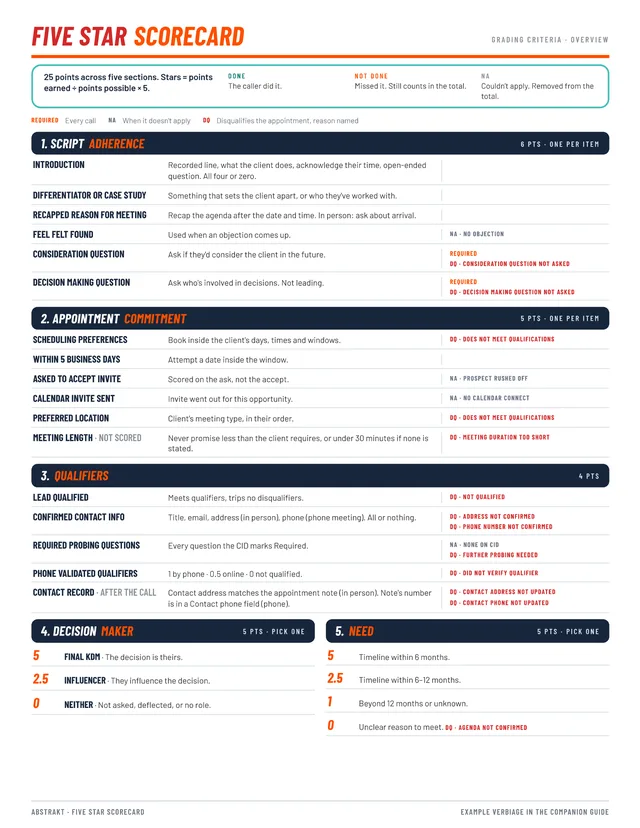
The real 25-point scorecard, marked for a fictional appointment from our scripted demonstration call. Stars = points earned ÷ points possible × 5.
Ask Ava anything about Abstrakt Sales, out loud or by typing.
The scorecard, applied
Anatomy of a qualified appointment
One appointment, the way the reviewer sees it. Pick a section of the scorecard to see what it measures, the lines on the call that earned it, and what would have changed the score.
Fictional example. Built from our scripted commercial roofing demonstration call. Names, the building and every detail are samples, not a client record.
Appointment profile
Dana, facilities director
Commercial roofing program · in-person meeting
Client program
Commercial roofing (sample program)Qualifiers
Prospect
Dana, facilities directorDecision-makerQualifiers
Property
Flat roof, about 40,000 square feet, last done in 2009. Size confirmed by Dana on the call.Qualifiers
Need
A leak over the warehouse in March. Wants a plan before winter.Need
Decision process
"Our CFO looks at anything big. But it's my call."Decision-maker
Current vendor
Has a roofer and says he's fine. Open to a second look.Script adherence
Consideration
"If the numbers make sense, I'd consider it."Script adherence
Meeting
Thursday the 17th at 2:00, 30 minutes, in person at the building. Check in at the front desk.Appointment commitment
Agenda
Warren Doyle, the project manager, walks the roof with Dana, documents its condition and leaves the written report.Script adherenceNeed
Confirmed details
Title, email and the main building address, confirmed on the call.Qualifiers
Invite
Sent during the call, with an ask to accept it so the time is held.Appointment commitment
What it measures. How the call was run: the opener, the reason to meet, and the two questions every call must ask.
IntroductionDone+1
Recorded-line notice, what you do, a nod to their time, and an open-ended question. All four, or it scores zero.
Recorded line, a nod to her time, what the client does, then an open question about inspections.
"The reason for my call, we work on low-slope commercial roofs across the metro, and your building came up as 40,000 square feet with the roof last done in 2009. I wanted to see how you're handling maintenance and inspections right now."
Something that sets you apart, or a customer they would recognize.
"What we do differently is the inspection itself. Ours are manufacturer-certified and filed in the warranty portal, so it protects your existing coverage instead of putting it at risk. And the written condition report costs you nothing either way."
Once the date and time are set, the caller replays the agenda. In person, they ask where to check in.
"Great. So that's Thursday the 17th at 2 o'clock, in person at your building, and we'll keep it to thirty minutes. Warren Doyle, our project manager, will walk the roof with you, document its condition, and leave you the written report. When he gets there, where should he check in?"
When the prospect pushes back: I understand, others felt the same, here is what they found.
She pushed back ("We already have a roofer"), so this item applied.
"I understand. A lot of the people I talk to felt the same way at first, and what they found is that a second look cost them nothing. When the management company's vendor files an inspection, it covers their scope. Ours is a second document at no cost, and if they've got everything handled it will say so."
Why this score. All six items are on the recording, including both required questions. 6 of 6.
What would have changed it, by the scorecard's rules
If Dana had not pushed back: Feel, felt, found is marked NA and leaves the total: 24 of 24 possible, still 5.00 stars.
If the consideration question had not been asked: DQ: consideration question not asked. The meeting is disqualified, whatever the other items score.
2. Appointment commitment5 / 5
What it measures. How solid the meeting is: inside your windows and meeting type, soon, and on both calendars.
Scheduling preferencesDone+1
Inside the days, times and windows you gave us.
"Let's put it on the calendar. I have Tuesday the 15th at 10, or Thursday the 17th at 2. Which is better? I'll send the invite while we're on the line, and I'll add Warren Doyle's mobile to it."
The caller goes for a date inside the next five business days.
"Let's put it on the calendar. I have Tuesday the 15th at 10, or Thursday the 17th at 2. Which is better? I'll send the invite while we're on the line, and I'll add Warren Doyle's mobile to it."
Your meeting type, in your order: in person, on site, phone or video.
In person at the building, the sample program's meeting type.
"Great. So that's Thursday the 17th at 2 o'clock, in person at your building, and we'll keep it to thirty minutes. Warren Doyle, our project manager, will walk the roof with you, document its condition, and leave you the written report. When he gets there, where should he check in?"
Never promise less time than you need. No stated length means 30 minutes minimum.
Thirty minutes, stated in the recap.
"Great. So that's Thursday the 17th at 2 o'clock, in person at your building, and we'll keep it to thirty minutes. Warren Doyle, our project manager, will walk the roof with you, document its condition, and leave you the written report. When he gets there, where should he check in?"
Why this score. Two specific times offered, one taken, length and place stated, invite sent with an ask to accept. 5 of 5, and the length check is met.
What would have changed it, by the scorecard's rules
If the date had fallen outside the next five business days: Within 5 business days is marked not done: 24 of 25, 4.80 stars. Not a disqualifier.
If the caller had promised less time than the program needs: DQ: meeting too short.
3. Qualifiers4 / 4
What it measures. Whether the prospect fits what you sell, against the qualifiers agreed with you in writing before the first dial.
Lead qualifiedDone+1
Meets your qualifiers. Trips none of your disqualifiers.
"Yeah, that sounds right. And roof work comes to me."
The address or phone number on the contact matches the appointment note.
Checked after the call: the building address on the contact matches the appointment note.
Why this score. The qualifier was confirmed by the prospect, not just looked up, and every contact detail an in-person meeting needs was confirmed. 4 of 4.
What would have changed it, by the scorecard's rules
If the roof size had only been checked online: Phone validation earns half a point: 24.5 of 25, 4.90 stars.
If the building address had not been confirmed: DQ: address not confirmed.
4. Decision-maker5 / 5
What it measures. Who said yes, and what part they play in the decision.
Decision-makerFinal decision-maker5 of 5
5 Final decision-maker · 2.5 Influencer · 0 Neither
Asked open. She named the CFO for big spends and said the call is hers.
"Our CFO looks at anything big. But it's my call."
Why this score. A dated reason to act, in the prospect's own words. 5 of 5.
What would have changed it, by the scorecard's rules
If her timeline had been 6 to 12 months: 2.5 of 5: 22.5 of 25, 4.50 stars.
If there had been no clear reason to meet: DQ: agenda not confirmed.
The score
How the call was run and what was confirmed. 25 points, shown as stars. A high score is not a verdict on its own.
The status
The reviewer's decision: qualified, pending review or disqualified. Any disqualifier marks the meeting disqualified, whatever its points.
The held meeting
Whether it actually happened. Tracked afterward on the opportunity board: meeting booked, meeting held, proposal sent, closed.
How the 5 Star Quality Scorecard works
What does a five-star appointment actually mean?
It means the appointment earned every point that could apply. Nothing more, and nothing less: the stars describe the call and what it confirmed, not whether the deal will close.
Shown to two decimals. Half points exist: a qualifier verified only online earns 0.5, an influencer earns 2.5.
NA comes out of the total
If an item could not apply, like handling an objection the prospect never raised, it does not count against the caller. 24 of 24 possible is still 5.00.
DQ is separate from the score
Some misses disqualify the appointment outright, and the reason is named. Points do not buy back a disqualifier.
The items are fixed; the standards are yours
Your qualifiers, Required probing questions, scheduling windows, meeting type and meeting length are set with you at onboarding, and the reviewer grades against them.
Worked examples, same formula
How points convert to stars
Appointment
Earned
Possible
Stars
Every item earned
25
25
5.00
No objection raised (NA)
24
24
5.00
Qualifier verified online only
24.5
25
4.90
Influencer, not final decision-maker
22.5
25
4.50
Consideration question not asked
Any
DQ
Illustrative arithmetic on the published formula, using the example appointment above.
The five sections
What makes an appointment qualified?
The five sections of the scorecard, item for item as the reviewer grades them. For the definition of a qualified appointment on its own, see what a qualified appointment is.
DoneThe caller did it.
Not doneMissed. Still counts in the total.
NACould not apply. Comes out of the total.
RequiredEvery call.
DQDisqualifies the appointment, reason named.
1. Script adherence
6 pts, one per item
What it evaluates
How the call was run: the opener, the reason to meet, and the two questions every call must ask.
Why it matters
The first ten seconds are your brand. And the two required questions are where a polite yes turns into a real one, or falls apart.
Evidence
The call recording and transcript, item by item.
How it is scored
One point per item. Feel, felt, found is marked NA when the prospect raises no objection, and comes out of the total.
Script adherence items
Item
Standard
Rules
Introduction
Recorded-line notice, what you do, a nod to their time, and an open-ended question. All four, or it scores zero.
1 point
Differentiator or case study
Something that sets you apart, or a customer they would recognize.
1 point
Recapped the reason to meet
Once the date and time are set, the caller replays the agenda. In person, they ask where to check in.
1 point
Feel, felt, found
When the prospect pushes back: I understand, others felt the same, here is what they found.
NA: no objection
Consideration question
Would they consider working with you down the road? A no here means no meeting.
RequiredDQ: consideration question not asked
Decision-making question
Who else is involved in a decision like this? Asked open, never "you're the decision-maker, right?"
RequiredDQ: decision-making question not asked
2. Appointment commitment
5 pts, one per item
What it evaluates
How solid the meeting is: inside your windows and meeting type, soon, and on both calendars.
Why it matters
Interest has a shelf life. A meeting outside your schedule, or promised shorter than you need, is one your rep cannot win.
Evidence
The date, time, place and length agreed on the call, and the invite record.
How it is scored
One point per item. Asking to accept the invite and sending it can be NA when the prospect rushed off or no calendar is connected. Meeting length is not scored; it is a check.
Appointment commitment items
Item
Standard
Rules
Scheduling preferences
Inside the days, times and windows you gave us.
DQ: does not meet qualifications
Within 5 business days
The caller goes for a date inside the next five business days.
1 point
Asked to accept the invite
Asked while still on the phone. Scored on the ask, not the accept.
NA: prospect rushed off
Calendar invite sent
An invite went out for this meeting.
NA: no calendar connected
Preferred location
Your meeting type, in your order: in person, on site, phone or video.
DQ: does not meet qualifications
Meeting lengthNot scored
Never promise less time than you need. No stated length means 30 minutes minimum.
DQ: meeting too short
3. Qualifiers
4 pts
What it evaluates
Whether the prospect fits what you sell, against the qualifiers agreed with you in writing before the first dial.
Why it matters
Lists go stale. The prospect does not. A qualifier confirmed in their own words is worth more than one looked up.
Evidence
The prospect's answers on the call, how each qualifier was verified, and the confirmed contact details.
How it is scored
One point each, except phone validation: confirmed by the prospect on the call is a full point, verified only online is half. The contact record is checked after the call and not scored.
Qualifiers items
Item
Standard
Rules
Lead qualified
Meets your qualifiers. Trips none of your disqualifiers.
DQ: not qualified
Confirmed contact info
Title and email, plus the address for an in-person meeting or the phone number for a phone meeting. All or nothing.
DQ: address or phone number not confirmed
Required probing questions
Every probing question your program marks Required.
NA: none requiredDQ: further probing needed
Qualifiers validated by phone
Confirmed by the prospect on the call: full point. Only verified online: half.
DQ: did not verify qualifier
Contact recordAfter the call
The address or phone number on the contact matches the appointment note.
DQ: contact address or phone not updated
4. Decision-maker
5 pts, pick one
What it evaluates
Who said yes, and what part they play in the decision.
Why it matters
A meeting with someone who cannot move the deal costs your rep an afternoon.
Evidence
The prospect's answer to the open decision-making question.
How it is scored
One of three marks: 5, 2.5 or 0. The question itself is required under Script adherence.
Decision-maker options
Points
Mark
Disqualifier
5
Final decision-makerThe decision is theirs.
None
2.5
InfluencerThey influence the decision.
None
0
NeitherNot asked, deflected, or no role.
None
5. Need
5 pts, pick one
What it evaluates
When the prospect plans to act, and whether there is a clear reason to meet.
Why it matters
Timing separates a meeting about a project from a meeting about someday.
Evidence
The prospect's own timeline and reason, in their words.
How it is scored
One of four marks: 5, 2.5, 1 or 0. No clear reason to meet is a disqualifier.
Need options
Points
Mark
Disqualifier
5
Within 6 months
None
2.5
6 to 12 months
None
1
Beyond 12 monthsOr unknown.
None
0
UnclearNo clear reason to meet.
DQ: agenda not confirmed
Disqualifiers
What makes an appointment fail quality review?
A disqualifier. Every one is on the scorecard, and when one is hit, the reason is named. A missed item that is not a disqualifier costs points but does not disqualify the meeting.
Meets the standard compared with disqualified, by area
Area
Meets qualification standards
Disqualified, reason named
Fit
Meets your qualifiers and trips none of your disqualifiers.
DQ Not qualified
Required questions
Consideration and decision-making questions both asked, the second one open.
DQ Consideration or decision-making question not asked
Schedule and meeting type
Inside your days, times and windows, in your meeting type.
DQ Does not meet qualifications
Meeting length
At least the time you need, or 30 minutes when none is stated.
DQ Meeting too short
Contact details
Title and email, plus the address (in person) or phone number (phone meeting).
DQ Address or phone number not confirmed
Probing questions
Every question your program marks Required.
DQ Further probing needed
Qualifier verification
Verified by the prospect on the call, or at least online.
DQ Did not verify qualifier
Reason to meet
A clear reason to meet, with the agenda confirmed.
DQ Agenda not confirmed
Contact record
After the call, the contact matches the appointment note.
DQ Contact address or phone not updated
How appointment quality review works
How every appointment moves through quality review
Six steps on every appointment, in this order. Step four is the review. For the whole program around it, from the target list to the results meeting, see how our appointment setting process works.
01
Qualified on the call
Checked against the qualifiers agreed with you at onboarding.
02
You hear about it right away
Email and text the moment it is booked.
03
The prospect gets an invite
Date, time, place and agenda.
04
Quality review
A reviewer who did not make the call scores the recording on the 25-point scorecard.
QualifiedMeets the scorecard and your qualifiers.
Pending reviewBooked and waiting on the reviewer.
DisqualifiedA disqualifier was hit. The reason is named on the scorecard.
05
Reminders go out
To your rep and the prospect, by email and text.
06
We ask how it went
A short survey after the meeting. The answers shape the next call.
After the meeting
Every booked meeting becomes an opportunity and moves across a board. That is where a qualified appointment and a held meeting part ways, and where the program is measured on revenue, not meeting counts.
Hear how qualification happens in a sales conversation
Play the call and the score builds as each item is earned. Pick a section to highlight the lines that earned it. Select any timestamp to jump there.
Illustrative Qualification Call Scripted demonstration, voiced by AI. Names and figures are samples.
Audio for this call is not available. The full transcript is below.
Highlight
SDR
Hi Dana, this is Chris with Summit Roofing on a recorded line. I know I'm catching you in the middle of the day, so I'll keep this short. How are you today?
Introduction, in progress
Prospect
Doing well. What's this about?
SDR
The reason for my call, we work on low-slope commercial roofs across the metro, and your building came up as 40,000 square feet with the roof last done in 2009. I wanted to see how you're handling maintenance and inspections right now.
+1 Introduction
Prospect
We already have a roofer. Honestly, he's fine.
SDR
I understand. A lot of the people I talk to felt the same way at first, and what they found is that a second look cost them nothing. When the management company's vendor files an inspection, it covers their scope. Ours is a second document at no cost, and if they've got everything handled it will say so.
+1 Feel, felt, found
Prospect
Okay, that makes sense.
SDR
Two quick things so I send the right person out. Does the roof sit at about 40,000 square feet, and are you the one who signs off on roof work, or does that go somewhere else?
+1 Lead qualified
+1 Required probing questions
+1 Qualifiers validated by phone
Prospect
Yeah, that sounds right. And roof work comes to me.
SDR
Besides you, who else is usually involved when a decision like this gets made?
+1 Decision-making question
Final decision-maker, in progress
Prospect
Our CFO looks at anything big. But it's my call.
+5 Final decision-maker
SDR
And when are you looking to have this sorted out?
Within 6 months, in progress
Prospect
Before winter, ideally. We had a leak over the warehouse in March. Buckets everywhere.
+5 Within 6 months
SDR
What we do differently is the inspection itself. Ours are manufacturer-certified and filed in the warranty portal, so it protects your existing coverage instead of putting it at risk. And the written condition report costs you nothing either way.
+1 Differentiator or case study
Prospect
Huh. I didn't know it worked that way.
SDR
If what we show you makes sense, is Summit Roofing a company you'd consider working with down the road?
+1 Consideration question
Prospect
Sure. If the numbers make sense, I'd consider it.
SDR
Let's put it on the calendar. I have Tuesday the 15th at 10, or Thursday the 17th at 2. Which is better? I'll send the invite while we're on the line, and I'll add Warren Doyle's mobile to it.
+1 Scheduling preferences
+1 Within 5 business days
Prospect
Thursday at two works.
SDR
Great. So that's Thursday the 17th at 2 o'clock, in person at your building, and we'll keep it to thirty minutes. Warren Doyle, our project manager, will walk the roof with you, document its condition, and leave you the written report. When he gets there, where should he check in?
+1 Recapped the reason to meet
+1 Preferred location
✓ Meeting length
Prospect
Front desk. Just ask for me.
SDR
Let me confirm your details: your title, the best email for the invite, and that we're meeting at your building address.
Confirmed contact info, in progress
Prospect
Facilities director. It's dana dot ellis at our company dot com. And yes, the main building.
+1 Confirmed contact info
SDR
Perfect. I'm sending the invite now. Could you accept it when it comes through, so the time is held? Thanks, Dana. Warren will see you Thursday.
+1 Asked to accept the invite
+1 Calendar invite sent
What your sales team receives
Quality you can see. Information your team can use.
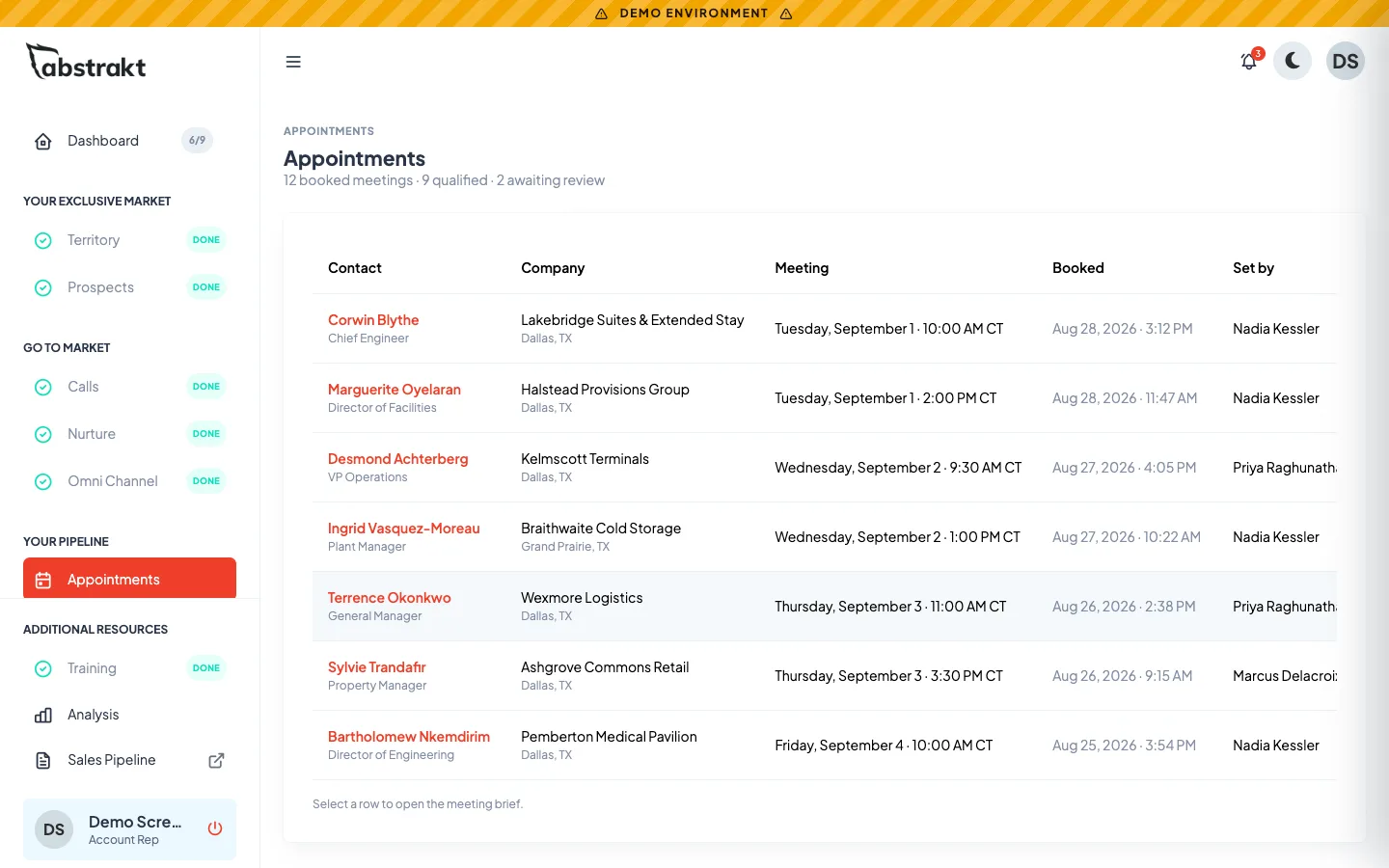
With every appointment: the meeting brief for whoever attends, the scorecard, the reviewer's notes with the call transcript, and a record that the brief was delivered. Here is the example appointment, laid out by what your team does with it.
Appointment handoff · Sample
Dana, facilities director · Thursday at 2:00, in person
Qualified25 / 25 · 5.00 stars
Qualification evidence
Qualifiers met
Roof about 40,000 square feet, confirmed by Dana on the callScorecard
Decision-maker
Final decision-maker: "it's my call"; the CFO reviews big spendsScorecard
Need and timing
Leak in March, wants a plan before winter: within 6 monthsScorecard
How it was verified
By phone, in the prospect's own wordsScorecard
Appointment details
When and where
Thursday at 2:00, 30 minutes, in person at the buildingMeeting brief
Check-in
Front desk, ask for DanaMeeting brief
Contact
Title, email and building address confirmedScorecard
Invites
Recipients and scheduling on recordDetails
Sales preparation
Who and why
Who your rep is meeting, why, and what was saidMeeting brief
Agenda agreed
Walk the roof, document its condition, leave the written reportMeeting brief
What they pushed back on
Already has a roofer; open to a second lookQuality review
What landed
Manufacturer-certified inspection filed in the warranty portal, and a written report at no costQuality review
Quality accountability
The scorecard
Every item and how it was marked: 25 of 25, 5.00 starsScorecard
Reviewer notes
The review, with the call transcript behind itQuality review
Delivery record
Proof the brief email was deliveredDetails
The recording
The real call on your account, in My VoiceResults Portal
The program side of the handoff, from the first touch to the results meeting, is on Our Process. Every call recording, survey result and dashboard lives in the Results Portal.
Quality assurance and client feedback
Quality doesn't stop when the meeting is booked.
Client feedback helps us evaluate whether the appointments we're developing align with agreed qualification standards. By reviewing appointment details and discussing outcomes, we can identify opportunities to improve targeting, messaging, and qualification.
Guaranteed in writing. An appointment guarantee based on your industry; the exact number is in your agreement. If we miss the number by the end of the year, we work for free until we hit it.
After the meetingA short survey asks how it went. The results sit in your Results Portal.
Any timeListen to the actual calls on your account in My Voice, next to the scorecard for each meeting.
Every monthWe walk through the program with you and change what needs changing: targets, messaging, qualifiers.
On the next callThe survey answers and your feedback shape how the next meeting is qualified.
Every section, item, point value and rule on this page comes from this sheet. Print it, hand it to your sales manager, or hold any provider's meetings up against it, ours included.
The PDF is an image of the printed sheet. The same content is on this page as text, in the five sections above.
Our four solutions
Four Solutions. One Team.
Individually powerful. Better together. Our four solutions work together to find your buyers, book meetings with them and help your team close more of them.
$6,500/monthAll three together: Get Outbound BDR, Inbound SDR and Brand Boost together, starting at $6,500 per month ($5,000 + $1,000 + $500 = $6,500). Enterprise SDR/BDR is custom.Build my program →
Your sales team deserves more than another meeting.
See how Abstrakt combines trained sales professionals, structured qualification, and quality accountability to help your team spend more time in meaningful sales conversations.
A confirmed meeting where the prospect meets the qualifiers agreed with you in writing, trips none of your disqualifiers, and agreed to meet inside your scheduling preferences and meeting type, with contact details confirmed. At Abstrakt, every booked appointment is then scored on the 25-point 5 Star Scorecard and marked qualified, pending review or disqualified.
How does appointment quality assurance work at Abstrakt?+
A quality reviewer who did not make the call scores the recording against the 25-point scorecard and the qualifiers set with you at onboarding. Each appointment is marked qualified, pending review or disqualified, and any disqualification reason is named on the scorecard.
What does an appointment qualification scorecard include?+
Ours has five sections worth 25 points: script adherence (6), appointment commitment (5), qualifiers (4), decision-maker (5) and need (5). Some items are required on every call, some can be marked NA when they could not apply, and some disqualify the appointment when missed.
What is a five-star appointment?+
One that earned every applicable point. Stars are points earned divided by points possible, times five, so 25 of 25 is 5.00. Items that could not apply, like handling an objection the prospect never raised, come out of the total instead of counting against the caller.
What makes an appointment fail quality review?+
A disqualifier: the prospect does not meet your qualifiers, a required question was not asked, the meeting is outside your scheduling preferences or meeting type, it was promised shorter than you need, contact details or a qualifier were not confirmed, required probing was not finished, there is no clear reason to meet, or the contact record does not match the appointment note. A missed item that is not a disqualifier costs points but does not disqualify the meeting.
Who reviews appointment quality?+
A quality reviewer on our team who did not make the call. Quality control sits on the support team behind every program, alongside recruiting, training, content and data.
How are sales calls evaluated?+
From the recording, item by item: how the call was run, how solid the meeting is, whether the prospect fits, who said yes and when they plan to act. The calls themselves follow the ENGAGE Sales Process, the standard the scorecard grades against.
What is the difference between a scheduled appointment and a qualified appointment?+
A scheduled appointment has a date and time. A qualified appointment has also been reviewed against the scorecard and your qualifiers and marked qualified. Whether the meeting was held is tracked separately afterward, on the opportunity board: meeting booked, meeting held, proposal sent and closed.
What information should a client receive with each appointment?+
A brief for whoever attends, the scorecard, the reviewer notes with the call transcript, and a record that the brief was delivered. Every call recording is also in the Results Portal.
How can a company verify appointment quality?+
Listen to the call. Every recording on your account is in My Voice in the Results Portal, and the scorecard shows how each item was marked, so you can check a meeting line by line against the qualifiers you agreed in writing.
How does a client raise a concern about a meeting?+
Bring it to us with the recording and the scorecard in hand. We walk through the program with you every month and change what needs changing: targets, messaging and qualifiers.
What metrics show appointment quality?+
Per meeting: the star score, the status and any disqualification reason. After the meeting: the post-meeting survey, and whether it moved to meeting held, proposal sent and closed on the opportunity board, so the program is measured on revenue, not meeting counts.
How does appointment qualification vary by industry?+
The 25 points are the same on every call. What counts as meeting them is set per program: your qualifiers and disqualifiers, the probing questions you mark Required, your scheduling windows, meeting type and meeting length. A roofing program might qualify on roof size and when it was last inspected; another industry uses its own facts.
How does Abstrakt's appointment setting process work?+
A target list built for your market, reps certified on your account, calls on the ENGAGE Sales Process with email, LinkedIn and direct mail around them, then the six appointment steps on this page, with every not-now kept in nurture. Our Process walks through the whole program.