Outsourced sales development for commercial landscaping

Your crews keep the grounds sharp. We help you get in front of the rebid.

We connect commercial landscaping companies with the property managers, facilities directors and association managers who award grounds and snow contracts. Our U.S.-based sales professionals prospect, qualify and book property walks so your team can focus on winning the rebid.

Ask Ava anything about the information on this page.

Verified performance benchmarks

What it takes to book a landscaping meeting

Real activity and outcomes logged on landscaping programs. Each figure carries its definition, and the panel below says exactly what it covers.

Abstrakt sales center data
  • 62,957prospecting callsOutbound dials logged by Abstrakt SDRs on client programs in this vertical.
  • 712appointments setMeetings booked with a decision-maker who met the client's criteria.
  • 88dials per appointmentCalls divided by appointments set, rounded.
  • 18.8%of opportunities reached a proposalOpportunities are appointments that became a sales opportunity. Not a rate per appointment.
  • 12.7%of proposals were wonProposals the client reports winning, divided by proposals sent.
Period
Cumulative program history through October 2026.
Scope
National. Abstrakt client programs in the "Landscape Services" vertical. No market-level rates.
Sample
62,957 calls and 712 appointments set.
Source
Abstrakt sales center, Performance Intelligence (Abstrakt's internal program reporting), imported 2026-10-01.
Not a promise
Historical averages across many programs, not a forecast or a promise for any single program. Client mix, offers and target lists differ.

How the sales center benchmarks are measured

Customer results

Real results from commercial landscaping companies

Approved landscaping client stories, closed business and testimonials. Every figure says what it is and the period it covers. See every landscaping result.

Who we target

The landscaping buyers our SDRs reach

Start with the property or community manager who lives with the service, then the regional director, owner or board who awards the contract.

Decision-makers and influencers

  • Property managerControls

    Grounds contract, vendor selection and day-to-day service requests

    Gets involved

    Contract end, budget season and after service failures

  • Regional facilities directorControls

    Vendor strategy and rebids across a portfolio

    Gets involved

    Annual planning, acquisitions, portfolio rebids

  • HOA or community association managerControls

    Bid process and recommendation to the board

    Gets involved

    Budget preparation and board meeting cycles

  • Owner / asset managerControls

    Approval on larger contracts and enhancement budgets

    Gets involved

    Acquisitions, sale preparation and annual budgets

  • Procurement / purchasingControls

    RFP process, vendor qualification, insurance and contract terms

    Gets involved

    RFP and rebid cycles

Company and building types

  • Commercial property management firms
  • Apartment property management firms
  • Commercial building owners and lessors
  • Hotels
  • Golf courses and country clubs
  • Senior living and skilled nursing
  • Colleges and universities
  • Ambulatory health care offices and clinics
  • Churches and religious organizations
  • Retail stores

What makes an account worth calling

  • Professionally managed properties. Property and HOA managers outsource all grounds work and rebid on a schedule, so there is always a contract end date to learn.
  • Grounds that affect leasing or customers. Office parks, apartments, hotels, senior living and medical campuses pay for curb appeal because tenants and visitors notice.
  • An incumbent with service complaints. Missed visits, poor communication and dead plants are why property managers switch. Dissatisfaction is learnable on a call.
  • Multiple sites in a tight geography. Route density is how landscape contracts make money. A portfolio near your existing routes is worth more than a scattered one.
  • Snow exposure in cold markets. Properties that need both landscape and snow service buy bigger contracts and value a single vendor.

Qualification criteria

  • A property type you service, near your existing routes
  • The person in the meeting manages, recommends or awards the grounds contract
  • A known contract end date, an active complaint, or a project with timing
  • Incumbent, scope and snow needs captured
  • Number of properties and decision process noted
  • A confirmed date and time for a site walk or sales conversation

Prospect intelligence from our landscaping programs

Fewest dials per appointment first, so the list starts where meetings come easiest. Rows with fewer than 30 opportunities are left out.

Titles

  1. Maintenance Director39
  2. Property Manager56
  3. Facilities Director77
  4. General Manager78
  5. Maintenance Manager79

Prospect industries

  1. Organizations (Non-Profit)50
  2. Healthcare Services58
  3. Hospitality58
  4. Real Estate74
  5. Education90

Dials per appointment, national. Source: Abstrakt sales center, Performance Intelligence, cumulative through October 2026.

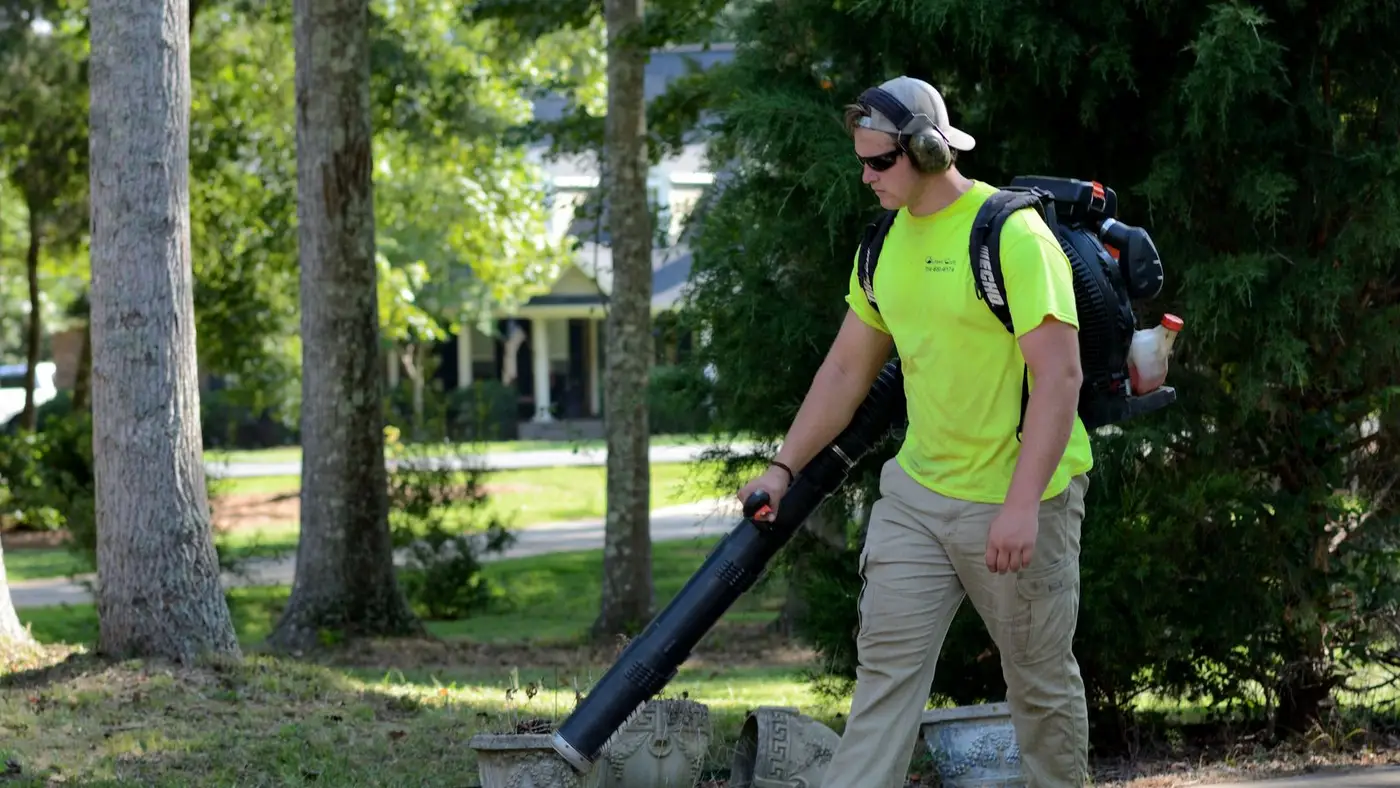
Landscaper in hi-vis gear clearing a walkway with a backpack leaf blower
Your crews do the landscaping work.Our SDRs keep the calendar full.
Buying triggers

What opens a landscaping account

These are reasons a buyer may be open to a conversation, not proof that anyone is buying. Some we can see before the first call; the rest only the buyer can confirm.

  • Observable signal visible before the call: ownership, leasing, leadership changes, construction, weather
  • Learned on the call only the buyer can tell us
  • Observable signalNew property manager or management company

    New managers rebid vendors and want to put their own team in place.

  • Observable signalProperty sale or acquisition

    New owners review every service contract on the property.

  • Observable signalRenovation or rebranding

    Building refreshes usually include new landscaping and a reason to revisit the contract.

  • Observable signalA rough winter or storm season

    Poor snow service or slow storm cleanup makes a property manager receptive to a single new vendor.

  • Learned on the callContract end date

    The fact that matters most. Most maintenance contracts run on a fixed term, and the rebid is the moment a property can switch without breaking anything.

  • Learned on the callService complaints about the incumbent

    Missed mows, dead plants and slow responses are why property managers switch.

  • Learned on the callIrrigation problems or high water bills

    Dead turf and water costs are visible, and they open an irrigation conversation.

Why "not now" is still a prospect. Almost every commercial property already has a landscaper, so a no is nearly always a timing answer. The useful outcome of a first call is the contract end date, the incumbent's name, what the manager wishes were different and whether snow is bundled in. Recorded and revisited ahead of the rebid, that turns a no into an invitation to bid and a site walk before the RFP goes out.

How Abstrakt works in commercial landscaping

We build the pipeline. Our clients close the business.

The same six steps run on every program. What changes for commercial landscaping contractors is who we call, the reason we give them, and the contract end date we track. It is our appointment setting for commercial contractors, with the phone work done by our cold calling services team.

  1. 01 · Build your target market

    Build the target list

    Professionally managed commercial, multifamily and institutional properties with real grounds, near your existing routes. We start with the prospect industries and titles that have booked fastest on our landscaping programs.

    How Abstrakt Intelligence builds the list
  2. 02 · Launch your marketing strategy

    Run phone, email and LinkedIn as one

    Your SDR works phone, email and LinkedIn under your company's name, so the prospect knows the name before the call.

    The team and technology behind it
  3. 03 · Qualify target companies and decision-makers

    Reach the people who decide

    Start with the property or community manager who lives with the service, then the regional director, owner or board who awards the contract.

    What "Right Contact" means
  4. 04 · Decision-maker introduction

    Confirm the reason to meet

    A contract coming up for rebid, complaints about the incumbent, a renovation, or a need for combined landscape and snow service. Right property type near your routes, a person who manages or awards the contract, a known contract end date or active dissatisfaction, and an agreed time for a site walk.

    The 5 Star quality process
  5. 05 · Nurture qualified companies

    Stay in touch until it is time

    Re-contact well before the contract end date and after visible service failures or storms; ask to be on the bidder list. The contract end date goes in the record so the next call lands on time.

    Our process, stage by stage
  6. 06 · New sales appointments

    Book the property walk

    A confirmed property walk with property and facility teams, checked for right company, right contact and right timing, and graded on our 25-point 5 Star Scorecard before it reaches your calendar. You receive the property list, incumbent, contract end date, scope, snow needs, decision process and the exact reason they took the meeting. Every call and booked meeting is visible to you in the Results Portal.

    What happens after a meeting is booked
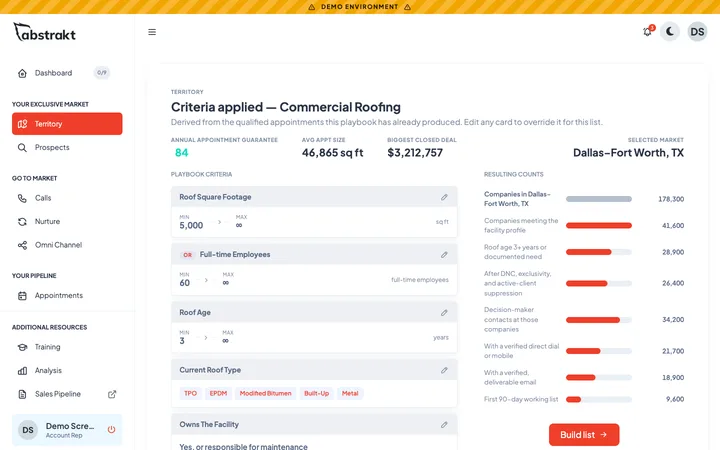
Abstrakt Intelligence · Targeting

Every list starts with the qualified prospects Abstrakt Intelligence finds in your industry, each one verified by our team.

See how lists are built

Real platform screen. Companies and contacts are fictional.

Calculate my opportunity

What a landscaping pipeline takes, in your numbers

Set a monthly property walk goal and your own conversion rates. Green tags are Abstrakt history, gray tags are your inputs. Contract value appears once you enter your own average: we never fill one in.

Your inputs

88 is the historical landscaping average from our sales center. Change it to test your own.

An appointment is not a proposal. 25% is only a starting example, not Abstrakt data: use your own experience.

12.7% of landscaping proposals were won across our programs. Your close rate depends on your own sales process.

What one grounds maintenance contract bills in a year (add snow if you sell it together).

1 shows first-year value only.

Illustrative math from your inputs. It updates as you type.

  • 704dials a month
  • 34dials every working day
  • 2proposals a month
  • 0.3wins a month, on average
  • 3wins from 12 months at this pace
  • 96property walks over 12 months
  • Enter your average annual maintenance contract value to see contract value. We do not fill in a number for you.

How this works: appointments x dials per appointment = outreach, spread over 21 working days. Appointments x your proposal rate x win rate = wins. Wins x your value = contract value: what signed work is worth, not revenue recognized, and recurring contracts bill over their term. Fractions are monthly averages. Not a forecast, a quote or a promise.

Market opportunity

Explore your landscaping market opportunity

Search 100 metros for the local numbers: how many landscaping companies compete, how many larger buildings buy the work, and which account types to call first. Most larger buildings per contractor in the data: McAllen, El Paso, Los Angeles, Houston, Albuquerque.

Type a city or state, then pick a market.

    landscaping market snapshot

    McAllen, TX

    • 34landscaping services establishments competing
    • 919larger buildings in landscaping-buying categories
    • 27.0larger buildings per contractor

    Account types to call first: Retail stores, Ambulatory health care offices and clinics, Commercial building owners and lessors

    Contractors: U.S. Bureau of Labor Statistics, Quarterly Census of Employment and Wages, private ownership, 2026 Q1, landscaping services establishments (NAICS 561730). Larger buildings: U.S. Census Bureau, County Business Patterns 2023, establishments with 20 or more employees in the categories that buy landscaping work. These are establishment counts, not qualified prospects: qualification happens on the call. Territory availability is not shown here because it changes as programs start; a strategist confirms it against current territory records.

    Browse all 100 landscaping market guides
    100 markets
    Commercial Landscaping market guides. Column headers sort the table.
    Market Contractors Larger buildings Per contractor Largest category
    Birmingham, AL market page 410 1,545 3.8 Retail stores
    Huntsville, AL market page 212 622 2.9 Retail stores
    Phoenix, AZ market page 1,099 6,278 5.7 Retail stores
    Tucson, AZ market page 271 1,282 4.7 Retail stores
    Little Rock, AR market page 246 978 4.0 Retail stores
    Central Valley, CA market page 700 3,153 4.5 Retail stores
    Los Angeles, CA market page 2,206 19,212 8.7 Retail stores
    Oxnard, CA market page 327 1,098 3.4 Retail stores
    Riverside, CA market page 1,104 4,653 4.2 Retail stores
    Sacramento, CA market page 798 3,030 3.8 Retail stores
    San Diego, CA market page 991 5,035 5.1 Retail stores
    San Francisco, CA market page 1,237 6,573 5.3 Retail stores
    San Jose, CA market page 560 2,531 4.5 Retail stores
    Santa Cruz, CA market page 148 362 2.4 Retail stores
    Santa Rosa, CA market page 335 712 2.1 Retail stores
    Stockton, CA market page 171 735 4.3 Retail stores
    Colorado Springs, CO market page 244 996 4.1 Retail stores
    Denver, CO market page 955 4,357 4.6 Retail stores
    Bridgeport, CT market page 784 1,396 1.8 Retail stores
    Hartford, CT market page 668 1,631 2.4 Retail stores
    Washington, DC market page 1,571 8,388 5.3 Retail stores
    Cape Coral, FL market page 653 1,161 1.8 Retail stores
    Daytona Beach, FL market page 468 888 1.9 Retail stores
    Jacksonville, FL market page 845 2,191 2.6 Retail stores
    Miami, FL market page 2,397 10,118 4.2 Retail stores
    North Port, FL market page 753 1,276 1.7 Retail stores
    Orlando, FL market page 1,335 4,203 3.1 Retail stores
    Tampa, FL market page 1,593 4,379 2.7 Retail stores
    West Palm Beach, FL market page 1,086 2,624 2.4 Retail stores
    Atlanta, GA market page 2,056 8,039 3.9 Retail stores
    Honolulu, HI market page 255 1,246 4.9 Retail stores
    Boise City, ID market page 591 1,141 1.9 Retail stores
    Chicago, IL market page 3,878 11,180 2.9 Retail stores
    Indianapolis, IN market page 847 2,957 3.5 Retail stores
    South Bend, IN market page 131 415 3.2 Retail stores
    Des Moines, IA market page 280 1,018 3.6 Retail stores
    Wichita, KS market page 208 947 4.6 Retail stores
    Lexington, KY market page 191 770 4.0 Retail stores
    Louisville, KY market page 570 1,767 3.1 Retail stores
    Baton Rouge, LA market page 277 985 3.6 Retail stores
    New Orleans, LA market page 223 1,323 5.9 Retail stores
    Portland, ME market page 459 1,044 2.3 Retail stores
    Baltimore, MD market page 914 3,823 4.2 Retail stores
    Boston, MA market page 2,652 7,632 2.9 Retail stores
    Springfield, MA market page 201 659 3.3 Retail stores
    Worcester, MA market page 478 1,064 2.2 Retail stores
    Detroit, MI market page 1,670 5,064 3.0 Retail stores
    Grand Rapids, MI market page 425 1,479 3.5 Retail stores
    Saginaw, MI market page 59 279 4.7 Retail stores
    Minneapolis, MN market page 1,454 5,563 3.8 Retail stores
    Kansas City, MO market page 819 3,110 3.8 Retail stores
    St. Louis, MO market page 1,121 3,648 3.3 Retail stores
    Omaha, NE market page 489 1,307 2.7 Retail stores
    Las Vegas, NV market page 485 2,828 5.8 Retail stores
    Manchester, NH market page 256 617 2.4 Retail stores
    Albuquerque, NM market page 160 1,141 7.1 Retail stores
    Albany, NY market page 364 1,169 3.2 Retail stores
    Buffalo, NY market page 559 1,527 2.7 Retail stores
    New York, NY market page 7,741 28,322 3.7 Retail stores
    Poughkeepsie, NY market page 423 866 2.0 Retail stores
    Rochester, NY market page 427 1,349 3.2 Retail stores
    Syracuse, NY market page 268 853 3.2 Retail stores
    Charlotte, NC market page 1,180 3,741 3.2 Retail stores
    Greensboro, NC market page 298 1,038 3.5 Retail stores
    Raleigh, NC market page 640 2,077 3.2 Retail stores
    Akron, OH market page 306 896 2.9 Retail stores
    Cincinnati, OH market page 814 2,618 3.2 Retail stores
    Cleveland, OH market page 1,047 2,823 2.7 Retail stores
    Columbus, OH market page 638 2,964 4.6 Retail stores
    Dayton, OH market page 252 1,005 4.0 Retail stores
    Oklahoma City, OK market page 455 1,940 4.3 Retail stores
    Tulsa, OK market page 346 1,337 3.9 Retail stores
    Portland, OR market page 987 3,918 4.0 Retail stores
    Allentown, PA market page 375 1,058 2.8 Retail stores
    Harrisburg, PA market page 208 904 4.3 Retail stores
    Philadelphia, PA market page 2,613 8,476 3.2 Retail stores
    Pittsburgh, PA market page 1,036 3,488 3.4 Retail stores
    Providence, RI market page 1,149 2,311 2.0 Retail stores
    Charleston, SC market page 286 1,233 4.3 Retail stores
    Columbia, SC market page 241 985 4.1 Retail stores
    Greenville, SC market page 361 1,209 3.3 Retail stores
    Chattanooga, TN market page 149 765 5.1 Retail stores
    Knoxville, TN market page 349 1,234 3.5 Retail stores
    Memphis, TN market page 324 1,578 4.9 Retail stores
    Nashville, TN market page 768 3,100 4.0 Retail stores
    Austin, TX market page 581 3,491 6.0 Retail stores
    Dallas, TX market page 1,548 10,544 6.8 Retail stores
    El Paso, TX market page 93 1,020 11.0 Retail stores
    Houston, TX market page 1,007 8,485 8.4 Retail stores
    McAllen, TX market page 34 919 27.0 Retail stores
    San Antonio, TX market page 443 3,107 7.0 Retail stores
    Provo, UT market page 343 893 2.6 Retail stores
    Salt Lake City, UT market page 591 1,922 3.3 Retail stores
    Richmond, VA market page 474 1,966 4.1 Retail stores
    Virginia Beach, VA market page 597 2,600 4.4 Retail stores
    Seattle, WA market page 1,543 5,344 3.5 Retail stores
    Spokane, WA market page 257 904 3.5 Retail stores
    Charleston, WV market page 44 272 6.2 Retail stores
    Madison, WI market page 310 1,074 3.5 Retail stores
    Milwaukee, WI market page 671 2,335 3.5 Retail stores
    The talk track

    What a sales call sounds like in facility trades

    This is the path our SDRs follow on a good call in facility trades. Each line is tagged with its step in the ENGAGE Sales Process: a specific reason to talk, a pushback handled without arguing, the qualifying and decision questions, the differentiator, and a clear ask for the meeting. It earns every point on our 5 Star Scorecard.

    • Opener
    • Reason for the call
    • Pushback
    • Feel, felt, found
    • Qualify
    • Decision-making question
    • Timeline
    • Differentiator
    • Consideration question
    • Close for the meeting
    • Meeting set
    • Recap the agenda
    • Confirm details
    • Invite sent

    Dramatized example.Written from our facility trades talk track and voiced by AI. Names and figures are samples. This is not a recording of a real call.

    Abstrakt SDR for Summit Facility ServicesBooking for a client in facility trades. Calling Dana Ellis, decision-maker.
    1. Opener
      Abstrakt SDRHi Dana, this is Chris with Summit Facility Services on a recorded line. I know I'm catching you in the middle of the day, so I'll keep this short. How are you today?
    2. ProspectSure. What's going on?
    3. Reason for the call
      Abstrakt SDRThe reason for my call, we handle facility maintenance across the metro, and your building came up at about 120 people on site. I wanted to see how repairs and upkeep are handled right now and whether anyone has documented what's been deferred.
    4. Pushback
      ProspectWe already have a maintenance vendor.
    5. Feel, felt, found
      Abstrakt SDRI understand. A lot of the people I talk to felt the same way at first, and what they found is that a second look cost them nothing. When your vendor fixes what you called about, that covers the repair. Ours is a written report on everything else the building is carrying. It's a second document at no cost, and if they've got everything handled it will say so.
    6. ProspectOkay, that makes sense.
    7. Qualify
      Abstrakt SDRTwo quick things so I send the right technician out. Is it roughly 120 people on site, and are you the one who signs off on repairs and maintenance, or does that go somewhere else?
    8. ProspectThat's right on headcount. And repairs come through me.
    9. Decision-making question
      Abstrakt SDRBesides you, who else is usually involved when a decision like this gets made?
    10. ProspectOwnership approves the annual budget. But the vendor decisions are mine.
    11. Timeline
      Abstrakt SDRAnd when are you looking to have this sorted out?
    12. ProspectWe start in about two months. Which means I start panicking in about six weeks.
    13. Differentiator
      Abstrakt SDRWhat we do differently is the walk-through itself. We document everything worn, leaking, or failing and hand you a written deferred-maintenance report at no charge either way. After that it's one agreement and one number to call for every trade.
    14. ProspectOne number would be nice. I've got six vendors right now.
    15. Consideration question
      Abstrakt SDRIf what we show you makes sense, is Summit Facility Services a company you'd consider working with down the road?
    16. ProspectYeah. I'd consider it.
    17. Close for the meeting
      Abstrakt SDRLet's put it on the calendar. I have Tuesday the 15th at 10, or Thursday the 17th at 2. Which is better? I'll send the invite while we're on the line, and I'll add Warren Doyle's mobile to it.
    18. Meeting set
      ProspectThursday at two.
    19. Recap the agenda
      Abstrakt SDRGreat. So that's Thursday the 17th at 2 o'clock, in person at your property, and we'll keep it to thirty minutes. Warren Doyle, our project manager, will walk the property with you, document the deferred maintenance, and leave you the written report. When he gets there, where should he check in?
    20. ProspectManagement office, first floor.
    21. Confirm details
      Abstrakt SDRLet me confirm your details: your title, the best email for the invite, and that we're meeting at your property address.
    22. ProspectProperty manager. Email's dana dot ellis at our company dot com. Yes, that's the one.
    23. Invite sent
      Abstrakt SDRPerfect. I'm sending the invite now. Could you accept it when it comes through, so the time is held? Thanks, Dana. Warren will see you Thursday.
    The landscaping prospecting playbook

    How landscaping accounts are won, from first call to signed work

    The research our SDRs train on for landscaping programs. Open any section. The same material, with sales center data, is in The State of Commercial Landscaping Business Development, 2026.

    Market overview and contract economics

    How the work is bought

    Commercial landscaping is a contract business. The maintenance agreement is the revenue base, and enhancements, irrigation and snow removal are sold on top of it to customers who already trust you. Nearly every property already has a landscaper, so the work is won at contract end or when the incumbent slips. The outbound job is to learn when each contract ends, stay in touch with the property manager, and be the obvious alternative when the rebid opens.

    Recurring work
    Annual or multi-year grounds maintenance contracts covering mowing, pruning, bed care and seasonal cleanups; irrigation service; snow and ice management in cold markets.
    Projects
    Enhancements and seasonal color, mulch and planting refreshes, landscape installs at renovations and new buildings, irrigation upgrades, tree work, hardscape.
    Emergency work
    Storm cleanup, irrigation breaks and tree failures. They prove responsiveness and can open a conversation, but contracts are awarded on the rebid.

    The landscaping services worth selling outbound

    • Best fit for outboundGrounds maintenance contracts

      The anchor. Every managed property has one, most renew or rebid on a known date, and that date is the fact outbound exists to learn.

    • Best fit for outboundSnow and ice management

      In cold markets, a strong crossover. Property managers prefer one vendor for both, and snow contracts are signed well before the first storm.

    • Good fitEnhancements and seasonal color

      Sold mostly to existing customers, but a good opening with property managers who want curb appeal for tenants or leasing.

    • Good fitIrrigation service and upgrades

      Water bills and dead turf get attention. A useful second conversation once you are on the property.

    • SituationalInstallation and construction

      New landscape installs are mostly bid through general contractors and developers. Outbound helps more by getting onto bid lists than by booking owners.

    Account types and how to open each one

    10 segments
    Commercial property management firms
    Buys
    Portfolio maintenance contracts, enhancements, irrigation, snow and ice
    Reach
    Property manager, regional facilities director, assistant property manager
    Opens the door
    Contract end date, new property under management, tenant complaints

    Tenant experience and fewer complaints. One relationship can open several properties at rebid.

    Apartment property management firms
    Buys
    Community maintenance contracts, seasonal color, irrigation, snow
    Reach
    Regional property manager, community manager, maintenance supervisor
    Opens the door
    Acquisition, renovation, leasing season, contract end

    Curb appeal for leasing. Portfolio pricing across communities matters.

    Commercial building owners and lessors
    Buys
    Maintenance contracts, landscape refreshes, irrigation upgrades
    Reach
    Owner, asset manager, director of property operations
    Opens the door
    Sale or refinance, tenant turnover, renovation

    Asset presentation and predictable cost. Ask how they choose vendors across buildings.

    Hotels
    Buys
    Grounds maintenance, seasonal color, irrigation, snow
    Reach
    Director of engineering, general manager, ownership group facilities lead
    Opens the door
    Brand-required renovation, ownership change, guest reviews

    Guest arrival and first impressions. Seasonal color is visible to every guest.

    Golf courses and country clubs
    Buys
    Clubhouse and common-area grounds, enhancements, irrigation, tree work
    Reach
    General manager, superintendent, clubhouse manager
    Opens the door
    Clubhouse renovation, membership events, new management

    Most courses run turf in-house, so the opening is the clubhouse, entrances, parking areas and event spaces.

    Senior living and skilled nursing
    Buys
    Maintenance contracts, safe walkways, seasonal color, snow and ice
    Reach
    Executive director, maintenance director, regional facilities manager
    Opens the door
    Ownership change, family complaints, state inspection findings

    Resident safety and how the property looks to visiting families. Regional operators often buy across sites.

    Colleges and universities
    Buys
    Grounds maintenance for specific areas, athletics surrounds, enhancements, snow
    Reach
    Director of grounds or physical plant, procurement
    Opens the door
    Bid calendar, campus expansion, commencement and admissions events

    Many campuses keep in-house grounds crews and outsource specific areas or snow. Learn the bid cycle and what they contract out.

    Ambulatory health care offices and clinics
    Buys
    Maintenance contracts, walkway safety, snow and ice
    Reach
    Practice administrator, office manager, landlord property manager
    Opens the door
    Patient complaints, building sale, new location

    Patient access and safety. Many practices lease, so the landlord or property manager is often the buyer.

    Churches and religious organizations
    Buys
    Grounds maintenance, seasonal cleanups, snow, landscape refreshes
    Reach
    Facilities committee chair, business administrator, senior pastor at smaller congregations
    Opens the door
    Building committee review, volunteer crew burnout, special events

    Volunteers often maintain the grounds until they cannot. Committee approval and budget timing matter.

    Retail stores
    Buys
    Grounds maintenance at freestanding stores, parking-area beds, snow and ice
    Reach
    Regional facilities manager, store manager, landlord property manager
    Opens the door
    Remodel, regional vendor consolidation, contract end

    Store appearance and snow safety. In shopping centers the landlord usually controls the contract, so qualify who buys.

    Buyer roles and what each one cares about

    5 roles
    Property manager
    Cares about
    Tenant complaints, a contractor who shows up as scheduled, budget accuracy

    Reliable crews, a single point of contact and fewer tenant complaints.

    Regional facilities director
    Cares about
    Consistency across sites, fewer vendors, predictable spend

    One accountable contractor across their properties, with route density to back it up.

    HOA or community association manager
    Cares about
    Board satisfaction, resident complaints, staying inside the budget

    Clear, comparable proposals that make the board's decision easy.

    Owner / asset manager
    Cares about
    Property value, leasing and cost

    Curb appeal that supports leasing and a contract that stays on budget.

    Procurement / purchasing
    Cares about
    Compliance, insurance, price

    Get on the bidder list before the RFP is released; procurement rarely starts the conversation.

    Qualification questions by account type

    52 questions
    Commercial property management firms6 questions
    1. Who maintains your properties now, and what month do those contracts end?

      End months across a portfolio give you a calendar of site walks to book ahead of each rebid.

    2. Is snow and ice in the same contract or a separate one?

      Bundled snow changes the bid and can be the reason a manager will or will not split vendors.

    3. What do tenants complain about on the grounds?

      Tenant complaints point to the property with the most pressure and the issues your proposal must fix.

    4. Is there an enhancement budget for color, mulch, plant replacements or irrigation repairs this year?

      Enhancement money is often available outside the maintenance contract and can be your first job.

    5. How many properties do you manage, and does one landscaper cover them?

      This tells you whether you are bidding a single site or setting up a portfolio conversation.

    6. Does the owner or asset manager approve the vendor, or do you make that call?

      Knowing who signs off keeps a site walk from turning into a proposal nobody can approve.

    Apartment property management firms6 questions
    1. When does your landscape contract end, and is it bid community by community or across the portfolio?

      Portfolio bids mean one decision covers several communities, so you need the regional contact involved.

    2. What is your enhancement budget for seasonal color, mulch and plant replacement?

      Enhancements are where curb appeal for leasing gets funded and are often an easier first sale.

    3. Does your landscaper also handle snow, and how did last winter go?

      A bad snow season is one of the most common reasons apartment managers start looking.

    4. What do residents complain about, such as mowing noise, trash in beds or irrigation overspray?

      Resident complaints tell you what the incumbent misses and what the community manager hears every week.

    5. Are any acquisitions or renovations planned that will change the grounds?

      New owners and renovations often bring a vendor review and a refreshed scope.

    6. When is your busiest leasing season, and what needs to look right before it?

      Leasing season sets the timeline for enhancements and gives you a reason to be on site before it starts.

    Commercial building owners and lessors5 questions
    1. How do you choose landscape vendors across your buildings?

      The answer shows whether you are selling to one site or into an owner's vendor list.

    2. When does the current maintenance contract end?

      The end date decides whether you price now or schedule a site walk ahead of renewal.

    3. Is a sale, refinance or new tenant coming that puts the property on display?

      Asset events create a short window where appearance matters and refreshes get approved.

    4. What is the irrigation system's condition, and who manages water use?

      Irrigation problems are a concrete cost issue owners understand and a common add-on scope.

    5. What do you budget each year for landscape refreshes beyond maintenance?

      This tells you whether there is money for enhancements or only for the base contract.

    Hotels5 questions
    1. What do guests see first on arrival, and are you happy with it?

      Arrival impressions are what a general manager cares about and where seasonal color earns its keep.

    2. Does your brand require landscape standards as part of a renovation or inspection?

      Brand requirements create a deadline and a defined scope.

    3. Who handles snow and ice at the entrances and parking?

      Snow coverage at a hotel is a guest safety issue and often a separate contract you can bid.

    4. When does the grounds contract end, and does ownership set vendors for several hotels?

      Ownership groups can open more than one property once you perform well at one.

    5. Have guest reviews mentioned the grounds or parking areas?

      Review comments give you a specific, outside reason for the GM to act.

    Golf courses and country clubs5 questions
    1. Which areas does your turf crew maintain, and which areas fall to someone else or to nobody?

      Most courses keep turf in-house, so the opening is the clubhouse, entrances, parking and event spaces.

    2. What events or member functions are coming that need the clubhouse grounds looking their best?

      Events create dates and make enhancement work easy to approve.

    3. Is a clubhouse renovation or new management company in the plans?

      Renovations and management changes are when outside grounds work gets added or rebid.

    4. Who approves outside contractors, the general manager, the superintendent or a board committee?

      Club decisions often need a committee, which affects your timeline and who you present to.

    5. Does the club need help with tree work or irrigation outside the course?

      Specialty work can be a first job that does not compete with the superintendent's crew.

    Senior living and skilled nursing5 questions
    1. How are walkways, entrances and parking kept safe in wet weather and winter?

      Resident safety is the priority, and a weak answer points straight to snow, ice and walkway work.

    2. What do visiting families and tour guests notice about the grounds?

      First impressions on tours tie landscaping to move-ins, which the executive director tracks closely.

    3. When does the current contract end, and is it set by the community or by regional operations?

      Regional buying means one relationship can cover several communities.

    4. Have any state inspections or family complaints raised grounds issues?

      A recorded issue creates a reason to change now instead of at renewal.

    5. Do residents use courtyards or gardens that need special care or scheduling?

      Resident-used spaces affect crew timing, noise and plant choices, and show you understand the setting.

    Colleges and universities5 questions
    1. Which areas does your grounds crew handle, and what do you contract out?

      Campuses often outsource specific areas, athletic surrounds or snow, which defines your bid.

    2. When is the next grounds or snow bid, and how do contractors get on the bidder list?

      Registering before the bid opens is the step most contractors miss.

    3. What needs to look right for commencement, admissions tours and move-in?

      Campus events set deadlines for enhancement work.

    4. Are any new buildings or campus expansions adding grounds?

      New grounds are often contracted separately from what the in-house crew already covers.

    5. Who in facilities writes the scope before procurement issues the bid?

      Getting in front of the scope writer lets you shape the specs instead of only pricing them.

    Ambulatory health care offices and clinics5 questions
    1. Do you own the building, or does a landlord or property manager handle the grounds?

      Many practices lease, so this tells you whether to keep selling here or move to the landlord.

    2. How are walkways and parking handled when it snows or ices over?

      Patient access and slip risk are the strongest reasons a practice will act.

    3. Have patients complained about the entrance, parking or grounds?

      Complaints give the practice administrator a reason to push for a change.

    4. When does the current grounds contract end?

      The date sets your follow-up timing.

    5. Are you opening new locations or relocating?

      New locations need a grounds vendor and often a snow plan before opening.

    Churches and religious organizations5 questions
    1. Who takes care of the grounds today, staff, volunteers or a contractor?

      Volunteer crews that are wearing out are the most common opening at a church.

    2. Does a facilities or building committee approve contracts, and when does it meet?

      Committee timing decides when your proposal can be heard.

    3. When is the budget set for next year?

      Proposals that miss the budget cycle often wait a full year.

    4. What events, like weddings, holidays or festivals, need the grounds looking their best?

      Event dates give you a reason to start with a cleanup or enhancement job.

    5. Do you need snow removal for services and parking?

      Snow is often the most urgent need and can be sold on its own.

    Retail stores5 questions
    1. Is this a freestanding store, or does the shopping center landlord handle the grounds?

      In centers the landlord usually buys, so this qualifies whether you are talking to the right company.

    2. Is grounds and snow bought store by store or through a regional or national program?

      Regional programs need a different conversation and a different contact than a single store.

    3. How is snow and ice handled before the store opens?

      Opening-time snow coverage is a safety and liability issue that gets attention fast.

    4. When does the current contract end?

      The end date tells you when to be back with pricing.

    5. Are remodels or new stores planned in the area?

      Remodels and openings bring new grounds scope and a chance to get on the vendor list.

    Objections and what they tell you

    5 objections
    “We're happy with our landscaper.”

    Good to know, and worth respecting. Ask how long they have been with them and when the contract is up.

    Next step: Record the incumbent and end date; follow up before the rebid with a light touch.

    “We're under contract.”

    That is a date, not a no. Contract length and end month are the facts you need.

    Next step: Calendar contact ahead of the rebid and ask to be included on the bidder list.

    “We just go with the lowest bid.”

    Price drives many decisions, but complaints are why they rebid. Ask what the current contractor misses.

    Next step: Offer a site walk so your proposal covers the true scope and is compared fairly.

    “Our maintenance staff handles it.”

    In-house teams often cover mowing and still contract out irrigation, enhancements, tree work or snow.

    Next step: Ask what they send out. That is the opening.

    “Send me your information.”

    Sometimes a polite exit, sometimes a real request. Ask what they would want to compare.

    Next step: Send something tied to their property type, then call back with a reason and a site-walk offer.

    Prospecting considerations

    Message and discovery
    Lead with
    Reliable crews, consistent communication and a property that looks right for tenants. Not the lowest price.
    Reason to call
    A contract coming up for rebid, complaints about the incumbent, a renovation, or a need for combined landscape and snow service.
    Watch for
    Contract end date, new manager or owner, service failures, renovation, a bad snow season.
    Learn on every call
    Incumbent, contract end date, scope included, snow coverage, irrigation, number of properties, what they would change, who awards and how.

    Sales cycle and timing

    When to call back

    Almost every commercial property already has a landscaper, so a no is nearly always a timing answer. The useful outcome of a first call is the contract end date, the incumbent's name, what the manager wishes were different and whether snow is bundled in. Recorded and revisited ahead of the rebid, that turns a no into an invitation to bid and a site walk before the RFP goes out.

    The landscape season is set by temperature, so crews are busiest in the warmer months, and in-season calls surface what property managers dislike about their current crew while it is fresh. Contracts are bid and awarded on each property's own end date and budget, including snow contracts in cold markets, so outbound runs every month and the SDR records those dates on the first call.

    Following up after the meeting

    5 stages
    1. 01After the first meeting or site walk

      Send a recap within a day with photos and notes from the walk: problem beds, irrigation issues, drainage, snow trouble spots and anything tenants or residents mentioned. Restate the scope and the contract end date you heard and confirm when you will deliver pricing. Copy the person who approves the contract if the manager agrees.

      Avoid: Do not send a price without first confirming the scope you saw matches what they want bid.

    2. 02After the bid is sent

      Book a call to walk through the bid line by line, separating maintenance, enhancements, irrigation and snow so the manager can compare it to the incumbent fairly. Ask how they will compare bids and what would make yours the easy choice. If snow is a separate decision, confirm when that gets made.

      Avoid: Do not leave a bid sitting in an inbox without a scheduled review.

    3. 03When the answer is no decision yet

      Ask what the decision is waiting on: the contract end month, the owner, the budget or the next board or committee meeting. Set your next touch to that date and offer something small in the meantime, such as an enhancement quote or a pre-season irrigation check. Record the incumbent, the end month and the snow arrangement in the CRM.

      Avoid: Do not drop the price to force a decision that is really tied to the season or the contract date.

    4. 04When the account goes to the incumbent

      Ask what decided it and when the new term ends, then put that date on the calendar. Offer to handle enhancements, irrigation repair or snow if the incumbent is weak there. Check in after the first full season, when service problems tend to show up.

      Avoid: Do not write off the property until the next rebid.

    5. 05Before the next season or rebid

      Call well before the contract end month and the budget meeting you recorded, so you are part of the bid rather than learning about it after. Offer a fresh site walk and ask what changed in the past season. For bid-driven accounts, confirm you are on the list and ask who is writing the specs.

      Avoid: Do not show up after the contract is renewed.

    What a qualified landscaping appointment includes

    The handoff
    • A property type you service, near your existing routes
    • The person in the meeting manages, recommends or awards the grounds contract
    • A known contract end date, an active complaint, or a project with timing
    • Incumbent, scope and snow needs captured
    • Number of properties and decision process noted
    • A confirmed date and time for a site walk or sales conversation

    You receive the property list, incumbent, contract end date, scope, snow needs, decision process and the exact reason they took the meeting.

    Questions

    Commercial landscaping appointment setting, answered

    How do commercial landscaping contractors win new commercial customers?

    Commercial landscaping is a contract business. The maintenance agreement is the revenue base, and enhancements, irrigation and snow removal are sold on top of it to customers who already trust you. Nearly every property already has a landscaper, so the work is won at contract end or when the incumbent slips. The outbound job is to learn when each contract ends, stay in touch with the property manager, and be the obvious alternative when the rebid opens. Most of these buyers already have a contractor, so new accounts come from a target list built around the right buildings, contact with the people who sign, and follow-up timed to their contract end date. An outsourced sales development team runs that work as an extension of yours and puts qualified meetings on your calendar.

    Who do you call to win commercial landscaping contracts?

    Property managers, regional facilities directors, HOA and community association managers, and owners or asset managers, with purchasing in the loop on larger portfolios. They field the complaints about missed mows and slow snow response, and they run the rebid.

    Which properties do you target?

    Commercial and apartment properties run by management firms, building owners, hotels, golf courses and country clubs, senior living, college campuses, medical offices, churches and retail centers. We weight the list toward the property sizes your crews can route profitably.

    Can you help us win recurring maintenance contracts and snow?

    Yes. The SDR asks who maintains the grounds now, when the contract ends and how last winter went, then books a property walk ahead of the rebid. Enhancements, irrigation and seasonal color come up too and can open the door, but the target is the recurring grounds contract, plus snow where you sell it.

    Do you offer exclusivity for landscaping companies?

    Yes. One client per trade per territory: we will not run landscaping appointment setting for your direct competitor in your territory. Whether your territory is open is confirmed by a strategist against current territory records, so ask for an availability review.

    What counts as a qualified landscaping appointment?

    A property type you service, near your existing routes; The person in the meeting manages, recommends or awards the grounds contract; A known contract end date, an active complaint, or a project with timing; Incumbent, scope and snow needs captured; Number of properties and decision process noted; A confirmed date and time for a site walk or sales conversation. Every meeting is graded on our 25-point 5 Star Scorecard before it reaches your calendar.

    Can you run landscaping programs in more than one market?

    Yes. The target list is built to your footprint, from one metro to several states, and stays inside the area your landscaping crews can serve. Each territory is exclusive, and each one is reviewed for availability separately.

    Can I see results from landscaping companies?

    Yes. Approved landscaping client stories: Commercial Landscaping. Each figure is labeled with what it is (appointments, closed business and so on) and the period it covers, and the full library is on our Success page. You can also ask for an introduction to a current landscaping client; we ask the client first.

    What does a program commit to?

    Program expectations and commitments are defined in your agreement. Before launch we agree on what a qualified landscaping meeting is, who we call and how results are reported. Outbound BDR programs are priced from a starting point (starting at $5,000 per month).

    Explore commercial landscaping client results · Hear a dramatized sample call · Watch a client testimonial

    Decide with the facts

    See how Abstrakt works for commercial landscaping

    Abstrakt at a Glance answers the five questions buyers ask before they sign: how it works, what clients got, what calls sound like, what reviewers say and what it costs. It opens with commercial landscaping selected where we have it.

    • Program commitments

      Program expectations and commitments are defined in your agreement. Before launch we agree on what a qualified property walk is, who we call and how results are reported.

    • Exclusive to your territory

      One client per trade per territory: we will not run landscaping appointment setting for your direct competitor in your territory.

    • Pricing

      Outbound BDR programs: starting at $5,000 per month. See what a program includes.

    Our four solutions

    Four Solutions. One Team.

    Individually powerful. Better together. Our four solutions work together to find your buyers, book meetings with them and help your team close more of them.

    All three together: Get Outbound BDR, Inbound SDR and Brand Boost together, starting at $6,500 per month ($5,000 + $1,000 + $500 = $6,500). Enterprise SDR/BDR is custom.Build my program

    Sales Talk newsletter

    Get Sales Talk in your inbox

    New playbooks, benchmarks and guides from our sales floor, for owners and sales leaders who sell to businesses. One email a month. See past issues.

    Your email and the details you choose to add, nothing else. We never sell or share your address, and every issue has a one-click unsubscribe. Privacy Policy.

    Check my marketCall (314) 338-8865