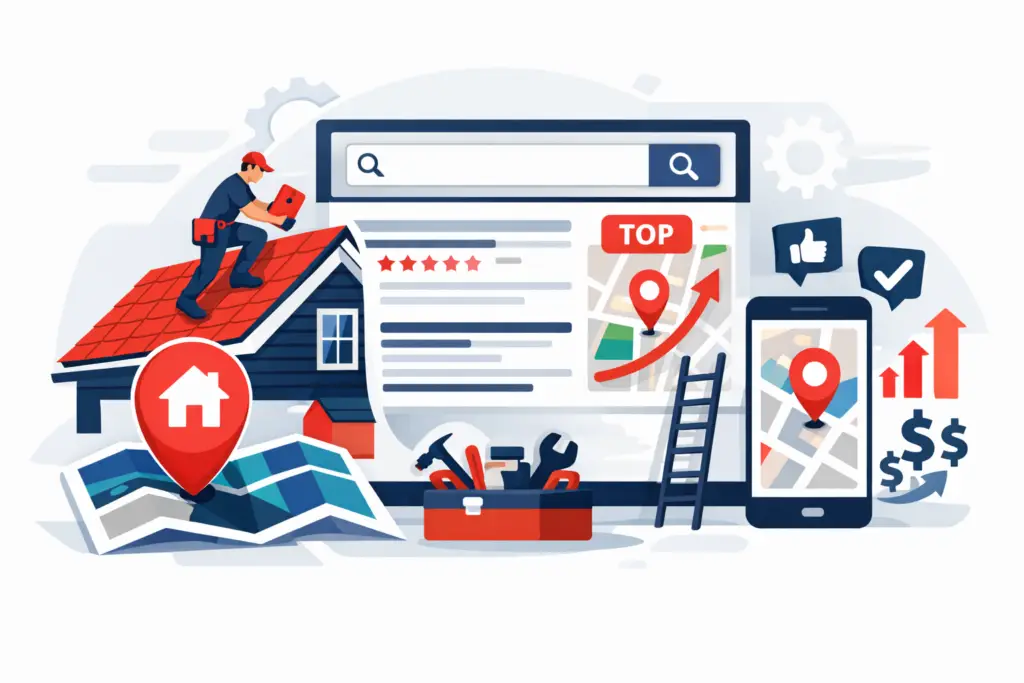
Local SEO for a roofing company means showing up on the Google map and in the "near me" results when someone in your service area searches for a roofer. Google decides those results on three things it names itself: how well your business matches the search, how far you are from the person searching, and how well-known your company is. Your job is to make your Google Business Profile, your website and your listings around the web say the same clear thing about what you do and where, then give Google and buyers reasons to trust it.
This guide takes those three factors one at a time and shows what a roofing company can actually change under each.
How a roofing search plays out locally
When a property manager types "commercial roofer" on a phone, or an office manager asks for "roof leak repair near me," Google shows a short list of businesses on a map above the regular results. That block is often called the map pack. A buyer can pick from it, check a website or two, and call without ever scrolling further.
Google ranks those local results on relevance, distance and prominence, and says plainly that you can't pay for a better local ranking. Everything below fits under one of the three.
Relevance: say exactly what you do
Relevance is how well your profile matches what someone searched. It's the factor roofers have the most control over, and the one they most often leave half done, with a profile that says "roofing" and a website whose only service page lists everything from emergency tarping to full tear-offs in a single paragraph.
- Primary category. Pick the one a buyer would use, such as "Roofing contractor." Google's profile guidelines ask you to use as few categories as possible and not to use them as keywords, so add secondary ones only where they're a real part of the business.
- Services list. Fill in each service you sell by name: repair, replacement, inspections, coatings, metal, single-ply, gutters if you do them. A service that isn't listed anywhere is hard to match.
- Website pages. Your profile links to your site, and the site carries most of the detail. One page per service gives Google something specific to match against "TPO roof repair" or "roof inspection for insurance."
- Business name. Use your real name. Google's guidelines say unnecessary information in the business name isn't permitted, which rules out adding "Best Roofer Dallas" to it.
Distance: set your service area honestly
You can't change where the searcher is standing. You can tell Google where you work.
Most roofing companies are what Google calls a service-area business: you go to the customer, they don't come to you. Google's guidelines say a service-area business should hide its address and set a service area instead, with one profile for the central office. Keep the area to the places you'd really send a crew. A city three hours away, listed because one big job came from there once, won't win you more work there, and it blurs the picture of where you're based for both Google and the property manager who wonders how fast you'd get to a leak.
On your website, add a page for each main area you cover, and make each one real: the buildings you've roofed there, a project photo from that town, the permit office your crews deal with. Copy-and-paste city pages with only the name swapped help nobody.
Prominence: give Google a reason to trust you
Prominence is how well-known your business is. Google says it draws on information from across the web, including how many sites link to you and how many reviews you have. For a roofer, it comes down to habits. Three matter most.
Consistent listings. Your name, address and phone number should match everywhere they appear: your site, your Google profile, Bing Places, Apple, Yelp, the Better Business Bureau, manufacturer contractor locators and the trade directories you belong to. An old phone number left on a dozen directories after a move is a common problem, and so are duplicate profiles for the same company.
Reviews. Ask. Ask every satisfied customer, every time, with a direct link. Answer the reviews you get, good and bad, in a calm voice. A facility manager reads your replies as closely as the stars.
Mentions and links. Manufacturer certification pages, local trade associations, the chamber of commerce and suppliers who list approved installers all count. These come from real relationships, so start with the ones you already have: the manufacturer whose system you install most, the supply house you buy from every week, the association whose meetings you actually attend, and the local charity whose building you reroofed at cost.
A monthly routine that keeps it working
- Check that your profile's hours, phone, services and service area are still right.
- Open the profile's Performance report. It lists the search terms people used to find your business, plus calls and website clicks. Watch whether non-brand terms like "roof repair" start to appear next to your company name.
- Add photos from recent jobs, with the town in the caption.
- Ask for reviews on the jobs you finished.
- Fix any listing that has drifted out of date.
Want a fast outside view first? Our Free AI Visibility Check looks at your website, your mobile speed, whether you come up in a local search, and what an AI assistant says when a buyer asks who to call. No email needed.
Handing it off
Everything above is doable in-house. Plenty of roofers do it. The catch is that it's never finished, and the website side (a page per service and area, kept fast and readable for search engines) takes real hours that most roofing offices don't have spare.
Inbound SDR handles that side. We optimize your Google Business Profile and Bing Places, keep your name, address and phone consistent across 65+ directories, suppress duplicates and add local schema. In the first month we build a website of up to 100 pages around every service and area you cover, then publish a new blog every business day and post it to up to 3 social platforms. Packages start at $1,000 per month on a 12-month term, with a dedicated strategist and a monthly report.
Be clear on the limits. We keep your profile accurate, but we don't post to it, and we don't ask for or manage reviews; that habit stays with you. If reviews are your biggest gap, a review platform is the better first spend.
Short answers
Do I need a physical office to rank locally?
No. Service-area businesses can rank with a hidden address and a set service area, which is how many roofing companies that work out of a shop or a home office already appear.
Should I make a profile for every city I serve?
No. One profile per real location.
Does posting on my Google profile help my ranking?
Google doesn't list it among its ranking factors. Posts can help a buyer who's already looking at your profile, which is reason enough if you have something worth saying.
Get the next one in your inbox
New playbooks, benchmarks and guides from our sales floor, for owners and sales leaders who sell to businesses. One email a month. See past issues.