HVAC and mechanical
Preventive maintenance agreements usually renew annually, so the renewal month is the fact to get. Ask about equipment past mid-life too. See the commercial HVAC hub.
You win commercial maintenance contracts by finding the buildings that fit, learning who services them today and when that agreement comes up, and being the contractor the buyer already knows when it does. Here is how to run that play, trade by trade.

By Jeff WintersChief Executive Officer, Abstrakt
Pick the buildings you want, call the person who chooses the vendor, and learn three facts on the first call: who does the work now, when the agreement renews or gets rebid, and who signs. Then come back before that date with a low-risk first step, such as a site walk or a second-opinion inspection, and ask to be included in the decision.
Most contractors who struggle here are not losing on price or quality. They are showing up at the wrong time. They chase emergency calls and bid requests, which means they meet buyers either mid-crisis or after the scope is already written. The contractors who build a book of agreements are in the conversation months earlier, when the buyer is deciding whether to keep the current vendor at all.
That takes a list, a phone and a record of every conversation. None of it is complicated. All of it is easy to drop when estimators and owners are busy with this month's work.
A maintenance contract pays you to be in the building on a schedule, and the contractor who is already in the building usually hears about the repair, the replacement and the next project first. The agreement is the revenue you can plan around and the door to the larger work.
Emergency calls still matter. They prove you answer the phone. But a no-heat call or a burst pipe rarely turns into an agreement on its own. The follow-up conversation after the emergency does.
The buyer changes with the building. In owner-occupied buildings it is usually a facility or plant leader. In leased and multi-tenant property it is usually a property manager working to an owner's budget. Find out which before you call, because the reason for the call changes with it.
| Building type | Who usually chooses the vendor | What pushes the decision |
|---|---|---|
| Commercial office and multi-tenant property | Property manager, with the owner or asset manager approving larger spend | The annual operating budget, tenant complaints and changes in ownership or management firm |
| Manufacturing plants | Plant manager, maintenance manager or plant engineer; EHS for safety systems | Planned shutdowns, insurer visits and customer audits, and keeping the line running |
| Warehousing and distribution | Facility or operations manager, or the landlord's property manager | Whether tenant or landlord owns the system, new tenants and changes in how the space is used |
| Hospitals and senior living | Director of facilities or plant operations, chief engineer, life safety manager | Accreditation and inspection deadlines, uptime of critical systems and how vendors are prequalified |
| Schools and colleges | Facilities director, director of physical plant, business manager or procurement | The summer work window, decided in winter and spring, and formal bid calendars |
| Hotels | Director of engineering or chief engineer, general manager, ownership group | Guest complaints, brand standards and changes in management company |
| Retail, dealerships and multi-site operators | Regional or corporate facilities manager | Portfolio-wide vendor programs and brand or image schedules; the local manager knows who decides |
Our guides to reaching facility managers and reaching property managers cover how each of these buyers runs their year.
Learn the incumbent and the renewal or rebid month on the first call, write it down, and call back well before it, early enough to influence the decision rather than answer a bid. For an annual service agreement, aim for a real conversation sixty to ninety days before renewal, and earlier if there is a notice period or a budget deadline.
Who handles it today, is it under an agreement, and when does that come up? Say why you are asking: you would rather call when it is useful than every month.
The notice date or the budget month is often the deadline that matters, not the end date. Write down both, plus who else is involved.
Light touches with a reason: a pre-season note, a check-in after a storm or a heat wave, a question about how the last inspection went.
Ahead of the deadline, ask how they plan to handle the agreement this year and whether they would like a comparison.
Offer a site walk, a condition report, a second-opinion inspection or a review of the last service report, so your proposal is built on their building.
Ask to be included in the rebid or to provide a number for the budget, and book the meeting with the person who signs.
The full method, including what to record after every "not now" and how the dates differ by trade, is in our guide to contract-cycle selling.
Start from the agreements you already service well and work outward: the same building types, of a size your crews can handle, inside the radius you can reach on a service call, with the person who chooses the vendor named at each one. A short list worked properly beats a big export nobody calls twice.
Our guide to building a B2B ideal customer profile covers the starting point, and our market guides show what a territory looks like city by city.
Ask about how the work is handled today, not whether they want to switch. A buyer who will not entertain a pitch will usually answer a few plain questions about their building, and those answers tell you when and how to win the contract.
| What you need to know | How to ask it | What the answer tells you |
|---|---|---|
| The incumbent | "Who takes care of that for you now, and how long have they been with you?" | How loyal the account is. Long tenure with no complaints needs patience. |
| The arrangement | "Is that on a service agreement, or do you call them when something comes up?" | A formal agreement has a date. An informal relationship can be won any time by offering structure. |
| The timing | "When does that agreement usually come up for renewal or rebid?" | When to call back, and how early. |
| The asset | "Roughly how old are the units, the roof or the system?" or "When was the last inspection?" | Whether a replacement or repair conversation is coming regardless of the agreement. |
| The gap | "If you could change one thing about how it is handled today, what would it be?" | The reason your follow-up will be welcome, in their own words. |
| The decision | "When you review vendors, who else weighs in?" | Who to involve before the meeting, without asking if they are the decision maker. |
| Permission | "Would it be all right if I got back in touch a couple of months before then?" | A follow-up they agreed to is expected, which makes it a different call from a cold one. |
Be who you are on every call: your name, your company and why you are calling. Do not ask for a copy of the contract or the incumbent's pricing, and if the buyer would rather not share something, note it and move on. The structure of the call itself is in our B2B cold calling framework.
Never criticize the current contractor. Let the buyer describe the gap, offer a small way to compare, and make switching look easy and safe. The buyer chose the incumbent, and attacking that choice puts them on the defensive.
Space touches out while the renewal is far away, tighten them as it gets close, and give every touch a reason the buyer would recognize. Keep calling every month of the year; the season only changes what you lead with.
| What you heard | What it usually means | The next move |
|---|---|---|
| "We're under contract." | There is a date. You do not know it yet. | Ask the term and end month, then plan a conversation ahead of the notice or renewal date. |
| "We're happy with who we have." | The incumbent is doing well for now. | Record who and how long. Check in after their next busy season or inspection, when problems surface. |
| "Our maintenance team handles it." | In-house staff cover routine work and still send some out. | Ask what they send out. That is the opening. |
| "Call me next year." | They told you their planning cycle. | Ask what happens next year, a budget, a renewal or a project, and calendar the call before it. |
| "Send me something." | Sometimes a polite exit, sometimes real interest. | Ask what it should cover, send something specific to their building, and call back with a reason. |
Peak season is not a reason to go quiet. During it, ask how the current vendor is keeping up; that is when buyers notice slow response and missed visits. Outside it, ask for the meeting and the site walk ahead of the decision. Triggers jump the schedule: a new facility manager, an ownership change, a failed inspection or a run of complaints moves an account forward the day you hear about it.
Use the phone for the conversations, and email, LinkedIn and direct mail to keep your name familiar between them. Our post on multi-channel outbound cadence shows how to coordinate them.
Every trade has its own date to learn and its own low-risk first step. Learn the date on the first call and the follow-up schedules itself.
Preventive maintenance agreements usually renew annually, so the renewal month is the fact to get. Ask about equipment past mid-life too. See the commercial HVAC hub.
Every sprinkled building already has someone inspecting it. Learn the next inspection due date, the renewal and whether last year's deficiencies were repaired, then offer to review the latest report. See the fire protection hub.
Almost every building has a cleaning company. Get the contract end date and what the manager had to chase the crew about this month, then offer a walkthrough ahead of the rebid. See the commercial cleaning hub.
Maintenance contracts run to an end date and a budget meeting that differ by property. Ask about the end date and whether snow is bundled in. In-season calls surface what managers dislike about the current crew. See the commercial landscaping hub.
Most buildings call a roofer only when something leaks. Sell inspection and maintenance programs: ask roof age, roof type and when anyone was last up there, and when capital requests are due. See the commercial roofing hub.
Sealcoating, crack fill and restriping run on a cycle, often across a property manager's whole portfolio. Ask the last sealcoat date and the month the budget is built. See the paving hub.
Many buildings have an electrician they call with nothing in writing. Offering a formal agreement for switchgear maintenance, infrared surveys or generator testing is the opening. Learn budget months and shutdown windows. See the commercial electrical hub.
Recurring work comes from tenant turnover and touch-up programs and multi-site repaint schedules. Ask when the building was last painted and when the budget is set. See the commercial painting hub.
Recurring flooring work comes from turnover replacements for property managers, multi-site rollouts and polished concrete maintenance. Ask what is wearing out and what turnover or renovation is coming. See the commercial flooring hub.
The recurring customer is the repeat owner that builds or renovates regularly, and some GCs add facility service and small projects. Ask when the capital plan is set and how builders get on the list. See the commercial construction hub.
Outsource it when the play is right but nobody on your team has the hours to run it every week. Winning maintenance contracts depends on calling the same accounts for a year or more and remembering what each one said, and that is the first thing to slip when your estimators and owners get busy.
In an Abstrakt program, a U.S.-based SDR team works your target list by phone, email and LinkedIn as an extension of your sales team. Not-now accounts are recorded with the incumbent, the date and the reason and stay in a cadence, for up to 18 months on Growth, and every dial, email, conversation and booked meeting is visible in the Results Portal. That patience is how Mechanical Service & Systems signed a $595,000 agreement after roughly two years of relationship development with one account.
We take one client per trade per territory, so we will not run the same program for a direct competitor in your territory. See how the appointment setting program works, or use our guide on how to choose an appointment setting company to evaluate any provider, including us.
Build a list of buildings that fit your services and service radius, call the person who chooses the vendor, and learn who services the building now and when that agreement renews. Follow up before the renewal with a site walk or second-opinion inspection, and ask to be included in the decision.
Turn one-off and emergency work into a follow-up conversation. After a repair, send a short report on the condition of the equipment or system and offer a scheduled maintenance program. Many buildings call a contractor as needed with nothing in writing, and offering structure is the opening.
Before the buyer decides whether to renew. For annual agreements, aim for a conversation sixty to ninety days ahead of renewal, and earlier when there is a notice period or a budget deadline. Keep calling all year; the season changes what you lead with, not whether you call.
In owner-occupied buildings, usually a facility, plant or engineering leader, with an owner or CFO approving larger spend. In leased property, usually a property manager working to an owner's budget. Procurement often runs the bid. Ask who else weighs in rather than whether your contact is the decision maker.
Ask the buyer, openly and as yourself, and explain that you want to call at a useful time. Many will tell you. Do not ask for the contract or the incumbent's pricing, and accept it if they prefer not to say. Our guide to contract-cycle selling covers the questions.
Ask what the buyer would change about how the work is handled today, then offer a low-risk way to compare, such as an inspection or condition report. Make the transition look simple. Never criticize the current contractor; the buyer chose them.
Often until the incumbent's agreement comes up, which can be months or more after the first call. That is why the record of each conversation and a steady follow-up cadence matter more than any single call.
Hire when you have someone who can manage a rep and a working process. Outsource when the play is clear but nobody has the hours to run it every week. Our post on in-house SDR vs. outsourced appointment setting walks through the decision.
Individually powerful. Better together. Our four solutions work together to find your buyers, book meetings with them and help your team close more of them.
All three together: Get Outbound BDR, Inbound SDR and Brand Boost together, starting at $6,500 per month ($5,000 + $1,000 + $500 = $6,500). Enterprise SDR/BDR is custom.Build my program
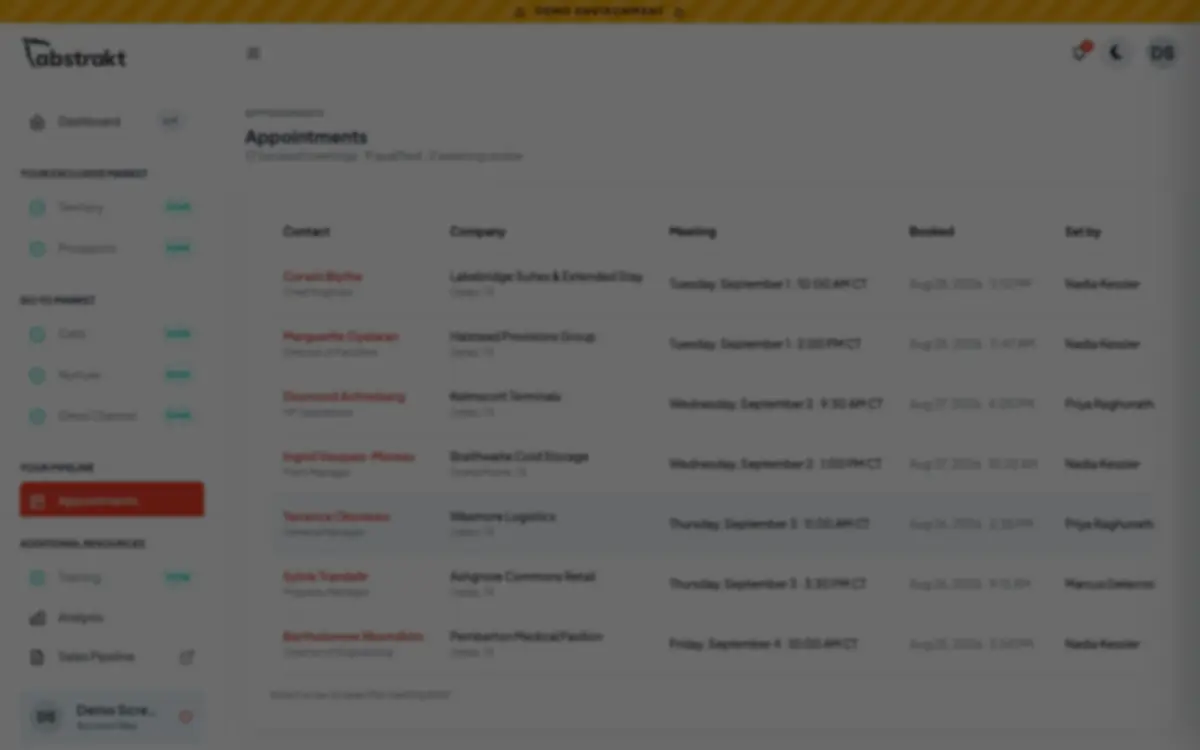
Photos on this page: Vitaly Gariev (opens in a new tab) (Unsplash License (opens in a new tab)); Tim van der Kuip (opens in a new tab) (Unsplash License (opens in a new tab)); Annie Spratt (opens in a new tab) (Unsplash License (opens in a new tab)); Austin Distel (opens in a new tab) (Unsplash License (opens in a new tab)); Hero image: the Abstrakt Intelligence appointments list (demo environment, fictional data). Abstrakt's own image.
New playbooks, benchmarks and guides from our sales floor, for owners and sales leaders who sell to businesses. One email a month. See past issues.