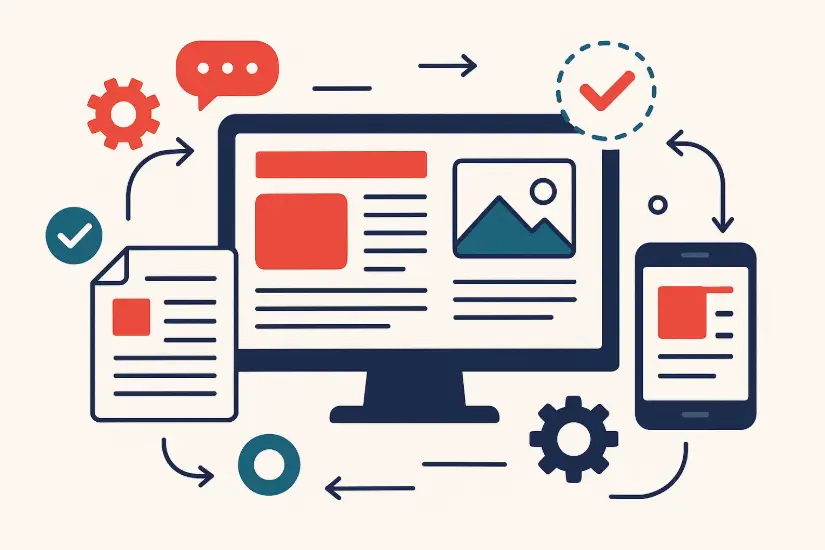
The main benefits of a content automation platform are time and consistency. It takes the repetitive steps of publishing content (scheduling, formatting, posting the same piece to several social channels, routing drafts for approval, pulling reports, and increasingly writing first drafts with AI) and runs them without someone doing each one by hand. What it can't automate is the part that makes B2B content worth reading: knowing the work, the buyer and the answer. Get that split right and a platform pays off. Get it wrong and you publish more of something nobody needed.
What a content automation platform actually does
"Content automation platform" covers a lot. Some tools only schedule social posts. Some are full marketing suites with a content calendar, approval workflows, a CMS, an AI writing assistant and analytics in one place. Most sit in between.
AI writing is now part of nearly all of them. In the Content Marketing Institute's 2026 B2B survey, 95% of B2B marketers said their organizations use AI-powered applications, with content creation tools the most common use the survey reported. So the real question for most companies is no longer whether to automate. It's which parts.
The benefits, honestly weighed
1. Less time on busywork
Clearest win first. Resizing a post for LinkedIn, Facebook and Instagram, writing three versions of a caption, scheduling it for the right time, chasing an approval by email: none of that needs a skilled person. A platform turns that pile of clicks into a few minutes.
2. A steady publishing rhythm
Without a system, most companies publish in bursts: five posts in a busy month when someone finally finds the time, then nothing at all for a quarter while everyone is out on jobs, until the owner notices the blog's newest post is older than some of the trucks. A calendar with scheduled posts keeps the site and social accounts from going quiet, which matters to a buyer who checks you out and sees your last update was a year ago.
3. One place for drafts, approvals and assets
When the estimator, the owner, the office manager and an outside writer all touch the same piece over a couple of weeks, with comments arriving by text, email and a sticky note on someone's monitor, a shared workflow finally ends the "which version is final?" problem. Logos, photos and approved descriptions of your services live in one library. Small benefit, but it saves real friction.
4. Reporting without spreadsheets
Most platforms pull performance data into one dashboard. Just check that it shows what you care about, like search clicks, calls and form fills, and not only likes and impressions.
5. Faster first drafts
Biggest catch here. AI can turn your notes or a recorded interview into a usable draft quickly, and for a busy owner that's valuable. A draft built only from what the AI already knows, though, will read like everyone else's, because it's assembled from what's already published.
Where automation goes wrong
Google is blunt. Its spam policies define scaled content abuse as generating many pages for the primary purpose of manipulating search rankings and not helping users, and one of the listed examples is using generative AI tools to create many pages without adding value for users. It's written policy.
You can still use AI. Google's guidance on helpful content asks who made a page, how and why; it says the "why" should be to help people, and that where automation substantially generated a page, telling readers can be useful. In practice, for a B2B company, that means three habits:
- Every piece starts from a real buyer question, ideally one your sales team hears.
- Someone who knows the work adds the details only your company has: job sizes, timelines, the problems your crews see.
- A person reads it before it goes live and would put their name on it.
Automate the steps around that. Keep people on those three. Always.
Choosing a platform
| If your team... | Look for... |
|---|---|
| Already writes but posts inconsistently | A social scheduler and content calendar |
| Has several people reviewing every piece | Approval workflows and a shared asset library |
| Needs help getting words on the page | An AI writing assistant you can feed your own notes and interviews |
| Can't tell what's working | Reporting that connects to Google Search Console and your analytics |
Whatever you pick, someone still has to run it. If nobody on your team owns content, it becomes another subscription nobody logs into.
Software, or someone to run it
That's the gap Inbound SDR covers. It's a program we run for you, with no software for your team to learn. We build a website of up to 100 pages in the first month, around every service you sell and area you serve. Then a new blog goes out every business day, published on your site and posted to up to 3 social platforms, with one white paper to start and a guide for every product or service. A dedicated strategist plans the topics with you, and you get a monthly report. Packages start at $1,000 per month on a 12-month term.
Daily publishing, by itself, earns nothing. The topics have to answer what your buyers ask, and your team's knowledge has to be in them, which is why we start with your services and the questions you hear most. It isn't the right fit if what you need is email marketing, paid ads or video production. And if you have a strong in-house writer, a good platform may be all you need.
To see how your current content shows up, try our Free AI Visibility Check. It looks at your website, mobile speed, whether you come up in a local search, and what an AI assistant says when a buyer asks who to call. No email needed.
Get the next one in your inbox
New playbooks, benchmarks and guides from our sales floor, for owners and sales leaders who sell to businesses. One email a month. See past issues.