An omnichannel content strategy is a plan for making sure a buyer hears the same story from your company wherever they run into you: your website, a Google search, your Business Profile, LinkedIn, a forwarded post, an email or a sales call. To build one, pick the handful of channels your buyers actually use, make your website the home base that everything points back to, turn each core piece of content into versions that fit each channel, and keep the facts identical everywhere. The goal is a buyer who can move from one place to the next without hitting a contradiction.
Omnichannel versus multichannel
The two words get used as if they mean the same thing. They don't, quite.
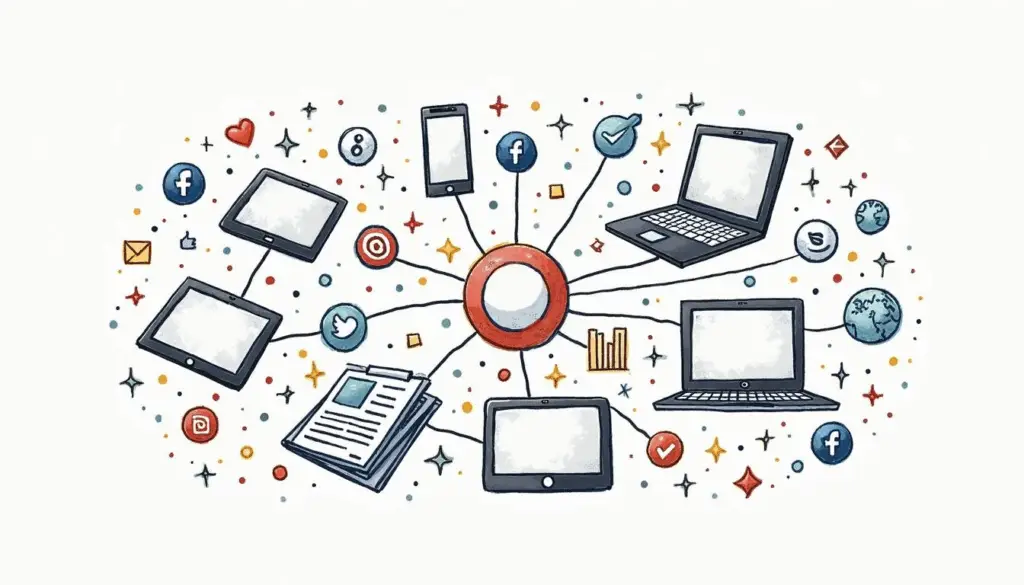
Multichannel means you're present in several places. Omnichannel means those places are connected, so the LinkedIn post links to the guide on your website, the guide matches what your salesperson says, and the phone number on your Google profile is the one that rings at your office. A property manager might see your post on Monday, search your name on Thursday and call the following week. Every stop along the way should feel like the same company.
Choose channels by where your buyers are
Small teams spread too thin. Five channels done badly will lose to two done well, every time.
Start with the numbers. Pew Research's latest survey of US adults found YouTube used by 84% and Facebook by 70%, while LinkedIn reaches about half of college graduates. For B2B content specifically, LinkedIn leads: in the Content Marketing Institute's survey of B2B marketers, LinkedIn topped the list of most effective channels for thought leadership at 76%, ahead of email newsletters at 54% and speaking events and webinars at 52%.
Then check your own customers. If your best accounts are run by facility managers who live in their inbox and never open Instagram, the national average doesn't matter much. Ask your last ten customers where they look when they need a vendor. Their answers will tell you more than any survey.
Make the website the hub
Social platforms change their rules, their reach and their audiences without asking you. Your website is the one place you own outright. Nobody can change its reach overnight.
So put the full version of every important piece on your site first, then send people to it from everywhere else. A detailed guide to commercial roof inspections lives on your website, and the LinkedIn post, the short clip and the Facebook update are trailers for it, each one short enough to read in the feed and each one ending with a link to the real thing. This also helps you show up in search and AI answers, because those systems read your site, and a site with real depth on each service you sell gives them something to work with.
One piece, cut several ways
You don't need separate ideas for each channel. You need one good idea and a few honest adaptations of it. Here's how one post about preparing a building for a roof inspection might travel.
| Channel | What the piece becomes | Where it points |
|---|---|---|
| Website | The full post, with photos, a checklist and a link to the inspection service page | The service page and the contact form |
| Three of the checklist items, written for a facility manager | The full post | |
| Facebook and Instagram | A before-and-after photo of a problem the checklist catches | The full post |
| YouTube or TikTok | A 30-second clip of a crew lead walking one item | The full post |
| Sales conversations | The checklist as a leave-behind after a site visit | Your phone number |
Every row points home. That connection is what makes it omnichannel.
Keep the facts identical
Consistency sounds soft. It isn't. A buyer who finds two different phone numbers, an old address on one directory and a service list that doesn't match your website starts to wonder what else is out of date.
Write down the facts that must never vary: legal business name, address, phone, service areas, the services you offer, and how you describe what you do in one sentence. Check every profile against that list twice a year. Fix what's drifted. Search engines and AI assistants compare these details across sources too, and mismatches make it harder for them to be confident about who you are.
Measure what you can, and accept the gaps
You won't see the whole journey. Nobody does. A lot of sharing happens where analytics can't follow. When SparkToro tested how Google Analytics labels social traffic, 100% of visits from TikTok, Slack, Discord, Mastodon and WhatsApp were marked as "direct", with no sign of where they came from.
Measure in layers. Watch which pages people land on before they call or submit a form, use tagged links on the posts you share, and ask every new customer how they first heard of you. The answers to that last question will tell you more about your channels than any dashboard.
Where Inbound SDR fits
The hardest part of omnichannel content for a small company is volume: something new, every day, in several places, all saying the same thing. Inbound SDR covers the website, search and social side of that. A new blog goes out every business day on your site and is posted to up to 3 social platforms: LinkedIn, Facebook, Instagram, TikTok, YouTube and X, each with a link back to the full post on your site. We build and host the website, up to 100 pages, keep your Google Business Profile and Bing Places accurate, and keep your name, address and phone consistent across 65+ directories. Packages start at $1,000 per month on a 12-month term.
It doesn't cover email, paid ads or video production, and we don't run outreach on LinkedIn. If those channels carry most of your business, you'll still need someone on them. If you're not sure your existing channels are even showing you to buyers, our Free AI Visibility Check looks at your website, your mobile speed, whether you come up in a local search, and what an AI assistant says when a buyer asks who to call. No email needed.
Before you add another channel
Ask whether the channels you already have are connected. Does every post point to your site? Do the facts match everywhere? Do you publish often enough that someone checking you out finds something recent? If any answer is no, fix that first. Expand later. A new channel added to a disconnected setup just adds another place for the story to drift.
Get the next one in your inbox
New playbooks, benchmarks and guides from our sales floor, for owners and sales leaders who sell to businesses. One email a month. See past issues.