

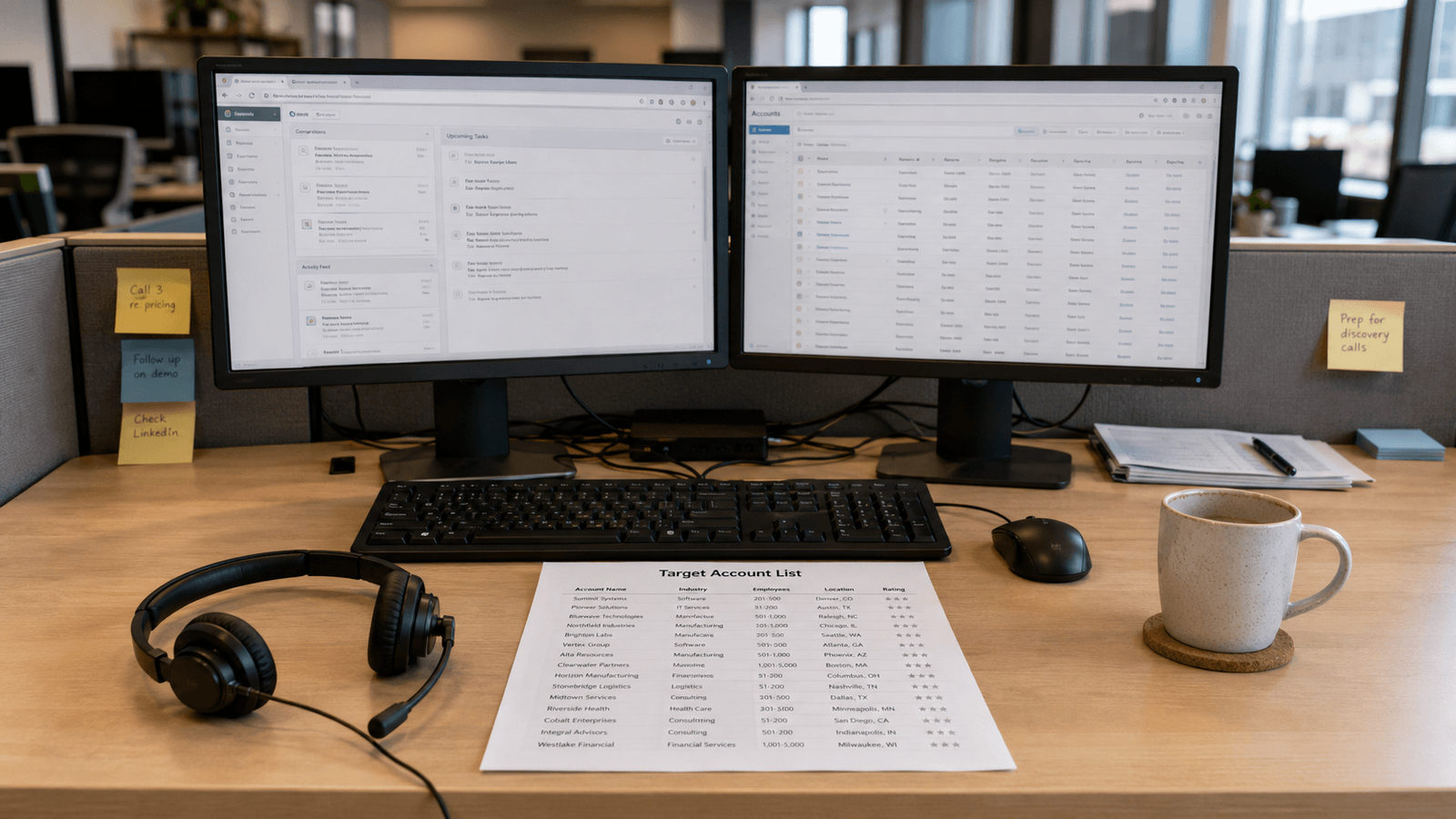
The appointment setter fills your pipeline so your closers stop dialing strangers and start signing deals.
An appointment setter is a sales professional whose entire job is to start conversations with potential customers and book qualified meetings for the closers on your team. They own the top-of-funnel work, cold calling, emailing, and following up, so your salespeople walk into calendars full of real, interested decision-makers instead of spending their day dialing strangers. In short: the appointment setter fills the pipeline, and the closer works it.
I run this motion every day. At Abstrakt we book more than 100,000 qualified appointments a year for over 2,000 active clients, and every one of those meetings starts with an appointment setter picking up the phone. So when I tell you what the role involves, I am not reading off a template. I am describing what my team does before lunch.
Let me get specific about what the day looks like, what separates a good setter from a bad one, and how the role fits into a real sales machine.
What an appointment setter actually does day to day
The core job is simple to state and hard to do well. Reach the right people, hold their attention long enough to earn a conversation, and get a meeting on the calendar with someone who has the authority and the need to buy. Here is what a real day looks like.
Outbound dialing. This is the heart of the job. A good appointment setter spends hours on the phone, working a curated list of target accounts. On our programs the volume floor sits at roughly 600 dials a month per client, and that is a floor, not a target.
Multi-channel follow-up. The phone leads, but it does not work alone. Setters send email, connect on LinkedIn, and use direct mail to stay in front of prospects who did not answer the first time. Most meetings come from the fifth, eighth, or twelfth touch, never the first.
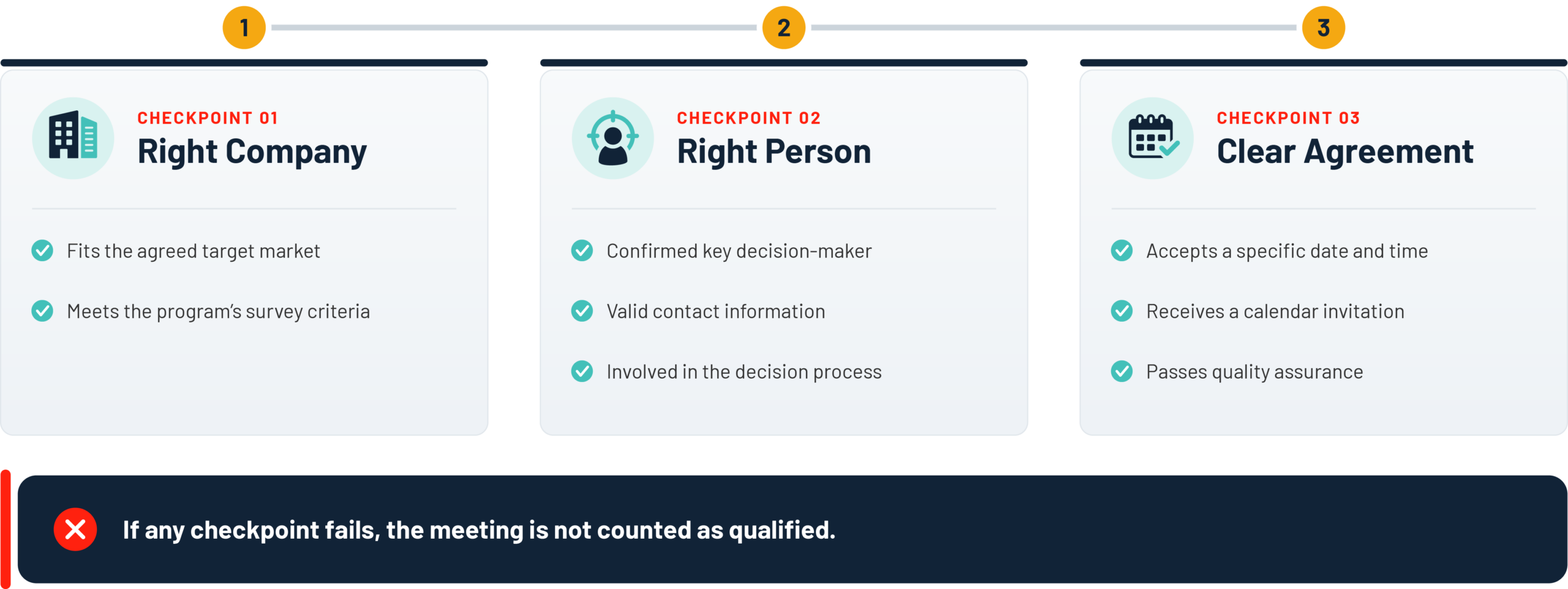
Qualifying, not just booking. Anyone can drop a name in a calendar. A setter’s real job is to confirm the prospect fits, meaning the right industry, the right role, the right timing, and a real problem worth solving, before it ever reaches a closer. A booked meeting with the wrong person costs you more than no meeting, because it burns your closer’s most expensive hour.
Handling the brush-off. “Not interested.” “Send me an email.” “We already have a vendor.” “Call me next quarter.” A strong setter has heard every one of these ten thousand times and knows which are real objections and which are reflexes.
Logging everything. Every dial, every conversation, every callback promised goes into the CRM. That record is how you learn what works and how you hand a clean, warm meeting to the closer.
The unglamorous truth is that appointment setting is a volume-plus-skill game. You need enough activity to create opportunities and enough skill to convert them. Neither one alone gets you there.
The skills that separate a good appointment setter from a bad one
Most people think appointment setting rewards a smooth talker. It does not. The best setters I have ever hired were rarely the loudest people in the room. Here is what actually matters.
Resilience over charm. A setter hears “no” far more than “yes.” The ones who last are not the ones who never get rejected. They are the ones who dial the next number without flinching. If a rep needs a win to stay motivated, they will not survive the role. The great ones treat the “no” as data, never as defeat.
Listening more than pitching. The rookie mistake is talking. A skilled setter asks a sharp question and then goes quiet. Decision-makers give away exactly what they care about in the first thirty seconds if you let them. The setter’s job is to catch it and steer toward a meeting, never to recite a script.
Thinking on their feet. Scripts are training wheels. A real gatekeeper conversation or a curveball objection cannot be scripted. The setters who book the most meetings hold a genuine business conversation with a busy executive and pivot in real time.
Discipline and consistency. The difference between a setter who books 5 meetings a month and one who books 15 rarely comes down to talent. It comes down to the number of quality conversations they have, day after day, without letting a bad morning bleed into the afternoon. Boring consistency beats brilliant bursts.
Research instinct. Before dialing, a good setter knows who they are calling, what that company does, and why now might be the right time. A cold call that opens with a relevant, specific reason to talk lands far better than a generic pitch.
Here is my mildly contrarian take. You cannot train someone into a great appointment setter if the resilience is not there. You can teach the product, the script, the objection handling, and the CRM. You cannot teach a person to enjoy, or at least stop fearing, the thousandth “no.” That is why hiring for the role is so much harder than it looks, and why so many in-house teams quietly give up on it.
Appointment setter vs. SDR vs. BDR vs. closer
These titles get used loosely, and that looseness causes real confusion. Here is how they actually differ.
Appointment setter. Focused on one outcome: booking qualified meetings. Primarily outbound, phone-forward, top of funnel. They hand the meeting off and move to the next prospect.
SDR (Sales Development Representative). Often used interchangeably with appointment setter, though the SDR title usually implies a bit more. Qualifying leads against a defined framework, sometimes handling inbound as well as outbound, and working more deeply inside a sales tech stack. In practice, at most modern outbound shops the SDR is the appointment setter. We use the terms as siblings.
BDR (Business Development Representative). Typically the outbound-only flavor of the SDR role, focused on generating brand-new pipeline from cold accounts rather than working inbound interest. Where a title distinction exists, BDR usually means “hunts cold,” while SDR may also handle warm.
Closer (Account Executive). The person who takes the qualified meeting, runs the demo or the discovery, negotiates, and signs the deal. Closers are expensive, and their time is your most valuable sales resource. The entire reason appointment setters exist is to protect that time.
The simplest way to hold it in your head: setters and SDRs open, and closers close. A common, costly mistake is asking your closers to prospect their own meetings. You are paying a surgeon to run the front desk, burning your highest-value people on your lowest-value activity. Splitting the roles is what makes the math work.
For where all of this sits inside the broader motion, see our guide to outbound sales.
What a professional appointment-setting operation looks like
One skilled setter with a phone is a start. A professional operation is a system. Here is how ours is built, and what to look for whether you build it in-house or buy it.
Staffing that does not break. Each of our SDRs leads four client programs and sits inside a pod of ten reps, with an eleventh rep on standby to back up any account running short. That structure matters more than it sounds. When a rep is out, on vacation, or ramping, your outreach does not go dark, because the backup steps in. Most in-house teams carry no such redundancy. One rep quits and the whole motion stalls for a month while you hire and train a replacement.
A real volume floor. We hold a minimum of roughly 600 dials a month per client program. Not because dials are the goal, but because you cannot manufacture conversations without enough attempts. Volume is the fuel and skill is the engine. You need both.
The right metrics, watched. The funnel we manage runs from dials to contact rate to pitch rate to close rate. The two numbers that actually matter are contact rate, meaning are we reaching real people, and close rate, meaning are those meetings turning into business. The vanity metric we ignore is raw automated email and LinkedIn activity counts. A dashboard full of “sent” numbers tells you nothing about whether anyone picked up.
A point of view on cold calling. Here is where I plant a flag. Cold calling is not dead. It is more valuable now than it has been in years. AI has flooded email inboxes and LinkedIn feeds with automated slop, and buyers have tuned it out. A live, one-to-one phone conversation is now the fastest path to a qualified meeting with a real decision-maker, precisely because so few competitors will do it well. Our contact rates have held steady for years. They are not declining. Anyone telling you the phone is over is selling you software.
When the system works, the results are concrete. A commercial roofing client of ours booked 167 appointments and roughly $700,000 in opportunities. A commercial cleaning company built a $415,000 pipeline in under a year. Those numbers do not come from a clever tool. They come from skilled appointment setters, on the phone, every day, backed by a system that does not miss.
Should you hire an appointment setter or outsource the role?
The honest answer depends on whether you can build the system around the person. Hiring one setter is easy. Building the pod, the redundancy, the management, the data, the QA, and the training that make that setter productive is where most companies stall, and where a hire quits within a year and takes the ramp investment with them.
That is the whole argument for outsourcing. When you buy outsourced SDR services, you are not renting one person. You are renting the entire operation around them. To understand the front-end function end to end, start at our B2B appointment setting hub.
Want appointment setters who book qualified meetings without you building the machine? Talk to Abstrakt about our outsourced SDR and appointment-setting programs.
Frequently Asked Questions
What does an appointment setter do?
An appointment setter reaches out to potential customers, mostly by phone plus email and LinkedIn, to start conversations and book qualified sales meetings for the closers on the team. They qualify each prospect to confirm the right role, need, and timing before the meeting is handed off. Their job is to fill the pipeline so salespeople spend their time selling instead of prospecting.
What is the difference between an appointment setter and an SDR?
In practice, very little. At most modern outbound teams the two terms describe the same job. An appointment setter is focused squarely on booking qualified meetings, while “SDR” sometimes implies a bit more qualification work and deeper use of the sales tech stack. We treat them as siblings and use the terms interchangeably.
What skills make a good appointment setter?
Resilience under constant rejection, real listening skill, the ability to think on their feet outside a script, and boring day-after-day consistency. The single hardest one to hire for is resilience. You can teach the product and the objections, but you cannot teach someone to keep dialing after the thousandth “no.”
Is cold calling still an effective way to set appointments?
Yes, and it is arguably more effective now than it has been in years. AI has flooded email and LinkedIn with automated outreach, so a live one-to-one phone conversation now stands out and gets through. Our contact rates have held steady for years, and the phone still books the meeting.
How many meetings should a good appointment setter book?
A healthy program books 5 to 10 new qualified meetings per client per month. The gap between a low performer and a high performer usually comes down less to talent than to the number of quality conversations they have, which is why volume floors and a strong management system matter as much as the individual rep.

Jeff Winters is the CEO of Abstrakt Marketing Group, a U.S.-based B2B lead generation and appointment-setting company that books qualified sales meetings for clients across the commercial trades, IT and managed services, manufacturing, and B2B services. He has spent his career building and running outbound sales programs at scale, and he breaks down what actually works in sales and lead generation on Abstrakt's podcast, The Grow Show.