
The person answering the phone isn’t blocking you. They’re blocking a pitch, and “plumbing services” sounds exactly like one.
Every commercial plumbing contractor who has tried to reach a facility manager has hit the same wall. You call the main line. Somebody answers. “Can I ask what this is regarding?” You say something about plumbing services, they say they will pass along the message, and nothing comes back.
It’s tempting to treat that person as the obstacle. They’re doing their job well, and once you understand what the job is, the same call goes through.
In short
- The front desk screens for one thing: is this useful to the person they’re protecting, or only to the caller?
- A reason gets routed. A service gets a message taken. Name the reason in the first sentence.
- Backflow and cross-connection compliance is the strongest reason a plumbing contractor has, and almost nobody uses it.
What the front desk is actually paid to do
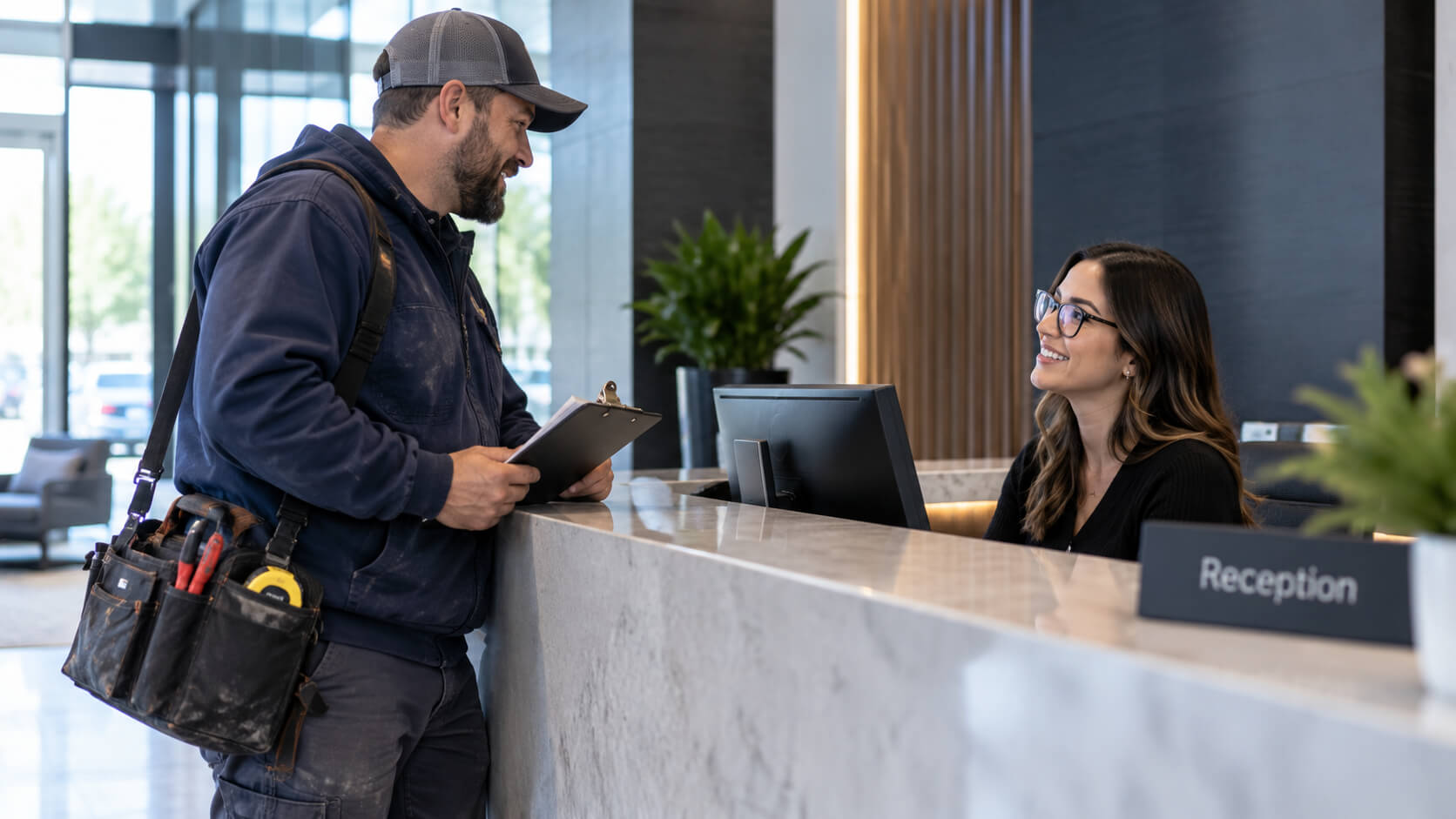
Somebody at a property management office or a plant reception desk fields calls all day, and a large share of them are vendors wanting a few minutes of the facility manager’s time to talk about themselves. If all of them got through, the facility manager would never leave the phone.
So the filter is simple, and it’s not about you. Is this call useful to the person I’m protecting, or only to the person making it?
That’s the whole test. A pitch gets a message taken. A call that helps the facility manager do something they’re already trying to do gets routed, often immediately, and sometimes with an apology for the delay.
Why “plumbing services” gets stopped
Say you’re calling about plumbing services and you have described a category, not a reason. The person answering has no way to tell whether this matters, so they default to safe, which means taking a message.
Worse, you have made them guess. Nobody routes a call they can’t explain in one sentence to their boss.
Gets a message taken
- “I’m calling about plumbing services”
- “I wanted to introduce our company”
- “Is the facility manager available?”
Gets routed
- “About the backflow assembly testing on the building”
- “About the water heaters before they go into the plan”
- “Whoever handles the plumbing budget for the property”
The difference isn’t politeness or persistence. The right-hand column names something that exists at that specific building and that somebody there’s responsible for.
Reasons that survive being repeated
Whatever you say gets retold in about eight words. Pick a reason that survives that compression.
| What you say | What gets repeated | Why it routes |
|---|---|---|
| Backflow assembly testing and records | “Something about backflow testing” | A compliance obligation the building owns, with a date attached |
| Water heater age and replacement planning | “About the water heaters” | A capital item somebody is already worrying about |
| Recurring drain problems in one area | “About the drains on the second floor” | Names a specific complaint they have been fielding |
| Grease interceptor service and records | “About the grease interceptor” | Inspection exposure, not a sales call |
| Fixture counts for a restroom renovation | “About the restroom project” | A project already in motion that needs a number |
Every row is a thing. Not a service, not a capability, and not a relationship you would like to build.
Skip the front desk entirely
Abstrakt sets appointments with the facility managers, property managers, and directors who approve commercial plumbing work, so your team is walking buildings instead of leaving messages. The walkthrough, the number, the proposal, and the contract are yours.
The compliance reason almost nobody uses
Row one deserves more attention than it gets, because it’s the rare opening that’s genuinely not about you.
The EPA describes cross-connections as “actual or potential connections between a potable water supply and nonpotable water plumbing,” and backflow as the unintended reversal of flow through one, which can become a serious public health hazard. Its guidance on cross-connection control programs is explicit that water system customers need to understand “their responsibilities for testing and repairing backflow prevention assemblies.”
That responsibility sits with the building. Not the water utility, not the contractor who installed the assembly years ago. The frequency and the paperwork are set by state rules and by the local water purveyor’s ordinance, commonly on an annual cycle, so check what applies in the jurisdiction before you quote a requirement at anybody.
Now consider how that sounds at a front desk. You’re not calling to sell plumbing. You’re calling because the building has assemblies that require testing and a record, and you’re asking who keeps that record.
“I’m not selling anything today. Do you know who keeps the backflow test records for the building? I want to check whether the ones here are current.”
Two things happen. Often nobody knows, which is itself the finding. And the question routes, because a gap in a compliance record is exactly the sort of thing the person answering the phone doesn’t want to be the reason nobody heard about.
The call, line by line
Them: “Can I ask what this is regarding?”
You: “Sure. I’m trying to reach whoever handles plumbing for the building. It’s about the backflow assembly testing and whether the records are current.”
Them: “Let me see if they’re available.”
There’s no company introduction in that, no list of services, and no request for a few minutes of anybody’s time. One sentence, naming one thing at their building. That’s the whole move.
Then be useful when you get through, and be brief. The call that earns a walkthrough is short, specific, and ends with a question the facility manager can answer in one word.
When they still won’t put you through
Sometimes the answer is no, and the way you handle that decides whether the next call is easier or harder.
Ask for the name and the correct route, not the extension. “No problem. Who should I be asking for, and is email better than calling?” Most people will tell you, because you have stopped trying to get past them and started asking them to direct you, which is a thing they’re happy to do.
Write down what you learn, including the name of the person who helped. Call back later with the name and the reason together and you’re no longer a stranger.
Frequently Asked Questions
How does a plumbing contractor get past the front desk?
Name a specific thing at that building in the first sentence instead of a service category. Backflow assembly testing, the water heaters, a recurring drain problem, the grease interceptor. A reason gets routed. A service gets a message taken.
Why does saying “plumbing services” get blocked?
Because it describes a category, not a reason, so the person answering can’t tell whether it matters and defaults to taking a message. It also forces them to guess, and nobody routes a call they can’t explain to their manager in one sentence.
Who is responsible for backflow prevention assembly testing?
The building, not the water utility. EPA guidance on cross-connection control states that water system customers need to understand their responsibilities for testing and repairing backflow prevention assemblies. Frequency and record-keeping are set by state rules and the local water purveyor’s ordinance, commonly annually, so confirm what applies locally before quoting a requirement.
What is a cross-connection?
EPA defines cross-connections as actual or potential connections between a potable water supply and nonpotable water plumbing. Backflow is the unintended reversal of flow through one, and it can create a serious public health hazard, which is why buildings carry prevention assemblies and have to keep them working.
What should you do if the gatekeeper still refuses?
Ask who you should be asking for and whether email works better. You have stopped trying to get around them and started asking to be directed, which most people will do willingly. Write down the name of whoever helped, and use it next time.
Should you ever mislead the front desk about why you’re calling?
No, and it’s unnecessary. The reasons that route are all true ones. A caller who talks their way in under a false pretext gets one meeting and no second call, and property managers talk to each other.
Keep going
- How to get past a gatekeeper on a sales call
- What to say when you cold call a facility manager
- Cold calling services
- Outsourced SDR services
- What to ask before you price a commercial landscaping bid
About this article
Jeff Winters is Chief Executive Officer at Abstrakt. Reviewed by Neil Erker, Chief Marketing Officer. Abstrakt sets appointments for commercial plumbing contractors and the rest of the trades, and the calls described here come from that work.

Jeff Winters is the CEO of Abstrakt Marketing Group, a U.S.-based B2B lead generation and appointment-setting company that books qualified sales meetings for clients across the commercial trades, IT and managed services, manufacturing, and B2B services. He has spent his career building and running outbound sales programs at scale, and he breaks down what actually works in sales and lead generation on Abstrakt's podcast, The Grow Show.