


The straight version of how you fill a B2B pipeline on purpose: how it works, what it costs, and what 5 to 10 qualified meetings a month actually takes.
B2B lead generation is the process of identifying the companies you want as customers, reaching the decision-makers inside them, and turning that interest into a qualified sales conversation. In plain terms: it is how you fill the top of your pipeline with the right businesses on purpose, instead of waiting and hoping the right ones find you. Every B2B lead generation program has one job. Produce qualified meetings your sales team can close.
I run this motion every day. At Abstrakt we book over 100,000 qualified appointments a year for 2,000+ active clients across dozens of B2B industries. So when I tell you what lead gen actually is, what it costs, and what a real month looks like, none of it is theory. It is the machine we operate.
This page is the foundation. If you have heard the term thrown around and want the straight version, no jargon and no hype, start here.
What is B2B lead generation?
A B2B lead is a business that has shown real interest in what you sell. B2B lead generation is the work of creating those leads on purpose and moving them toward a sale.
The “B2B” part matters more than people think. Selling to a business is a different game than selling to a consumer. There is rarely a single buyer. There is a buying committee. The sales cycle runs longer, the deal runs bigger, and the person you need to reach is busy, guarded, and pitched by ten of your competitors every week. That reality shapes how you run good B2B lead generation. You are not chasing volume. You are chasing the right conversations with the right people at the right accounts.
That is why the metric that matters is qualified meetings, not “leads.” A pile of email addresses is not a pipeline. A calendar full of booked conversations with fit decision-makers is. Everything below is built around that distinction.
How does B2B lead generation work, step by step?
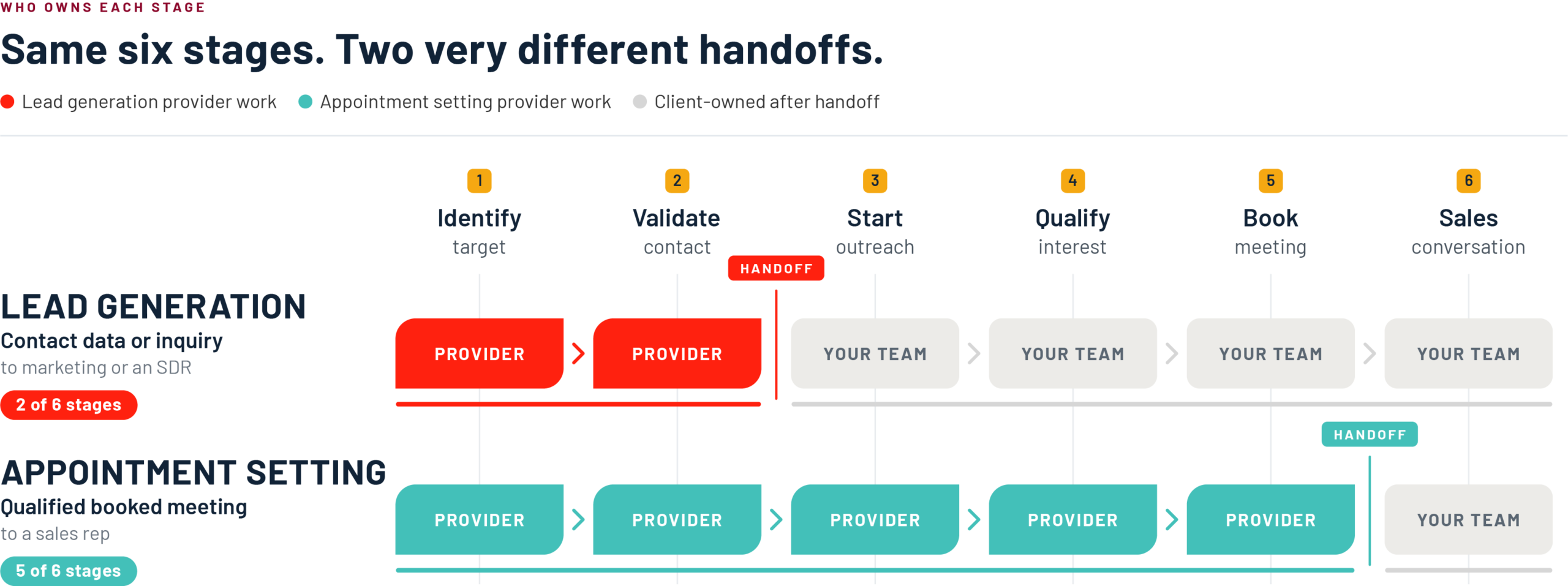
B2B lead generation works by moving a defined target market through a funnel: build the list, make contact, qualify interest, and book the meeting. Everything downstream of the meeting is sales. Everything upstream is lead gen. Here is the sequence we run.
1. Define the target market
You decide exactly who you are going after: industry, company size, geography, and the titles that hold the budget. This is where most programs quietly fail. Aim at “everyone” and you reach no one. We build a tight target list before a single dial goes out, so the effort lands on accounts that can actually buy.
2. Make contact
You reach those decision-makers where they actually are: by phone, email, LinkedIn, and direct mail. Multi-channel is not a buzzword here. It is how you get past a gatekeeper who ignores one channel and answers another.
3. Qualify the prospect
Not every conversation deserves your sales team’s time. Qualifying means confirming the prospect has the need, the budget, and the authority before you hand them off. A meeting that is not qualified is worse than no meeting, because it burns your closer’s calendar.
4. Book the meeting
The finish line for lead gen is a confirmed, calendared conversation between a qualified prospect and your salesperson. That handoff is the whole point.
5. Measure and tune
You watch dials, contact rate, pitch rate, and close rate, and you adjust. More on the numbers below, because this is where honest programs separate from the ones selling you activity. That funnel, target then contact then qualify then book, is the entire discipline. The channels change. The sequence does not.
Inbound vs. outbound: the two engines of B2B lead generation
There are two ways to generate B2B leads, and the best programs run both. Inbound pulls buyers toward you. Outbound goes out and gets them.
Inbound is the “they find you” motion. You publish content, rank in search, run ads, and show up at events, so a buyer who starts looking finds you waiting. Inbound compounds, since a page that ranks keeps working while you sleep. It is slow to build, and it only captures demand that already exists. If nobody is searching for your solution yet, inbound has nothing to catch.
Outbound is the “you find them” motion. You proactively reach decision-makers who have not raised their hand: cold calling, cold email, LinkedIn outreach, direct mail. Outbound stands up faster, works even when no one is searching, and lets you pick your accounts instead of taking whoever wanders in. The tradeoff is that it takes skilled, consistent effort, because you cannot automate your way to a good conversation. Our full breakdown lives on the outbound sales page.
My point of view is not the popular one. Outbound is more valuable now than it was five years ago, not less. AI flooded email and LinkedIn with automated garbage, and buyers have gone numb to it. That is exactly why a live, one-to-one phone conversation cuts through. It is the fastest path to a real meeting with a real decision-maker. Cold calling is not dead. The channels everyone assumed would kill the phone are the ones that made it valuable again.
Most healthy B2B lead gen programs blend both engines. Inbound builds long-term authority and lowers your cost per lead over time. Outbound gives you control and speed today. Forced to pick one to start, outbound gets you meetings this quarter and inbound pays off next year.
Where does appointment setting fit in B2B lead generation?
Appointment setting is the last and most important step of outbound lead generation, the part where interest becomes a booked meeting.
Think of it this way. Lead generation is the whole funnel. Appointment setting is the finish. An appointment setter, in B2B usually a Sales Development Rep or SDR, does the calling, handles the objections, qualifies the prospect, and puts a confirmed meeting on your closer’s calendar. Their entire job is producing qualified meetings. Nothing downstream, nothing distracting.
This is the piece most companies underestimate. Generating interest is one thing. Getting a busy decision-maker to commit a slot on their calendar is a specialized skill, and it is where amateur programs fall apart. That is the work we built our whole company around. For the full explanation, read the B2B appointment setting hub.
What does B2B lead generation cost, and what should you expect?
Here is the honest version, because most pages dodge it.
What it costs
Vendors price B2B lead generation one of three ways: per meeting, per SDR seat, or on a monthly retainer for a full program. What you pay depends on how hard your market is to reach, how senior the titles are, and how many channels you are running. A senior-decision-maker, multi-channel program costs more than blasting a cheap email list, and it is worth more, because the meetings are real. Do not accept paying for raw activity. A vendor who invoices you for email volume and LinkedIn connection requests is selling you a vanity metric. You are buying qualified meetings. Price the outcome, not the busywork.
The build-vs-buy math
Building in-house means salary, benefits, tools, data, management, and ramp time for every SDR, and SDR turnover is brutal. Outsourcing means you rent a team that is already built, already trained, and already dialing on day one. We staff it with backup built in, so a program does not go dark when someone is out. We break the full comparison down on our outsourced SDR services page.
What a real month looks like
A healthy B2B lead generation program books 5 to 10 new qualified meetings per client, per month. Not 50. When someone promises you fifty qualified meetings a month, they are either redefining “qualified” down to worthless or they do not understand your market. Five to ten genuinely qualified conversations with fit decision-makers, every month, is a pipeline that closes. Underneath that number is real volume. Ten meetings a month comes from hundreds of dials, not a clever trick. That is the tradeoff nobody advertises.
The timeline
Outbound produces meetings inside the first month or two once the list and messaging are dialed in. It takes a quarter or so to find the rhythm, the right list, the right pitch, the right cadence, and then it stabilizes. Inbound runs slower. Plan on six to twelve months before content and search meaningfully move. Anyone promising instant inbound results is selling you something. Anyone who cannot get you an outbound meeting in 60 days is not running enough volume.
What good looks like: the numbers that matter
Watch four numbers and ignore the noise. The B2B lead gen funnel runs dials, then contact rate, then pitch rate, then close rate. Dials measure effort. Contact rate tells you whether you are reaching humans. Pitch rate tells you whether the message lands. Close rate tells you whether the meetings were real. Watch contact rate and close rate hardest. Contact rate is the honest read on whether your outreach is working at the top, and close rate is the honest read on whether your “qualified” meetings were actually qualified.
Ignore one number above all: raw automated email and LinkedIn activity counts. “We sent 40,000 emails this month” tells you nothing about pipeline. It is the vanity metric vendors hide behind. Judge a program by meetings booked and deals closed, full stop.
You do not have to take the framework on faith. We run this same machine across commercial roofing, solar, commercial cleaning, concrete and paving, and dozens of other B2B industries. Different markets, one motion: target, contact, qualify, book, run at volume, measured on the metrics that matter.
Should you build B2B lead generation in-house or outsource it?
Build in-house if lead gen is a core competency you want to own, you have the budget to hire and manage a full team, and you can wait out the ramp. Outsource it if you need meetings now, you do not want to carry SDR turnover, or you want a proven system instead of building one from scratch.
Most companies that try to build it in-house underestimate three things: how hard SDRs are to hire and keep, how much management outbound actually demands, and how long it takes to get the list and messaging right. Outsourcing skips all three. You plug into a team already booking meetings across dozens of industries. The honest catch is that vendors are not equal, so choose carefully.
Whichever path you pick, the standard is the same: 5 to 10 qualified meetings a month, measured on contact rate and close rate, built on real volume. That is B2B lead generation done right.
Frequently Asked Questions
What is B2B lead generation in simple terms?
B2B lead generation is the process of finding the businesses you want as customers, reaching their decision-makers, and turning that interest into qualified sales meetings. It is how you fill your pipeline on purpose instead of waiting for buyers to find you. The goal is booked conversations your sales team can close, not leads for their own sake.
What is the difference between inbound and outbound lead generation?
Inbound pulls buyers toward you through content, search, and ads, so they reach out when they are ready. Outbound goes out and reaches decision-makers directly by phone, email, LinkedIn, and direct mail before they have raised their hand. Inbound compounds slowly and captures existing demand. Outbound stands up faster and lets you choose your accounts. Strong programs run both.
How many meetings should a B2B lead generation program produce?
A healthy program books 5 to 10 new qualified meetings per month. That means genuinely qualified conversations with fit decision-makers, not a big number of low-value “leads.” When a vendor promises dozens of qualified meetings a month, they are likely redefining “qualified” down to something worthless.
How much does B2B lead generation cost?
Vendors price it per meeting, per SDR seat, or as a monthly program retainer, and the cost depends on how hard your market is to reach and how senior the titles are. Pay for outcomes, meaning qualified meetings, not for activity like email volume or connection requests. Judge cost against pipeline created, not raw effort.
How long before B2B lead generation produces results?
Outbound typically produces meetings within the first month or two once the list and messaging are dialed in, and stabilizes after about a quarter. Inbound runs slower, usually six to twelve months before content and search meaningfully move the needle. Anyone promising instant inbound results, or who cannot book an outbound meeting inside 60 days, is a red flag.

Jeff Winters is the CEO of Abstrakt Marketing Group, a U.S.-based B2B lead generation and appointment-setting company that books qualified sales meetings for clients across the commercial trades, IT and managed services, manufacturing, and B2B services. He has spent his career building and running outbound sales programs at scale, and he breaks down what actually works in sales and lead generation on Abstrakt's podcast, The Grow Show.