

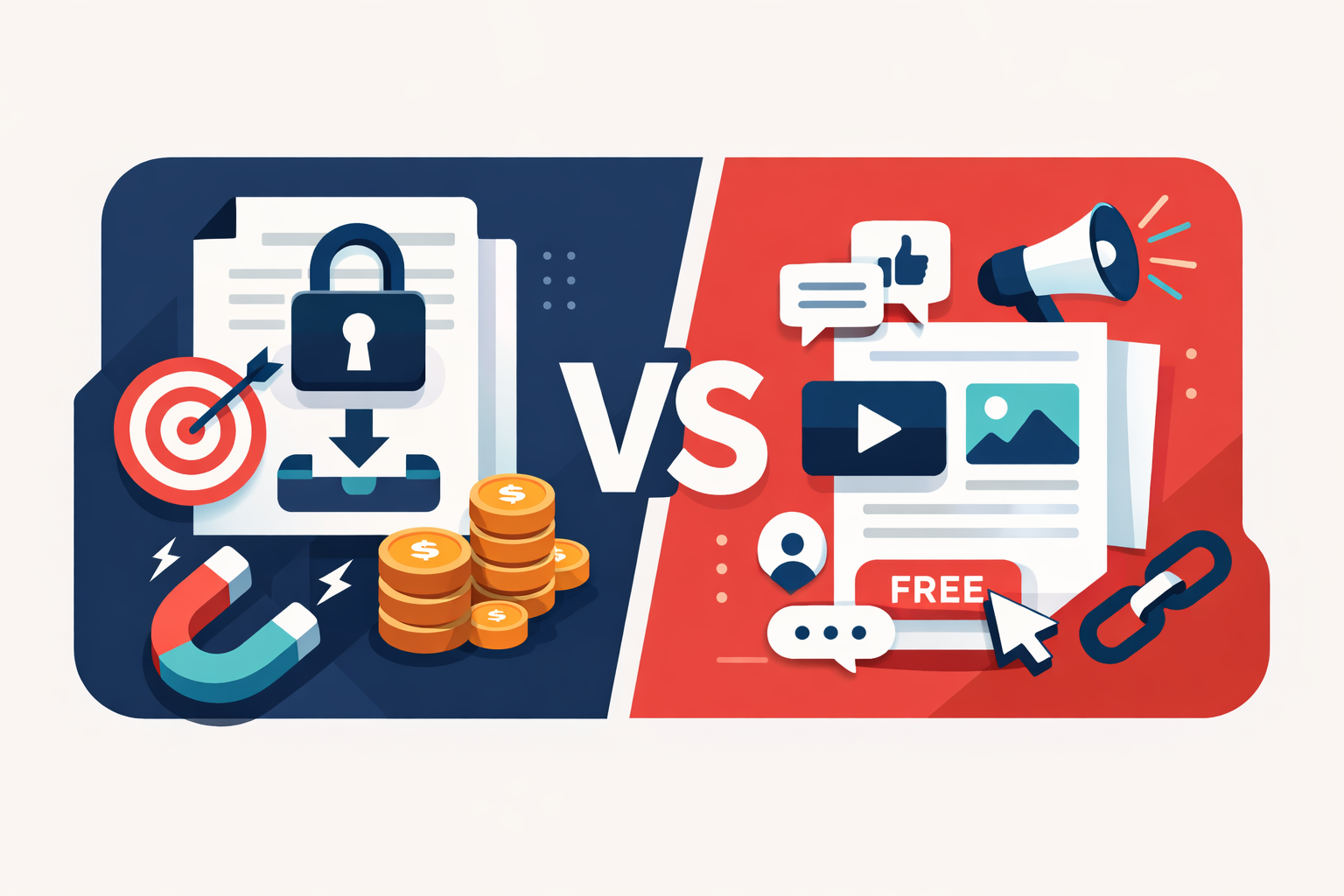
Every marketer eventually faces the same frustrating question: should you require an email address before someone can access your best content, or let everyone read it freely? The gated content versus ungated content debate has sparked countless arguments in marketing meetings, and honestly, both sides have legitimate points.
I’ve watched companies swing wildly between extremes. One B2B software firm I worked with gated everything, including blog posts, and watched their organic traffic crater by 60% over eight months. Another company went fully ungated and generated massive traffic but couldn’t identify a single qualified lead from their content efforts. Neither approach worked because neither understood the actual trade-offs involved.
The real question isn’t which strategy generates more leads. That’s too simplistic. The question is which approach generates more revenue-producing opportunities for your specific business model, sales cycle, and target audience. A SaaS company selling $50/month subscriptions needs volume. An enterprise software vendor with $200,000 deals needs precision. Same tactic, wildly different results.
What follows is a practical framework for making this decision based on what I’ve seen work across dozens of B2B organizations. No dogma, no one-size-fits-all answers, just the actual considerations that matter when you’re trying to build a pipeline that converts.
Defining the Gate: Core Differences in Content Strategy
Before arguing about which approach works better, we need to be precise about what we’re actually comparing. The mechanics matter more than most marketers realize.
The Mechanics of Gated Content for Lead Capture
Gated content places a form between your visitor and your content. Simple enough. But the execution varies dramatically. Some companies ask for just an email. Others request job title, company size, phone number, and buying timeline. That difference isn’t trivial: I’ve seen conversion rates swing from 45% to 8% based purely on form length.
The typical gated content stack includes landing page software like Unbounce ($90-200/month), form tools integrated with your CRM, and often enrichment services like Clearbit ($99-999/month) to fill in data gaps. The loaded cost of running a gated content program extends well beyond the content creation itself.
What you’re really doing is trading content access for contact information. The visitor makes a calculation: is this content worth giving up my email and potentially receiving sales outreach? Your conversion rate reflects their collective answer to that question.
The Role of Ungated Content in Brand Awareness
Ungated content removes all barriers. Anyone can read, share, and link to your work. The trade-off is obvious: you gain reach but lose direct lead capture.
But here’s what gets overlooked. Ungated content builds brand equity and trust in ways that gated content simply cannot. When someone reads five of your articles before ever filling out a form, they arrive warmer, more informed, and more likely to convert to a customer. The lead capture happens later, but the lead quality often improves.
The reach advantage compounds over time. Ungated content gets indexed, ranks in search, earns backlinks, and spreads through social sharing. Gated content does none of those things. You’re essentially choosing between immediate lead capture and long-term audience building.
Lead Generation Performance: Quality vs. Quantity
The volume versus quality debate sits at the heart of this decision. Raw lead counts mean nothing if those leads never convert to revenue.
Conversion Rates and the Friction Factor
Every form field adds friction. Every friction point reduces conversions. The math is predictable: a single-field form might convert at 30-40%, while a seven-field form drops to 5-15%. I’ve run enough A/B tests to know these ranges hold fairly consistently across industries.
But conversion rate alone misleads. A 40% conversion rate on a landing page that gets 100 visitors generates 40 leads. A 10% conversion rate on ungated content that reaches 10,000 people through organic search, then converts a fraction through site-wide CTAs, might generate 200 leads. The lower-converting approach produced five times the volume.
The friction factor also affects who converts. High-friction forms filter out casual browsers and leave you with more motivated prospects. Low-friction approaches capture everyone, including competitors doing research and students writing papers. Neither is inherently better: it depends on whether your sales team can handle volume or needs pre-qualification.
Assessing Lead Intent and Sales Readiness
Here’s where gated content advocates make their strongest argument. Someone who fills out a form to download your “Enterprise Security Buyer’s Guide” has demonstrated explicit interest. They’ve self-identified as potentially in-market. That signal has real value.
Ungated content provides weaker intent signals. You know someone read your article, maybe which pages they visited afterward, but you don’t know who they are unless they take a separate action. Tools like Clearbit Reveal can identify companies visiting your site, but individual-level identification requires the visitor to opt in somehow.
I’ve seen sales teams waste enormous time chasing gated content leads who were never serious buyers. The form completion felt like intent, but it was really just curiosity. Conversely, I’ve watched companies miss obvious buying signals from ungated content visitors because they had no mechanism to identify or follow up with them. The intent signal from gated content is valuable but imperfect.
The SEO and Reach Trade-off
This is where the long-term math starts to favor ungated content heavily, at least for certain business models.
Search Engine Indexing and Organic Visibility
Google can’t index what it can’t crawl. Gated content sits behind forms, invisible to search engines, generating zero organic traffic. Every piece of content you gate is content that will never rank, never compound, and never bring you traffic while you sleep.
The opportunity cost is substantial. A well-optimized ungated guide might generate 500-2,000 organic visitors monthly for years. At a conservative 1% conversion to email subscribers through embedded CTAs, that’s 60-240 leads annually from a single piece of content, with no ongoing promotion cost. Gated content requires constant paid promotion or email distribution to generate any traffic at all.
For companies playing the long game, this math is decisive. The 6-12 month investment period for SEO to compound feels painful, but the payoff dwarfs what most gated content programs achieve.
Social Sharing and Backlink Potential
Nobody shares gated content. Think about your own behavior: when did you last tweet a link that required your followers to fill out a form? It doesn’t happen. Gated content is essentially invisible to social sharing and word-of-mouth distribution.
Backlinks follow the same pattern. Other websites link to useful resources their readers can access. Gated content doesn’t qualify. Since backlinks remain a primary ranking factor, gating your best content creates a ceiling on your domain authority growth.
I worked with a company that ungated their most popular gated asset, a comprehensive industry benchmark report. Within six months, it had earned 47 backlinks from industry publications and ranked for 200+ keywords. The lead generation shifted from direct downloads to newsletter signups and demo requests from people who found the report through search. Total leads increased, and lead quality improved because visitors had actually read the content.
Strategic Framework for Content Gating Decisions
Rather than choosing one approach universally, smart marketers match their gating strategy to specific content and audience contexts.
Mapping Content to the Buyer’s Journey
Awareness-stage content should almost never be gated. Someone searching “what is account-based marketing” isn’t ready to talk to sales. Gating that content just ensures they’ll find the answer on a competitor’s site instead.
Consideration-stage content sits in the middle. Comparison guides, evaluation frameworks, and detailed how-to content can work either way depending on your traffic sources and sales capacity.
Decision-stage content is where gating makes the most sense. Pricing calculators, ROI tools, vendor comparison templates, and implementation guides attract people actively evaluating solutions. These visitors expect to provide information because they’re close to a purchase decision.
The buyer’s journey mapping isn’t just theoretical. I’ve seen companies double their qualified pipeline by simply ungating top-of-funnel content while maintaining gates on bottom-of-funnel assets.
High-Value Assets Worth the Gate
Some content genuinely deserves a gate because the perceived value justifies the exchange. Original research with proprietary data falls into this category. If you surveyed 500 CMOs about their budget allocations, that’s worth an email address.
Interactive tools and calculators work well gated. A custom ROI calculator that provides personalized outputs based on user inputs delivers enough value that form completion feels fair.
Templates and frameworks that save significant time can justify gates. A fully-built financial model or project plan template represents hours of work: trading an email for that makes sense to most visitors.
The test is simple: would you personally fill out a form to access this content? If the honest answer is no, don’t gate it.
The Hybrid Approach: Maximizing Conversions and Traffic
The best-performing content programs I’ve seen don’t choose between gated and ungated. They architect systems that capture the benefits of both.
The ‘Pillar and Cluster’ Model
Create comprehensive ungated pillar content that ranks and attracts organic traffic. Surround it with related gated assets that offer deeper value on specific subtopics. The pillar builds your audience; the clusters capture leads from that audience.
A pillar page on “B2B Lead Generation Strategy” might rank for dozens of keywords and attract 3,000 monthly visitors. Embedded within it are CTAs for gated assets: a lead scoring template, a channel comparison spreadsheet, and a budget planning calculator. The ungated content does the heavy lifting of audience building while the gated assets convert interested visitors.
This model also satisfies different visitor preferences. Some people want to browse freely. Others want to download something they can reference later. You’re serving both.
Semi-Gated Content and Soft CTAs
Semi-gating shows partial content freely, then gates the remainder. Show the first three chapters of your ebook, then require an email for the rest. This approach lets visitors evaluate quality before committing and typically converts at higher rates than fully-gated content.
Soft CTAs offer value exchanges without hard gates. “Get this article as a PDF” or “Subscribe for weekly insights like this” capture emails from interested readers without blocking access to the content itself. These convert at lower rates than hard gates but generate leads from content that would otherwise produce none.
Progressive profiling reduces friction over time. First visit, ask for email only. Second download, ask for company name. Third interaction, ask for phone number. Tools like HubSpot and Marketo handle this automatically, and I’ve seen it improve both conversion rates and data quality.
Measuring Success Beyond Total Lead Count
If you’re still measuring content performance by total leads generated, you’re optimizing for the wrong metric.
The metrics that actually matter connect content to revenue. Track leads to opportunities, opportunities to closed deals, and closed deals back to originating content. A piece of content that generates 50 leads and zero customers is worthless compared to content that generates 10 leads and three customers.
Cost per lead matters, but cost per opportunity matters more. I’ve seen gated content programs generate $15 CPLs that converted to opportunities at 2%, yielding a $750 cost per opportunity. Meanwhile, ungated content with soft CTAs generated $40 CPLs that converted at 15%, yielding a $267 cost per opportunity. The “expensive” leads were actually cheaper when measured correctly.
Time-to-close and deal size also vary by content source. Leads from comprehensive ungated content often close faster because they arrive educated. Leads from gated content sometimes require more nurturing because they downloaded something without fully engaging with it.
The right measurement framework depends on your sales cycle and deal size. Enterprise B2B companies with 6-month sales cycles need to track influenced pipeline, not just lead source. SMB-focused companies with shorter cycles can measure more directly.
For companies looking to build a lead generation engine that balances volume with quality, working with specialists often accelerates results. Abstrakt Marketing Group focuses specifically on B2B lead generation and can help you architect a content strategy that matches your sales capacity and revenue goals. Learn more about how their approach might fit your pipeline needs.
The gated versus ungated debate ultimately resolves into a more nuanced question: what combination of approaches, for which content types, at which funnel stages, produces the most revenue-generating opportunities your sales team can actually work? Answer that, and the tactics follow naturally.