

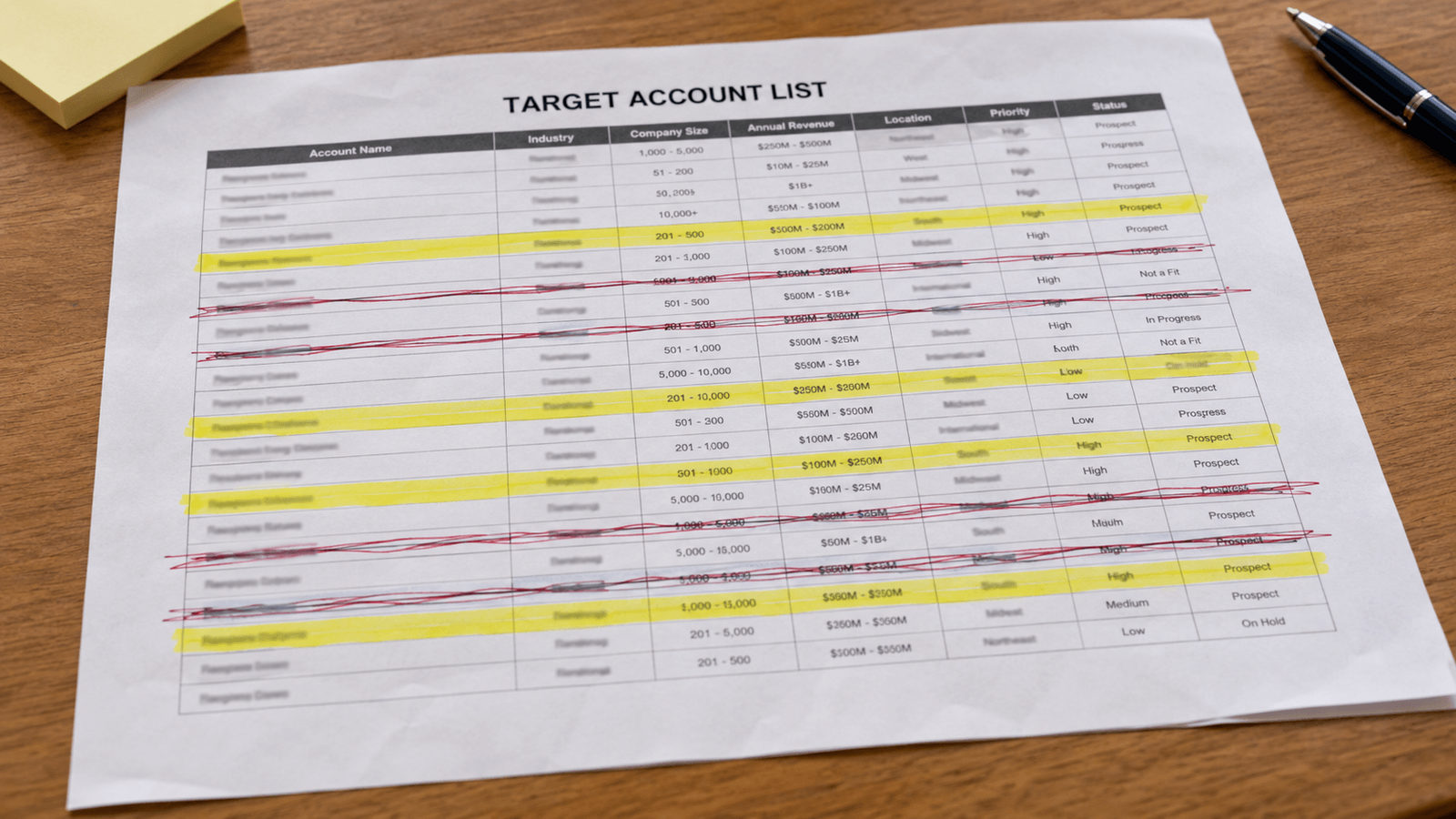
The list is the strategy, and a disciplined 400 right-fit accounts will beat 4,000 scraped maybes every single time.
B2B prospecting is the work of deciding who you’re going to sell to before you ever try to sell to them: defining your ideal customer, sourcing the specific accounts that match, ranking them by fit, and finding the real decision-maker inside each one. It’s the targeting front of outbound. Get it right and every call, email, and touch after it has a fighting chance. Get it wrong and you can run a flawless outbound motion straight into the ground, because you aimed it at the wrong companies.
I run this every day. At Abstrakt we book more than 100,000 qualified appointments a year for over 2,000 active clients, and we build our target lists off 125 million records. So here is the part almost nobody gives enough attention to: the list is the strategy. A disciplined list of 400 right-fit accounts beats a bloated list of 4,000 maybes every single time, and this page shows you how to build the first kind. We will cover defining an ICP, sourcing and prioritizing accounts, tiering the list, finding the right people inside each account, and the multi-channel motion you use to actually work it.
What is B2B outbound prospecting?
B2B outbound prospecting is the process of proactively identifying and researching target accounts and decision-makers before outreach begins, so that when your reps pick up the phone or send the email, they’re talking to companies that genuinely fit what you sell. It’s the front half of outbound sales. Outbound is the whole motion of reaching buyers who haven’t raised their hand. Prospecting is the discipline that decides which buyers are worth reaching in the first place.
People collapse the two, and that’s the first mistake. “Prospecting” gets treated as a synonym for cold calling or sending emails. It’s neither. Those are the outreach steps. Prospecting is everything that happens before them: the ICP, the account sourcing, the tiering, the org-chart research. Your outreach is only as good as that groundwork. You can hire the best SDRs alive, and if they’re dialing the wrong 600 companies, they will produce nothing but polite rejections.
Volume aimed at the wrong accounts is the most expensive mistake in outbound
Here is my contrarian take, and it’s the thesis of this whole page: more activity isn’t the goal, and a bigger list isn’t progress. The instinct in outbound is to widen the net. Load 10,000 contacts, blast them, and let the law of large numbers do the work. It feels productive. It’s the most expensive mistake a B2B team can make.
Every dial, every email, every rep-hour you spend on a bad-fit account is capacity you can’t spend on a good-fit one. Point a high-volume machine at the wrong market and you get worse than zero, because you have burned your reps’ time and taught them the phone doesn’t work. The phone works fine. You were calling the wrong people.
I would rather run a program against 400 accounts we have genuinely qualified for fit than 4,000 names somebody scraped. The narrower list earns a higher contact rate, a higher pitch rate, and a dramatically higher close rate, because the conversations are relevant. Discipline at the list stage is the highest-impact decision in the entire funnel. Everything downstream is execution on the target you already chose.
Step one: define your ICP (ideal customer profile)
Your ideal customer profile is a precise description of the companies that get the most value from what you sell and give you the most value back. You define it with firmographics, not gut feel: industry, company size, revenue band, geography, tech stack, business model, and any trigger that signals a company is in the market. If your ICP is “any B2B company that could use our product,” you don’t have an ICP. You have a wish.
Build it from evidence, not aspiration. Look at your best existing customers, the ones who close fast, stay long, expand their spend, and never drain your support team, and find what they have in common. That pattern is your ICP. Then write down the negative profile too: the accounts that look tempting but consistently churn, haggle, or never close. Knowing who to exclude is half the value of an ICP.
We serve 100+ B2B industries, so we have built ICPs across an enormous range, from commercial roofing and facility services to solar, HVAC, concrete and paving, fire protection, and SaaS. The exact firmographics change wildly by industry. The method never does. Start from who already succeeds with you, describe them precisely, and treat that description as the gate every account has to clear before it earns a spot on the list.
Step two: source and prioritize the accounts
Once you know who fits, you source the specific companies that match the profile and rank them, instead of dumping everything that technically qualifies into one pile. Sourcing is where data depth matters. We build target markets off 125 million records, which lets us hold a client’s ICP up against a very large universe and pull out the accounts that actually match on the criteria that count, instead of guessing from a thin list.
Precision is the point, not raw volume of data. Those 125 million records earn their keep because they let us be selective. A first pull off that database is a hypothesis: these are the companies that match on paper. The prioritization is where the strategy lives. Which of these matching accounts have a trigger event, a new location, a leadership change, a growth signal, a compliance deadline, that makes now the right time? Which sit in a geography your reps can actually serve? Which look most like the customers you already close?
You rank accounts on two axes: fit, meaning how well they match the ICP, and timing, meaning how likely they’re to move soon. An account that’s a perfect fit with a live trigger goes to the top. A perfect fit with no signal goes in the nurture pile. A weak fit goes nowhere, no matter how big the logo. This is where a real prospecting strategy separates itself from a spray-and-pray list. You’re not working accounts in the order they came out of a database. You’re working them in the order most likely to convert.
Step three: tier the list
Tiering is how you match effort to opportunity. You sort your target accounts into tiers and spend the most human energy on the accounts most worth winning. Not every account deserves the same motion. Treating a 12-touch, phone-led, multi-channel sequence and a light email nurture as the same investment is how teams waste their best rep-hours on their worst-fit prospects. Here is a simple three-tier structure that works.
Tier A: high fit, high value, strong signal
These are your best accounts, and they get the full multi-channel treatment: personalized research, the phone doing the heavy lifting, direct mail, and a named plan for each one. A small number of these is worth more than a hundred cold names.
Tier B: solid fit, good value, some signal
These make up the bulk of a healthy list. They get a consistent multi-channel sequence with lighter personalization and more repeatable messaging.
Tier C: fits the profile, lower value or no timing signal
You keep these warm with efficient, mostly automated touches until a signal moves them up. You don’t ignore them. You just don’t spend Tier-A energy on them.
The tiers aren’t permanent. An account moves up the instant a trigger fires. A Tier-C company that just opened a second location and hired a new VP might jump to Tier A tomorrow. Tiering is a living system for pointing your best effort at your best odds. For the broader playbook of how these targeting decisions plug into a full program, see our guide to b2b lead generation strategies.
Step four: find the right decision-maker
A perfect account is worthless if you’re talking to the wrong person inside it. Prospecting is only finished when you have named the human who can actually say yes, plus the one or two people around them who influence the decision. Naming the company isn’t enough. Getting routed to the wrong contact is one of the quietest killers of outbound, because the call feels like it went fine right up until nothing happens.
So map the org chart before you dial. Who owns the problem you solve? Who controls the budget? Who feels the pain day to day and will champion you internally? In a lot of B2B deals these are three different people, and a good prospecting process identifies all of them, then decides who to lead with. Sometimes you go straight to the economic buyer. Sometimes you start with the person living the problem and let them pull you up the chain. Either way, you make that call deliberately, instead of reaching out to whoever’s email you happened to find first.
This is also where the phone earns its keep. A live conversation is the fastest way to confirm you have the right person, and to get referred to the right one when you don’t. You can’t do that over a one-way email blast. I cover the reasons in our breakdown of what is cold calling.
Step five: work the list with a multi-channel motion
Now, and only now, you run outreach. You work a well-built list across cold calling, email, LinkedIn, and direct mail at once, so a decision-maker who ignores one channel still hears you on another. No single channel is enough anymore. The channels aren’t equal, though, and the sequence matters.
The phone does the heavy lifting. AI has flooded email inboxes and LinkedIn feeds with automated, personalized-looking noise, and buyers have learned to tune all of it out. A live one-to-one phone conversation cuts straight through that. It’s the fastest path to a qualified meeting with a real decision-maker, and our contact rates have held steady for years while everyone else swears the phone died. It didn’t. On every client program we hold a floor of roughly 600 dials a month for exactly this reason. Email and LinkedIn play support, staying visible between calls, warming an account, and delivering something a prospect asked for. Direct mail stays quietly effective on Tier-A accounts precisely because so few people bother with it anymore.
The staffing behind this is deliberate too. Each of our SDRs runs four client programs and sits on a pod of ten reps, with an eleventh rep on standby to cover any account running short, so a client’s outreach never stalls because one person is out. A great list only converts if you work it consistently, week after week, and that’s a structure problem as much as a strategy one.
The short version
B2B prospecting is choosing who to sell to before you sell. You define an ICP from your best real customers. You source matching accounts, which we do off 125 million records, and prioritize them by fit and timing instead of working them in random order. You tier the list so your best effort lands on your best odds. You find the actual decision-maker inside each account, not just the company. Then you work it across cold calling, email, LinkedIn, and direct mail, with the phone leading. Do the list right and everything downstream gets easier. Skip it and no amount of volume will save you.
If you would rather have the list built and worked for you, that’s the core of what we do in b2b appointment setting.
Frequently Asked Questions
What is B2B outbound prospecting?
B2B outbound prospecting is the process of identifying, researching, and prioritizing target accounts and decision-makers before any outreach begins. It’s the targeting front of outbound sales: defining your ideal customer, sourcing companies that match, ranking them, and finding the right person inside each. The outreach that follows is only as good as this groundwork.
How do you build a B2B target list that actually converts?
Start with a precise ICP built from your best existing customers, then source accounts that match it, prioritize them by fit and timing, and tier them so your best effort goes to your best-fit accounts. Finally, identify the specific decision-maker inside each account before you reach out. A disciplined list of right-fit accounts converts far better than a bigger list of maybes.
What is an ICP in B2B prospecting?
An ICP, or ideal customer profile, is a precise description of the companies that get the most value from what you sell and are the most valuable for you to win, defined by firmographics like industry, size, revenue, geography, and buying triggers. Build it from the patterns in your best current customers, and define who to exclude as clearly as who to include. If your ICP is “any company that could use us,” it’s not an ICP.
Is a bigger prospecting list better?
No. A bigger list is usually worse. Every dial and email you spend on a bad-fit account is capacity you can’t spend on a good-fit one, so volume aimed at the wrong market produces worse-than-zero results and burns out your reps. A narrower, well-qualified list earns higher contact, pitch, and close rates because the conversations are relevant.
How do you find the right decision-maker in an account?
Map the org chart before you reach out. Identify who owns the problem you solve, who controls the budget, and who feels the pain day to day and could champion you internally. In many B2B deals these are different people, so decide deliberately who to lead with. The phone is the fastest way to confirm you have the right person or get referred to them.

Jeff Winters is the CEO of Abstrakt Marketing Group, a U.S.-based B2B lead generation and appointment-setting company that books qualified sales meetings for clients across the commercial trades, IT and managed services, manufacturing, and B2B services. He has spent his career building and running outbound sales programs at scale, and he breaks down what actually works in sales and lead generation on Abstrakt's podcast, The Grow Show.