
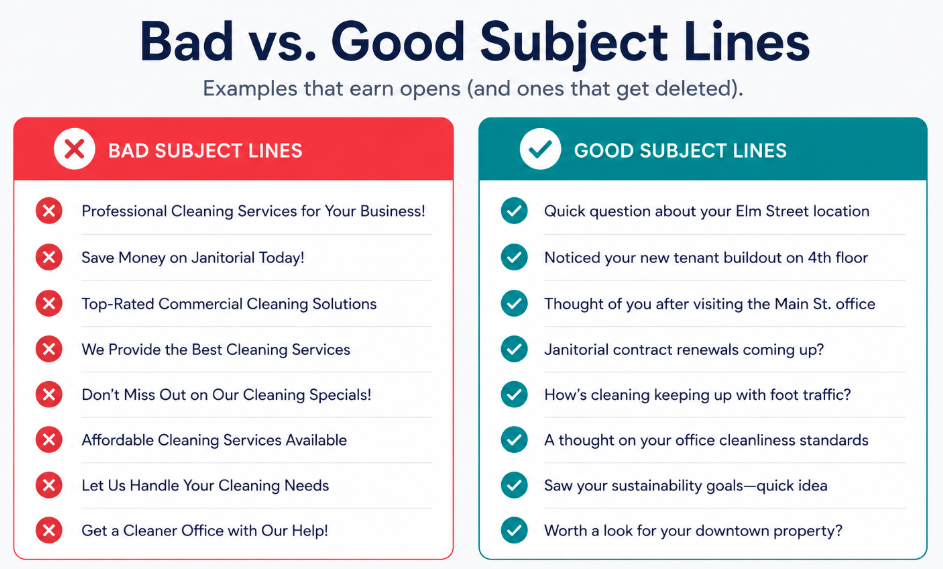
Your cold email to a facility manager has about two seconds to earn an open. That’s it. Two seconds between “this looks relevant” and the trash icon. I’ve watched commercial cleaning companies burn through thousands of prospect emails with subject lines that read like spam filters wrote them: “Professional Cleaning Services for Your Business!” or “Save Money on Janitorial Today!” These get deleted on autopilot. The companies that actually fill their sales pipeline through email outreach are doing something fundamentally different. They’re writing subject lines that sound like they came from a real person who knows something specific about the recipient’s building, industry, or pain point. If you’re trying to generate commercial cleaning leads through cold email, the subject line isn’t just a detail: it’s the entire ballgame. Here’s what actually works in 2026, based on real outreach data and patterns I’ve seen across dozens of cleaning companies.
The Psychology of High-Performing Cleaning Service Subject Lines
Before looking at specific templates, it’s worth understanding why certain subject lines trigger opens while others get ignored. Facility managers and office administrators receive an average of 121 emails per day, according to recent workplace productivity studies. Your cleaning service pitch lands alongside vendor invoices, maintenance requests, HR updates, and messages from their own boss. You’re not competing against other cleaning companies: you’re competing against everything in their inbox.
The subject lines that consistently perform well share three psychological traits. First, they create a small information gap: the reader knows enough to be curious but not enough to dismiss the email without opening it. Second, they signal relevance through specificity, whether that’s a building name, a neighborhood, or an industry-specific concern. Third, they feel human. No ALL CAPS, no exclamation points, no phrases that scream “mass email blast.”
One pattern I’ve noticed separates top-performing cleaning outreach from the rest: the best subject lines read like something a colleague might send, not something a salesperson would write. “Quick question about your Elm Street location” feels like an internal message. “Premium Cleaning Solutions for Your Business” feels like a billboard.
Optimizing Open Rates for Cleaning Service Sales Emails
Open rates for cleaning service sales emails vary wildly depending on your approach. Industry benchmarks for B2B cold email hover around 20-25% open rates, but I’ve seen commercial cleaning companies hit 40-55% with well-crafted subject lines and properly warmed sending domains. The gap between average and excellent is enormous, and it almost always comes down to the subject line and sender reputation.
A few technical factors matter here. Your sending domain needs proper SPF, DKIM, and DMARC authentication. If you’re sending from a brand-new domain, warm it up over 2-4 weeks by gradually increasing volume. Tools like Instantly or Smartlead (both in the $30-97/month range) handle this automatically. Without proper domain health, even the best subject line lands in spam.
On the content side, keep subject lines between 4-9 words. Mailchimp’s data consistently shows that shorter subject lines outperform longer ones, and this holds true for cold outreach as well. Personalization tokens like the recipient’s first name or company name can boost open rates by 10-15%, but only when they feel natural. “John, quick question about your building” works. “John, Are You Looking for Commercial Cleaning Services?” does not.
Track your open rates by subject line variant, not just by campaign. If you’re sending 500 emails with the same subject line, you’re missing the chance to learn what resonates. Split your list into groups of 50-100 and test different approaches against each other. After 2-3 weeks, you’ll have real data about what your specific market responds to.
Balancing Professionalism with Urgency and Curiosity
There’s a tension in cold email subject lines between sounding professional enough to be taken seriously and creating enough curiosity to earn the open. Lean too far toward professional, and you sound like every other vendor. Lean too far toward curiosity, and you sound like clickbait.
The sweet spot for commercial cleaning outreach sits closer to casual professionalism. Think about how you’d email someone you met at a local business networking event: friendly, direct, and specific. You wouldn’t write “Regarding Potential Synergies in Facility Maintenance.” You’d write something like “Good running into you – had a thought about your office.”
Urgency works, but only when it’s genuine. “Your current cleaning contract is expiring” only works if you actually know their contract timing (some companies track this through public bid records or industry contacts). Fake urgency destroys trust. Curiosity, on the other hand, is almost always available to you. Referencing something specific about their building, mentioning a relevant local event, or asking a genuine question all create natural curiosity without manipulation.
One approach that threads this needle well: lead with a specific observation. “Noticed your new tenant buildout on 4th floor” tells the reader you’ve done your homework. It’s professional because it’s informed, and it’s curiosity-inducing because they want to know what you noticed and why it matters.
Personalized B2B Subject Lines for Office Cleaning
Generic subject lines produce generic results. The single biggest factor separating high-performing cold email subject lines for commercial cleaning from low-performing ones is personalization, and I don’t mean just inserting a first name token. Real personalization means your subject line could only apply to that specific recipient or building.
Here’s the math that makes this worthwhile. Sending 1,000 generic emails with a 15% open rate and 2% reply rate gives you 3 conversations. Sending 200 highly personalized emails with a 45% open rate and 8% reply rate gives you 7 conversations. Half the volume, more than double the results. The time you spend researching each prospect pays for itself many times over.
Personalized B2B subject lines for office cleaning work because they signal effort. When a facility manager sees a subject line that references their specific building or a challenge unique to their industry, they recognize that someone took time to understand their situation. That alone differentiates you from the 90% of cleaning companies blasting templated pitches.
Leveraging Local Relevance and Specific Building Details
Local details are your secret weapon. Most commercial cleaning companies operate within a defined service radius, which means you can reference neighborhoods, landmarks, business districts, and local events that immediately signal “I’m nearby and I know your area.”
Here are subject line frameworks that use local relevance effectively:
- “Cleaning for [specific building name or address] – quick question”
- “Saw the renovation at [street name] – congrats”
- “[City/neighborhood] property managers are switching to green cleaning”
- “Your [street name] building vs. the one next door”
- “After the [local event/weather event], how’s your building holding up?”
The building-specific approach requires some research, but it’s not as time-consuming as you’d think. Google Maps, property management directories, and local business journals give you plenty of material. Spend 3-5 minutes per prospect looking at their building’s age, recent tenant changes, or any visible maintenance issues from Google Street View. That small investment transforms your subject line from forgettable to compelling.
I’ve seen a cleaning company in Denver increase their reply rate from 3% to 11% simply by referencing the specific business park or office complex in each subject line. The emails were otherwise identical. The subject line personalization alone tripled their response rate.
Addressing Industry-Specific Pain Points in the Subject Line
Different industries have different cleaning concerns, and acknowledging this in your subject line shows you understand the prospect’s world. A medical office worries about infection control and compliance. A law firm cares about after-hours discretion and protecting confidential documents. A manufacturing facility needs industrial-grade floor care. A coworking space deals with high-traffic common areas and inconsistent usage patterns.
Subject lines that reference these specific pain points outperform generic alternatives by a wide margin:
- For medical offices: “OSHA-compliant cleaning for [practice name] – 2 min read”
- For law firms: “After-hours cleaning with security protocols for [firm name]”
- For tech companies: “Keeping [company name]’s server room dust-free”
- For restaurants with office space: “Front-of-house vs. back-office cleaning at [business name]”
- For schools or daycares: “Flu season prep for [facility name] – quick thought”
The key is matching the pain point to the industry without being presumptuous. You’re not saying “I know you have a problem.” You’re signaling “I understand your world.” That distinction matters. Facility managers respond to vendors who demonstrate industry knowledge because it reduces the risk of hiring someone who doesn’t understand their specific requirements.
Research the prospect’s industry for 60 seconds before writing their subject line. Check their website, look at any compliance requirements their industry faces, and reference something that shows you get it. This small effort puts you ahead of 95% of cold outreach they receive.

Jeff Winters
Jeff Winters is the Chief Executive Officer (CEO) of Abstrakt and former CEO of Sapper Consulting, acquired by Abstrakt in 2021. A seasoned entrepreneur, Jeff founded Sapper in 2013 and led it to a successful acquisition. With expertise in sales and revenue growth, he drives strategies that deliver results. As co-host of The Grow Show, Jeff shares practical insights and real stories from experienced leaders to help entrepreneurs grow. Tune in weekly on Spotify, Apple Podcasts, and more!
Jeff Winters
Jeff Winters is the Chief Executive Officer (CEO) of Abstrakt and former CEO of Sapper Consulting, acquired by Abstrakt in 2021. A seasoned entrepreneur, Jeff founded Sapper in 2013 and led it to a successful acquisition. With expertise in sales and revenue growth, he drives strategies that deliver results. As co-host of The Grow Show, Jeff shares practical insights and real stories from experienced leaders to help entrepreneurs grow. Tune in weekly on Spotify, Apple Podcasts, and more!