

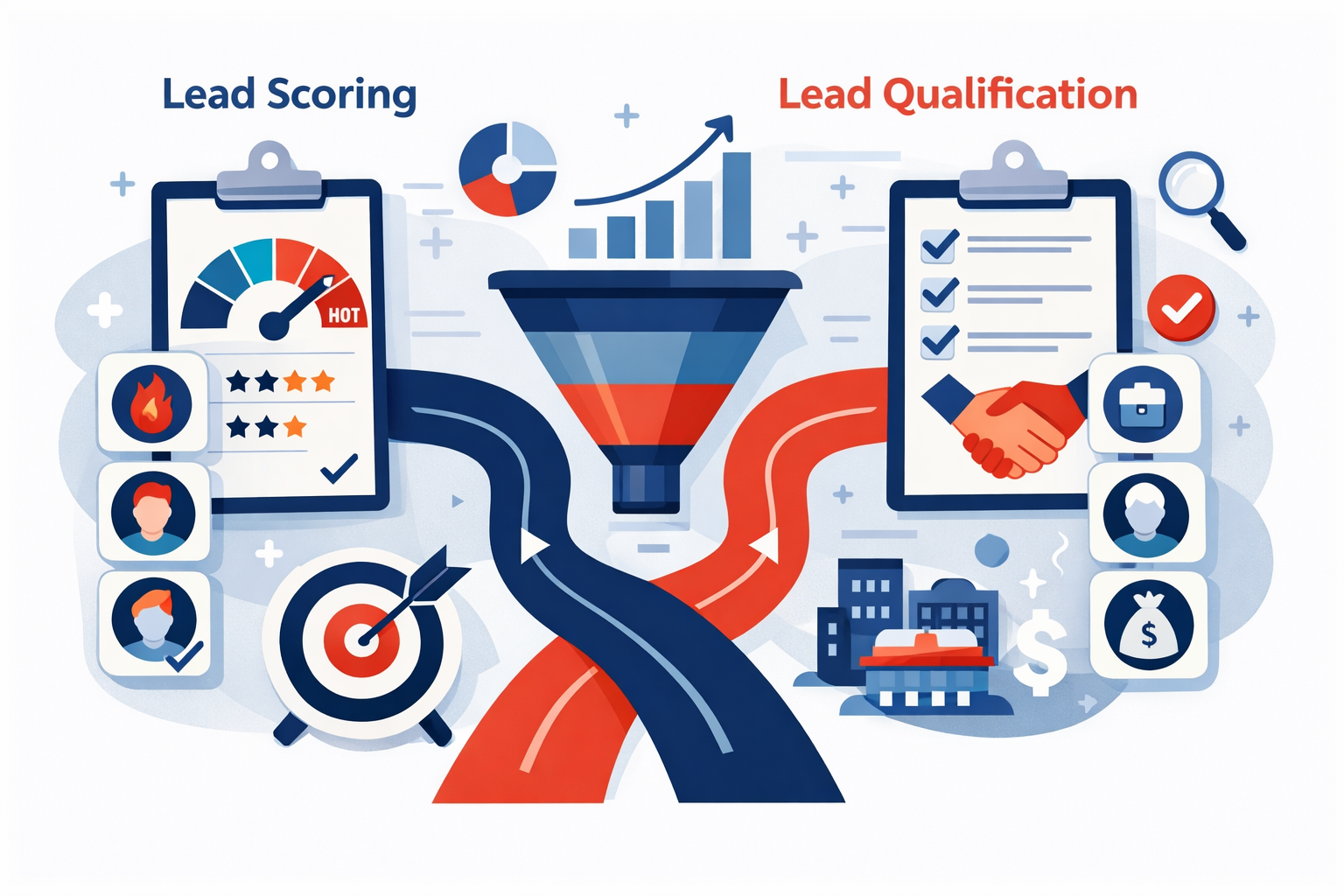
Identifying the right prospects can be a real game changer. When your sales and marketing teams align around data and intelligent insights, you empower your business to achieve more efficient conversion rates. In this article, we’ll unpack the nuanced differences between lead scoring and lead qualification, explore why they matter, and reveal how leveraging both intelligently can revolutionize your pipeline.
Both methods serve as the backbone of effective lead management, yet the strategies vary widely. Let’s break down the essentials, compare their benefits, and look at how companies can overcome real-world challenges through personalization and precision.
A Closer Look at Lead Scoring
Lead scoring is all about assigning values to potential customers based on their behavior, demographic information, and engagement history. This systematic method aims to sift through a sea of leads to highlight those with the highest probability to convert.

When done right, lead scoring transforms raw data into actionable insights. The idea is to allocate resources efficiently, ensuring sales teams are talking to prospects who are already showing buying signals.
The Fundamentals of Lead Scoring
At its core, lead scoring involves a series of steps that assess both explicit customer data-such as job role or industry-and implicit behavioral signals like website visits and email interactions. By combining these dimensions, companies gain a 360-degree view of a lead’s intent.
This structured approach enables teams to create more targeted outreach strategies. For example, a lead that repeatedly visits product pages or downloads white papers accumulates points that indicate high interest. It’s no wonder that companies which get lead scoring right see up to 192% higher lead qualification rates than those that rely solely on intuition.
Building an Effective Lead Scoring Model
Creating a robust lead scoring system isn’t a one-size-fits-all endeavor. It involves continuous refinement and data-driven insights. Start by setting clear criteria based on your ideal customer profile. What behaviors or demographic markers hint at imminent purchases? Then, assign weights to these markers. Consider factors like website activity and content engagement alongside more traditional metrics.
For instance, companies using behavior-based scoring see up to a 42% higher Sales Qualified Lead (SQL) to opportunity rate. This clearly indicates that a lead scoring system which factors both static and dynamic inputs can dramatically improve qualification accuracy.
Real-World Impact of AI-Integrated Lead Scoring
The integration of AI into lead scoring mechanisms is turning heads. AI-powered lead scoring models have delivered a striking average increase in conversion rates between 25-30%. For many companies, this represents not only improved efficiency but also a robust 138% ROI improvement over traditional methods.
Although implementing an AI-powered solution might appear daunting initially, the payoff is worth the innovation. With AI, systems continuously learn from new data, adapting in real-time to shifting market conditions and buyer behaviors, ensuring that scoring remains both relevant and effective.
Understanding Lead Qualification
While lead scoring is about quantifying potential, lead qualification takes a deeper dive into evaluating whether a lead meets the criteria for a sales-ready opportunity. It’s a multi-step process that filters out noise and ensures that what lands on your sales team’s desk is worth pursuing.
Qualified leads bring clarity and precision to your sales process. By focusing on quality over quantity, you save time, reduce costs and, ultimately, boost your bottom line.
The Multi-Dimensional Nature of Lead Qualification
Lead qualification involves more than just checking boxes. It requires that sales and marketing professionals understand the underlying intent, challenges, and budget considerations of a potential customer. The goal is to avoid chasing unqualified leads, a mistake that can waste up to 33% of a sales team’s time and cost over $1 million annually when scaled, according to AgentiveAIQ.
Organizations need to merge qualitative insights with quantitative data. This means that while lead scoring provides initial insights into engagement levels, lead qualification digs deeper into contextual factors and intent.
Key Steps in the Lead Qualification Process
The lead qualification process generally unfolds in several key stages. First, an initial screening identifies leads that meet basic criteria. This is followed by a more detailed evaluation where specific questions are asked about needs, budget, decision-making power, and urgency. Finally, the lead is either progressed to sales or handed off for further nurturing.
This robust process ensures that your teams are confident in the quality of each lead. As Marcus Andrews from HubSpot notes, the solution isn’t about making compromises between marketing and sales; it’s about using an intelligent data strategy to serve both sides.
The Role of Behavior and Engagement in Qualification
A dynamic factor in lead qualification is understanding customer behavior. While 80% of leads might be categorized as Marketing Qualified Leads (MQLs), only a fraction progress to being sales-ready. This gap highlights the importance of qualifying those leads effectively using behavior-driven assessments.
Using behavior-based criteria, such as content downloads, time spent on key pages, and specific product interactions, provides a clearer picture of a prospect’s interest. Companies that adjust their strategies based on behavior see more efficient conversion funnels.
Bridging the Gap Between Lead Scoring and Qualification
Rather than viewing lead scoring and lead qualification as separate processes, consider them parts of an integrated strategy. The synergy between the two can transform raw inquiries into mature sales opportunities.
This integrated approach nurtures leads from awareness to consideration, ensuring that each stage receives the appropriate attention. By aligning strategies, your marketing and sales teams can work in tandem to maximize conversion rates and return on investment.
Integrating Data-Driven Approaches for Cohesion
The key is to build a feedback loop between your lead scoring system and your lead qualification process. When a lead is scored highly, the qualification process digs deeper to confirm readiness for sales engagement. This alignment minimizes the risk of overlooking promising prospects while filtering out lesser leads.
Systems that combine data analytics with real-time adjustments ensure that both scoring and qualification methodologies remain in sync. Such integration leads to smarter outreach strategies and more effective targeting.
Challenges in Synchronizing Sales and Marketing
One of the long-standing issues in many organizations is the disconnect between marketing and sales. Marketing teams often aim for volume, generating numerous leads, while sales teams desire quality and intent. The clash is not a matter of compromise but one of coordination.
This misalignment often results in wasted resources. Optimizing collaboration begins with establishing agreed-upon definitions of what constitutes a qualified lead. When both teams work from the same playbook, efficiency rises dramatically.
Technology as the Great Equalizer
Modern CRM systems and marketing automation platforms play a pivotal role here. They provide a centralized database where every touchpoint is recorded and analyzed. With the right tools in place, sales and marketing can work with transparency and efficiency.
Features like automated lead routing, triggered follow-ups, and dynamic scoring algorithms ensure that no promising lead is left behind. Companies that invest in technology tend to see greater productivity and smoother handoffs between teams.
Practical Examples and Strategies for Implementing These Systems
Adopting both lead scoring and lead qualification is a strategic move requiring careful planning and regular evaluation. Here, we outline practical steps and share actionable tips to design a seamless process that bridges the gap between marketing and sales.

From establishing clear metrics to leveraging modern technology, the process begins with understanding your unique business requirements and continues with fine-tuning and evolution.
Step 1: Define Your Ideal Customer Profile
Start by identifying the characteristics of your best customers. This demographic and behavioral profile serves as the foundation for both your scoring and qualification systems.
Ask critical questions like: What industries are they in? What problems are they looking to solve? What is the typical buying cycle? Clear definitions help ensure that both systems are aligned on the same targets.
Step 2: Create a Layered Scoring System
The next step is building a scoring mechanism that integrates multiple data points. Include both explicit information such as job title, company size, and industry alongside implicit factors like website interactions and email engagement.
By calibrating weights to these data points, you create a scale that distinguishes between a casually interested lead and one with serious intent. Many organizations are turning to AI solutions, which have been reported to yield over a 25-30% boost in conversion rates. This approach not only streamlines the process but also provides ongoing adjustments based on real-world results.
Step 3: Implement a Rigorous Qualification Process
Once leads are scored, it’s crucial to validate them through a robust qualification process. This should include both automated methods and personal interactions where needed. Automation can handle initial screenings, while a follow-up call or detailed questionnaire can reveal more nuanced intent.
This dual approach ensures that only the most promising leads reach your sales team. It also helps in pinpointing areas where your marketing strategy might need further refinement.
Step 4: Leverage Technology for Integration
Modern CRM tools are designed not just for storing contacts but also for actively managing their journey. These platforms can automate lead routing based on scoring and qualification status, ensuring no lead falls through the cracks.
Integrating your marketing automation system with CRM helps maintain consistency in data collection and eliminates the need for repetitive manual entries. This automation creates a smooth transition from lead generation to qualification and, ultimately, conversion.
Step 5: Monitor, Analyze, and Refine
The final step is ongoing monitoring and analysis. Regular reviews of your scoring and qualification metrics can point out patterns, successes, and areas needing improvement.
Invest in analytics tools that provide you with comprehensive insights into lead behavior, conversion rates, and overall ROI. With such insights, your teams remain agile, capable of adapting strategies based on data rather than assumptions.
Why Personalization Is Key in Overcoming Today’s Barriers
The modern business landscape is defined by complexity and rapid change. Personalized outreach is not just a nice-to-have but a necessity. A tailored approach helps in overcoming barriers such as unpredictable customer behavior and diverse market conditions.
Personalization in both lead scoring and qualification means aggregating data that dynamically adapts to each prospect’s journey. It transforms each interaction into a step closer to closing the sale.
Adapting Your Messaging to Individual Needs
Each prospect is unique, and recognizing this fact is critical. Personalized outreach involves using segmented messaging and dynamically adjusting communications based on where the lead is in the buying cycle.
For example, a lead who has engaged with technical content may need messaging that emphasizes product specifications and benefits, while another may require information on pricing and ROI before considering a deeper conversation.
Using Data to Craft Ultra-Targeted Campaigns
Data is the cornerstone of personalization. With precise lead scoring, you can create targeted campaigns that speak directly to different segments of your audience. This targeted approach increases the relevancy of your communications and builds trust from the outset.
Adopting behavior-driven strategies, which have been noted to improve SQL to opportunity rates by more than 40%, means that every email, call, or piece of content is tuned to the prospect’s current interests and needs.
Overcoming Modern Outreach Barriers
In today’s marketplace, barriers like attention fragmentation and digital noise are common. Breakthrough personalization leverages both real-time data and historical behavior to cut through the clutter. This makes your outreach more effective by ensuring every interaction is meaningful.
Utilizing customizable data points not only ensures a higher degree of personalization but also secures a competitive edge in converting leads. Personalized outreach built for today’s barriers is letting businesses reach the right prospects at precisely the right time.
Integrating Lead Scoring and Qualification with Your CRM Strategy
Your Customer Relationship Management (CRM) system is the heartbeat of your sales and marketing strategy. Integrating lead scoring and qualification into your CRM ensures every lead is systematically nurtured from the first touch until conversion.
This integration provides sales and marketing teams with transparency and real-time insights so that no opportunity slips away.
Key CRM Features to Support Lead Management
Modern CRMs offer a host of features that support excellent lead management. Features such as automated lead routing, real-time data syncing, and embedded analytics help ensure that your system remains robust and responsive.
These features not only streamline operational workflows but also reinforce the connection between lead scoring and qualification. The result is a seamless pipeline that accelerates the movement from initial engagement to closing deals.
Customizing Your CRM for Better Lead Visibility
The effectiveness of your lead management strategy is directly tied to how well your CRM is customized. Start by tailoring dashboards to display real-time lead scores and qualification statuses. This customization provides clarity, enabling your team to prioritize activities based on data-driven insights.
When your team can visually track lead progression, miscommunications are minimized and follow-ups become more strategic. In practice, this leads to improved sales workflows and a better overall customer experience.
Training Your Team for CRM Excellence
For your CRM system to deliver optimal results, your staff needs to be well-trained on using its full suite of tools. Regular training sessions and updates on best practices will empower your team to fully leverage the system’s capabilities.
This commitment to training also ensures that as your lead scoring and qualification processes evolve, your team remains adept at adopting and implementing necessary changes.
Common Pitfalls and How to Avoid Them
Despite the clear benefits of lead scoring and qualification, many organizations encounter challenges when implementing these strategies. Recognizing and avoiding common pitfalls is essential to maintaining an effective lead management system.
Here are some pitfalls to watch out for, along with strategies to keep your process on track.
Pitfall 1: Focusing Solely on Volume
Chasing a high quantity of leads often leads to lower quality engagements. Marketing teams sometimes generate an overwhelming number of leads, not all of which have purchasing intent. This misallocation often results in wasted sales resources, with teams chasing leads that are unlikely to close.
Instead, shift your focus towards quality. Ensure that every lead you prioritize is measured against your ideal customer profile and validated through behavior-driven analysis before it reaches the sales team.
Pitfall 2: Neglecting the Sales Team’s Input
When defining what qualifies as a lead, input from the sales team is crucial. Only 26% of sales and marketing leaders agree on what defines a qualified lead (AgentiveAIQ). This disconnect often leads to misalignment and inefficiency.
Involve both teams in developing criteria for lead qualification. When sales professionals contribute their frontline insights, the overall strategy becomes more robust and effective.
Pitfall 3: Outdated Data and Static Models
Relying on stale or static data is a surefire way to derail your efforts. Markets, customer behaviors, and product offerings are in a state of constant change. Using outdated criteria may cause you to miss out on promising leads that don’t fit an old mold.
Incorporate real-time analytics and regularly update your models. Integrate continuous feedback loops so your team can adjust parameters based on emerging trends. This flexibility ensures that your approach remains agile and relevant.
Pitfall 4: Lack of Integration Between Systems
Disconnected tools and platforms create silos that hinder the efficiency of both lead scoring and qualification. When marketing and sales systems aren’t integrated, valuable data can slip through the cracks.
Opt for a unified platform that enables smooth data-sharing and seamless transitions between lead generation, scoring, and qualification. Such integration not only enhances visibility but also drives accountability across teams.
Maximizing ROI Through Smart Lead Strategies
Investing in smart lead strategies inevitably drives better ROI. Companies that utilize advanced lead scoring coupled with rigorous lead qualification report outstanding financial results, often surpassing traditional methods by a significant margin.
Strategic use of AI and automation further solidifies your approach, enabling a more efficient funnel and higher conversion rates. The numbers speak volumes: with proper integration, conversion rate improvements of 25-30% and ROI jumps to 138% are not uncommon.
Why ROI Improves with Intelligent Lead Management
The precision of lead scoring, when paired with the detail-oriented process of lead qualification, directly correlates with increased sales efficiency. Intelligent systems filter out the noise and direct attention where it’s needed most.
This refined targeting decreases wasted effort. Sales teams redirect resources to engage with prospects who are already inclined to convert, fostering improved interactions and higher close rates.
Evaluating Success: Metrics That Matter
Success in lead management revolves around key performance metrics. Monitor conversion rates, lead qualification ratios, and engagement levels to continuously assess your strategy’s performance. Tracking these metrics not only informs future improvements but also benchmarks performance across different periods.
Adopt dashboards that clearly display these indicators. With easy access to quality data, businesses quickly identify what works and where to adjust their approach, ensuring sustainable growth and profitability.
The Long-Term Benefits of Aligning Sales and Marketing
When both teams are coordinated, the long-term benefits are substantial. More accurate lead qualification means better sales productivity and improved customer satisfaction. It sets a strong foundation for scalable growth.
Aligning your lead scoring and qualification processes nurtures trust between marketing and sales. This collaboration builds a culture of shared success, where every member understands the value of precision in every outreach.
Looking Ahead: Future Trends in Lead Management
As technology evolves, so do the strategies behind lead management. Future trends point to an increasing reliance on artificial intelligence, personalization, and integrated platforms. These trends promise not only to simplify the process but also to unlock new efficiencies.
Businesses that embrace these innovations will likely be the ones that lead the pack. Staying ahead means continuously testing, learning, and adapting your strategies.
AI and Machine Learning in Prospecting
AI’s role is set to expand further, especially in predicting lead conversion potential. With machine learning, systems learn from each interaction, refining scoring algorithms on the fly. This evolution transforms an already powerful tool into an even more precise instrument of growth.
Companies who integrate these technologies often experience better targeted outreach and more consistent sales funnels.
Personalization at Scale
The demand for personalized interactions will only increase. Future lead management strategies will be driven by the need to treat each prospect as an individual. Tailored content, dynamic messaging, and adaptive follow-ups are all on the horizon.
Personalization allows businesses to cut through generic mass messaging and build real connections with potential clients, further improving the chances of conversion.
Integrated Platforms and Unified Data
The future is all about integration. As more marketing and sales tools become interconnected, companies will be able to harness more complete data sets. This comprehensive view of each lead’s journey ensures that every decision is based on the most up-to-date information available.
Unified platforms reduce friction, streamline workflows, and ultimately drive efficiencies that impact the bottom line.
Wrapping Up: Strategy, Execution, and Continuous Improvement
Understanding the differences between lead scoring and lead qualification is key to creating a cohesive lead management strategy. By combining these methods, companies can tailor their outreach, optimize resource allocation, and maximize conversions.
Successful businesses leverage data-driven insights and integrated systems to build processes that are both flexible and robust. Every lead is a potential win when strategy and technology work together.
Actionable Takeaways
To wrap things up, here are some actionable steps you can implement immediately:
- Define your ideal customer profile: Clearly outline who your target audience is based on both demographic and behavioral data.
- Assign dynamic lead scores: Use a combination of explicit and implicit signals to build a comprehensive scoring model.
- Integrate and align: Make sure your sales and marketing teams work from a single, integrated platform that captures and analyzes all relevant data.
- Regularly measure and refine: Constantly audit your processes to ensure that they remain accurate and effective.
- Invest in AI and personalization: Leverage advanced technologies to create a more tailored outreach strategy.
Embracing a Collaborative Future
Lead scoring and lead qualification are not static concepts. They evolve with your business, your customers, and the technology that drives the market. The future of lead management lies in continuous improvement, robust data integration, and a relentless focus on quality over quantity.
By fostering a collaborative environment between sales and marketing teams, you create a sustainable model that drives growth and boosts revenue. As the industry moves forward, those who refine their processes will be well-positioned to capture and convert the highest quality leads.
Frequently Asked Questions About Lead Scoring vs Lead Qualification
To help solidify your understanding, let’s address some of the common questions that arise about these two crucial concepts.
These insights help clarify why every step-from the initial score to the final qualification-is essential to your overall lead management strategy.
What exactly is the difference between lead scoring and lead qualification?
Lead scoring is a numerical representation of a lead’s likelihood to convert, based on its interactions and data points. Lead qualification, on the other hand, dives deeper into evaluating the specific needs, budget, and decision-making factors of the prospect. In essence, scoring gives you a snapshot, while qualification provides the detailed picture.
This granular approach allows sales teams to focus on prospects that not only show interest but are also primed for conversion.
How much does behavior-based scoring really affect conversion rates?
Behavior-based scoring significantly enhances conversion rates by targeting leads who exhibit genuine purchasing intent. For example, companies that tailor their strategies using behavior data see up to a 42% higher SQL to opportunity conversion, as noted in various industry analyses.
This data reinforces the importance of integrating behavioral signals into both scoring and qualification processes.
Is AI integration necessary for these strategies to work?
AI integration isn’t a strict necessity, but it undeniably offers a competitive edge. AI-powered systems provide real-time adjustments and deeper insights, making your lead management processes more agile and precise. Organizations using AI have reported conversion rate improvements of 25-30%, demonstrating its substantial benefits.
Ultimately, while traditional methods can still work, adopting AI helps sustain high efficiency and better ROI over time.
How do I ensure sales and marketing remain aligned?
Alignment starts with clear communication and shared metrics. Involve both teams in defining what constitutes a qualified lead. Integrating tools such as a unified CRM can facilitate transparency and collaborative workflows. Regular meetings and feedback loops help maintain this alignment, ensuring everyone operates from a common framework.
When both departments understand and agree on the objectives, the lead management process becomes smoother, and overall performance improves.
Final Thoughts
Lead scoring and lead qualification are two sides of the same coin. Each plays a vital role in filtering and nurturing prospects, turning raw inquiries into actionable sales opportunities. The success of modern sales strategies hinges on the seamless integration of these processes, supported by technology and informed decision-making.
As markets become more competitive and customer behaviors more complex, a data-driven approach that personalizes outreach and systematically categorizes leads will set your business apart. Embrace these practices, refine your systems, and watch as your conversion rates and sales productivity soar.
By continuously fine-tuning your strategies based on real-world feedback and evolving technologies, you’ll not only meet the expectations of today’s buyer but also be prepared for the trends of tomorrow.
For more insights on precision lead management, check out the detailed studies and resources available from AgentiveAIQ and Brixon Group. These sources provide valuable context and real-world evidence to support a well-rounded strategy.
By aligning lead scoring and qualification, investing in integrated technology, and committing to continuous improvement, your business is not only ready to overcome today’s barriers but also positioned to capitalize on the opportunities of tomorrow. Now is the time to re-examine your approach-adjust the scoring models, refine the qualification criteria, and move forward with a smarter, more efficient system in place.
Implementing Change and Measuring Success
Implementing an integrated lead management strategy is a journey. It’s about understanding every aspect of the customer journey-from the first click to the final conversion-and optimizing every touchpoint along the way.

Measure success with a mix of quantitative and qualitative metrics. Look at the conversion rates, ROI, and feedback from both your sales and marketing teams to understand where improvements are needed.
Operational Tips for a Smooth Transition
Start small. Pilot your enhanced lead scoring and qualification processes on one segment of your market before rolling it out company-wide. This allows you to troubleshoot issues on a smaller scale and refine your approach before a full-scale launch.
Document each stage of the process. Having a clear record helps in identifying what works well and where adjustments are necessary. This documentation becomes your blueprint for future improvements, ensuring consistency and clarity across teams.
Feedback Loops: The Key to Continuous Improvement
Establish regular feedback sessions between your sales and marketing teams. These meetings should focus on the quality of leads, conversion rates, and any obstacles encountered during the qualification process. Use this feedback to make iterative improvements to both your scoring models and overall strategy.
Integrate these learnings into your CRM updates and team training sessions. Continuous learning and improvement will help your teams stay agile and responsive to changes in the market.
Celebrating Milestones and Successes
Recognize and celebrate improvements, both big and small. Whether it’s a noticeable uptick in conversion rates or a smoother handoff between teams, these milestones reinforce the value of your efforts and motivate your team to keep pushing forward.
Sharing success stories internally can also highlight best practices, encouraging wider adoption of effective strategies across the organization.
Conclusion
Deciding between lead scoring and lead qualification isn’t an either/or scenario. Instead, success hinges on integrating both into a cohesive, data-driven strategy that empowers your sales team and refines your marketing efforts.
Embrace a framework that combines the numerical insight of lead scoring with the depth of qualitative lead qualification. By doing so, you not only improve the overall efficiency of your sales funnel but also build a more resilient, future-proof system for growth.
In a landscape where only a fraction of leads are truly sales-ready, leveraging the best of both worlds can make all the difference. Reassess your current processes, invest in the right technology, and encourage a culture that values precision, accountability, and continuous improvement.
Adapting to these advanced methodologies is a long-term investment in your company’s ability to stay competitive and relevant. The journey may require adjustments, training, and integration efforts, but the results-a more qualified pipeline, improved conversion rates, and ultimately higher revenue-are well worth it.
As you move forward with your lead management strategy, remember that success is not solely defined by numbers. It is also reflected in the alignment between your marketing and sales teams, the quality of the conversations you initiate, and the meaningful relationships you build with your prospects. Your commitment today is the foundation of tomorrow’s business victories.
Ready to elevate your lead management strategy and transform your sales outcomes? Abstrakt is here to empower your business with expert B2B lead generation services. From appointment setting to digital marketing, our team is dedicated to filling your pipeline with quality, consistent leads. Join the ranks of satisfied clients who have seen over 100,000 appointments set. Don’t miss out on your opportunity to boost your sales productivity. Send us a message today and let’s start a conversation about your future success.

Jeff Winters
Jeff Winters is the Chief Executive Officer (CEO) of Abstrakt and former CEO of Sapper Consulting, acquired by Abstrakt in 2021. A seasoned entrepreneur, Jeff founded Sapper in 2013 and led it to a successful acquisition. With expertise in sales and revenue growth, he drives strategies that deliver results. As co-host of The Grow Show, Jeff shares practical insights and real stories from experienced leaders to help entrepreneurs grow. Tune in weekly on Spotify, Apple Podcasts, and more!