

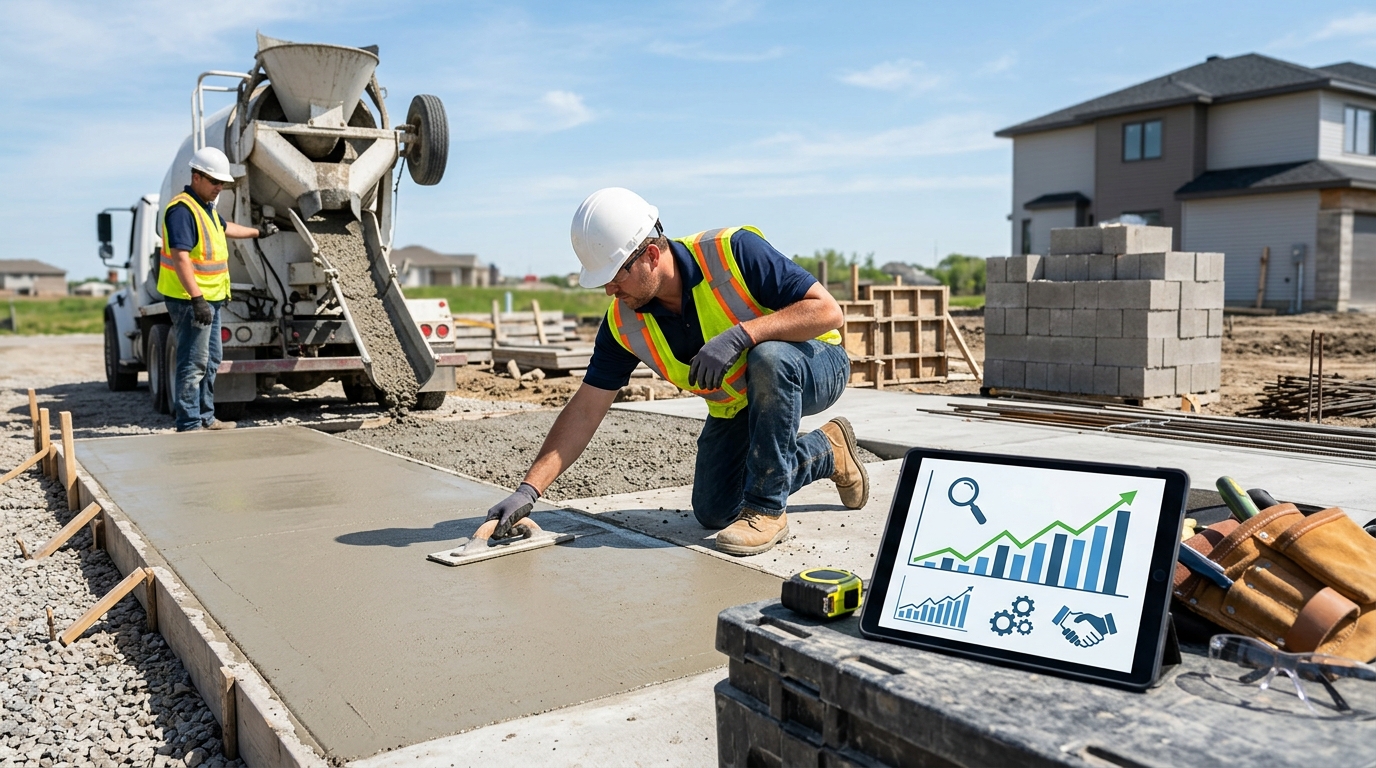
Most concrete contractors I’ve talked to get their business the same way they did ten years ago: word of mouth, yard signs, maybe a truck wrap. And those channels still work. But here’s the reality: when a homeowner needs a new driveway or a property manager is sourcing a foundation repair, the first thing they do is pull out their phone. If you’re not showing up in that search, you’re handing jobs to competitors who might do worse work than you but have better internet marketing for their concrete business.
The gap between contractors who are booked out three months and those scrambling for leads often comes down to online visibility, not skill. I’ve watched concrete companies go from $400K to $1.2M in annual revenue within 18 months simply by getting serious about their digital presence. The five steps below aren’t theoretical fluff. They’re the same strategies I’ve seen produce real results for contractors who actually implement them. The order matters: you need a solid website before SEO pays off, and you need organic visibility before paid ads become cost-efficient.
Building a High-Converting Concrete Services Website
Your website is the foundation of every other marketing effort. Run paid ads without a good site, and you’re paying to send people to a page that doesn’t convert. Invest in SEO without proper site structure, and Google won’t reward you. I’ve seen contractors spend $2,000 a month on ads driving traffic to a website that looks like it was built in 2009, and they wonder why the phone isn’t ringing.
A high-converting concrete contractor website doesn’t need to be fancy. It needs to be fast, clear, and built to turn visitors into phone calls or form submissions. That means professional photos, obvious contact information, and a design that works on mobile. The benchmark I aim for is a 3-5% conversion rate on service pages. If you’re below 2%, the site itself is the bottleneck.
Showcasing Project Portfolios and Before-and-After Galleries
Nothing sells concrete work like visual proof. A stamped patio looks incredible when you show the bare dirt “before” next to the finished product. I recommend organizing galleries by service type: driveways, patios, foundations, decorative work, and commercial flatwork. Each project should include a brief description noting the scope, square footage, timeline, and any special challenges.
Invest in decent photography. You don’t need a professional photographer for every job, but a $300 smartphone gimbal and some attention to lighting will make your $15,000 patio pour look like a $15,000 patio pour instead of a blurry mess. Take photos at the same angle before and after. Consistency makes the transformation more dramatic.
Some of the best-converting contractor sites I’ve seen include a short client testimonial alongside each project gallery. When a visitor sees the finished driveway and reads “Mike’s crew showed up on time every day and the result exceeded what we expected,” that combination of visual proof and social validation is incredibly persuasive.
Optimizing for Mobile Users and Fast Load Times
Over 70% of local service searches happen on mobile devices. If your site takes more than three seconds to load on a phone, you’ll lose roughly half your visitors before they even see your work. Google’s own data shows that bounce rates increase 32% when page load time goes from one second to three seconds.
Compress your project images before uploading them. A tool like TinyPNG or ShortPixel (free tiers available) can reduce file sizes by 60-80% without visible quality loss. Use a hosting provider that costs at least $20-30 per month: the $5/month shared hosting plans are too slow for a business site. SiteGround and Cloudways are solid options I’ve recommended to contractors.
Test your site on your own phone regularly. Tap every button. Fill out the contact form. If anything feels clunky or slow, your potential customers feel it too, and they’ll hit the back button and call the next contractor in the search results.
Implementing Clear Calls-to-Action for Free Estimates
Every page on your site should make it dead simple to request a quote. A sticky header with your phone number, a “Get a Free Estimate” button that follows the user as they scroll, and a short form (name, phone, zip code, project type) on every service page. That’s the minimum.
I’ve tested this repeatedly: reducing form fields from seven to four typically increases submission rates by 25-40%. You don’t need their full address or a detailed project description upfront. You need enough information to call them back within an hour. The speed of your follow-up matters more than the data you collect on the form.
Consider adding a click-to-call button that’s prominent on mobile. For concrete contractors, phone calls convert to booked jobs at a significantly higher rate than form fills, often 2-3x higher. Make calling you the easiest action a visitor can take.
Dominating Local Search Results with Concrete SEO
Paid ads stop generating leads the moment you stop paying. SEO compounds over time. A well-ranked service page can generate 15-30 leads per month for years with minimal ongoing investment. The tradeoff is patience: expect 4-8 months before you see meaningful organic traffic from a new SEO campaign.
For concrete contractors, internet marketing through search engine optimization is almost entirely local. You’re not competing with every concrete company in the country. You’re competing with the 5-15 contractors in your metro area who have bothered to do any SEO at all. That’s good news, because the bar is usually low.
Claiming and Optimizing Your Google Business Profile
Your Google Business Profile (GBP) is the single most important piece of digital real estate you own. It’s what shows up in the map pack when someone searches “concrete contractor near me,” and map pack results get roughly 42% of all clicks for local searches.
Start with the basics: claim your profile, verify your business address, add your phone number, set your service area, and select the right primary category (“Concrete Contractor” specifically, not just “Contractor”). Upload at least 20 high-quality photos of completed projects. Businesses with more than 100 photos get 520% more calls than the average listing, according to Google’s own published data.
Post weekly updates to your GBP. These can be simple: a photo of a job in progress, a seasonal tip about concrete maintenance, or a promotion for a specific service. Google rewards active profiles with better visibility. Set a recurring calendar reminder every Monday morning and spend ten minutes on this. It’s one of the highest-ROI activities you can do.
Targeting Location-Specific Keywords for Paving and Foundation Work
Generic keywords like “concrete contractor” are competitive and vague. The real wins come from targeting specific services in specific locations. Think “stamped concrete patio installation in Plano TX” or “foundation repair contractor Overland Park KS.” These long-tail keywords have lower search volume individually, but they convert at much higher rates because the searcher knows exactly what they need.
Build dedicated service pages for each major offering: driveways, patios, foundations, sidewalks, decorative concrete, and commercial work. Then create location-specific versions for each city or neighborhood you serve. A contractor covering the Dallas-Fort Worth metro might have 30-40 pages targeting different service-location combinations.
Each page needs unique content, not just the city name swapped out. Include details about local soil conditions, common foundation issues in the area, HOA requirements, or permit processes specific to that municipality. This approach signals to Google that your content is genuinely relevant to that location.
Generating Immediate Leads via Paid Advertising
SEO is a long game. If you need leads this week, paid advertising is the answer. I typically recommend contractors allocate $1,500-3,000 per month for paid ads initially, then scale based on results. At an average cost-per-click of $8-15 for concrete-related keywords, that budget generates meaningful data within the first 30 days.
The key metric to watch isn’t cost-per-click: it’s cost-per-lead and, ultimately, cost-per-booked-job. I’ve seen contractors pay $12 per click and generate leads at $45 each that close at 30%, putting their customer acquisition cost around $150. On a $5,000 driveway job, that’s a 3% acquisition cost. Those are excellent numbers.
Utilizing Google Local Services Ads for Verified Leads
Google Local Services Ads (LSAs) sit above regular search ads and organic results. They show your business name, review rating, and a “Google Guaranteed” badge. You pay per lead, not per click, which means you only pay when someone actually contacts you through the ad.
LSA lead costs for concrete contractors typically run $25-60 per lead depending on your market. The verification process requires a background check and proof of insurance, which filters out fly-by-night competitors. That badge builds instant trust with homeowners who are nervous about hiring the wrong contractor.
One tactical tip: respond to LSA leads within five minutes. Google tracks your response time and factors it into your ad placement. Contractors who respond fastest get shown more often. Set up instant notifications on your phone and have a templated but personalized response ready to go.
Retargeting Website Visitors with Facebook and Instagram Ads
Only about 3-5% of website visitors contact you on their first visit. Retargeting puts your business back in front of the other 95% as they scroll through Facebook and Instagram. The cost is remarkably low: typically $3-8 per thousand impressions, which translates to pennies per person reached.
Install the Meta pixel on your website (your web developer can do this in 15 minutes). Then create a custom audience of people who visited your site in the last 30 days. Show them carousel ads featuring your best project photos with a clear call-to-action for a free estimate. These ads feel less like advertising and more like a reminder, because the person already showed interest by visiting your site.
I recommend budgeting $300-500 per month for retargeting. It’s not a primary lead source, but it consistently improves your overall conversion rate by 15-25% by recapturing visitors who would otherwise forget about you.
Leveraging Social Proof and Reputation Management
A concrete contractor with 47 Google reviews averaging 4.8 stars will win the job over a competitor with 6 reviews at 4.5 stars almost every time. Reviews are the digital version of word-of-mouth, and they directly impact both your search rankings and your close rate. I’ve seen businesses increase their lead-to-sale conversion by 20% simply by going from 15 reviews to 75.
Automating Review Requests After Project Completion
The best time to ask for a review is within 24 hours of project completion, while the customer is still admiring their new patio. But most contractors forget or feel awkward asking. Automation solves both problems.
Tools like NiceJob ($75/month), Podium ($249/month), or even a simple automated text message through your CRM can send a review request with a direct link to your Google profile. The message should be short and personal: “Hi Sarah, thanks for trusting us with your driveway project. If you’re happy with the result, a Google review would mean a lot to our small business.” Include the direct review link so it takes one tap.
Aim for a 20-30% response rate on review requests. If you complete 15 jobs per month and 25% leave a review, that’s roughly 45 new reviews per year. Within two years, you’ll have a review count that dominates your local market.
Managing Online Feedback on Industry-Specific Directories
Google isn’t the only place people check reviews. Angi, HomeAdvisor, Houzz, the Better Business Bureau, and even Yelp all influence how potential customers perceive your business. Claim your profiles on each platform, ensure your contact information is consistent, and respond to every review, positive or negative.
Negative reviews happen to every contractor. How you respond matters more than the review itself. A calm, professional response that acknowledges the concern and offers to make it right actually builds trust with future customers reading that exchange. Never argue, never get defensive, and never ignore a complaint.
Scaling Growth Through Content Marketing and Video
Once your website converts well, your local SEO is solid, and your paid ads are generating consistent leads, content marketing becomes the multiplier. Blog posts and videos build authority, improve your organic rankings, and give you material to share across social media and email campaigns.
Creating Educational Blogs on Concrete Maintenance and Durability
Write about what your customers actually ask you. “How long should I wait to park on a new concrete driveway?” “Does stamped concrete crack more than regular concrete?” “How do I protect my patio from salt damage in winter?” These questions get searched hundreds of times per month in most metro areas.
Each blog post should target a specific question, answer it thoroughly in 800-1,200 words, and include a call-to-action for your services. A post about “when to replace vs. repair a concrete driveway” naturally leads to offering a free inspection. Over 12 months, publishing two posts per month gives you 24 indexed pages working as lead magnets around the clock.
Using Time-Lapse Videos to Demonstrate Craftsmanship
A 60-second time-lapse of a patio pour from start to finish is mesmerizing content. Set up a GoPro or even a phone on a tripod, capture the full process, and speed it up. These videos perform exceptionally well on Instagram Reels, TikTok, and YouTube Shorts, often reaching 10,000-50,000 views organically.
The production cost is essentially zero if you already own a smartphone. The return is brand awareness that money can’t easily buy. I’ve worked with a contractor in Kansas City whose time-lapse videos generated over 200,000 views in six months. He traced three jobs worth a combined $28,000 directly to people who found him through those videos.
Pair video content with your blog strategy. Embed project videos in relevant blog posts, share them on your Google Business Profile, and use them in your retargeting ads. One piece of content, distributed across five channels, working for you indefinitely.
Putting It All Together
These five steps build on each other. A great website makes every dollar you spend on ads and SEO more effective. Strong reviews improve both your organic rankings and your close rate. Content marketing feeds your SEO while giving you social media material. The concrete contractors who win online aren’t doing one thing well: they’re building a system where each piece reinforces the others.
Start with your website and Google Business Profile. Those two things alone can transform your lead flow within 90 days. Then layer in paid ads for immediate volume and SEO for long-term compounding. If you’re looking for a partner to help build and manage this kind of growth system, Abstrakt Marketing Group specializes in B2B lead generation and has a track record of helping service businesses scale predictably. Learn how they can help.
The contractors who commit to this process don’t just get more leads. They get to choose their projects, raise their prices, and build the kind of business that doesn’t depend on hoping the phone rings.

Jeff Winters
Jeff Winters is the Chief Executive Officer (CEO) of Abstrakt and former CEO of Sapper Consulting, acquired by Abstrakt in 2021. A seasoned entrepreneur, Jeff founded Sapper in 2013 and led it to a successful acquisition. With expertise in sales and revenue growth, he drives strategies that deliver results. As co-host of The Grow Show, Jeff shares practical insights and real stories from experienced leaders to help entrepreneurs grow. Tune in weekly on Spotify, Apple Podcasts, and more!