

In today’s digital landscape, mobile devices dominate how people access the internet. With over 60% of global web traffic coming from smartphones and tablets, businesses can no longer afford to ignore mobile SEO. Optimizing your website for mobile users isn’t just a nice-to-have—it’s essential for visibility, user experience, and ultimately, your bottom line.
This comprehensive guide dives deep into everything you need to know about mobile SEO. From the fundamentals to advanced strategies, you’ll learn how to create a mobile-first approach that drives traffic, boosts engagement, and converts visitors into loyal customers.
Contents
- 1 Why Mobile SEO Matters More Than Ever
- 2 Core Elements of Effective Mobile SEO
- 3 Advanced Mobile SEO Strategies to Outrank Competitors
- 4 Common Mobile SEO Mistakes to Avoid
- 5 Measuring and Monitoring Mobile SEO Performance
- 6 SEO Drives Traffic — But Outreach Turns That Traffic Into Customers
- 7 Conclusion: Mobile SEO Is No Longer Optional
Why Mobile SEO Matters More Than Ever
The rise of mobile internet usage has transformed how search engines rank and display content. Google’s mobile-first indexing, which prioritizes the mobile version of your site over desktop for ranking purposes, underscores the importance of mobile optimization. If your site isn’t mobile-friendly, your search rankings will suffer.
Consider these critical statistics:
- More than 70% of all Google searches happen on mobile devices.
- Mobile users are 5 times more likely to abandon a site that isn’t mobile-friendly.
- Sites that load within 3 seconds on mobile see 50% lower bounce rates than slower sites.
These numbers highlight the stakes. Mobile SEO is no longer optional; it’s a fundamental part of your digital marketing strategy. Ignoring mobile optimization means losing potential customers to competitors who deliver seamless mobile experiences. With the increasing reliance on smartphones for everything from shopping to information gathering, businesses must adapt to meet the expectations of their mobile audience. A well-optimized mobile site not only enhances user experience but also fosters brand loyalty, as customers are more likely to return to sites that are easy to navigate on their devices.
Google’s Mobile-First Indexing: What You Need to Know
Since 2018, Google has shifted to mobile-first indexing. This means Google predominantly uses the mobile version of your website content for indexing and ranking. If your mobile site lacks the content or structure of your desktop site, your rankings may drop.
Key implications of mobile-first indexing include:
- Mobile content must be as comprehensive as desktop content.
- Structured data and metadata should be consistent across both versions.
- Page speed and usability on mobile devices are critical ranking factors.
Ensuring your mobile site is fully optimized is no longer just about user experience—it directly impacts how Google evaluates and ranks your pages. Moreover, mobile-first indexing also emphasizes the importance of responsive design, which allows your website to adapt seamlessly to any screen size. This adaptability not only improves user satisfaction but also simplifies your SEO efforts, as you can manage a single URL for both desktop and mobile users. In a landscape where user attention spans are dwindling, having a site that loads quickly and presents information clearly on mobile devices can significantly enhance engagement and conversion rates.
Core Elements of Effective Mobile SEO
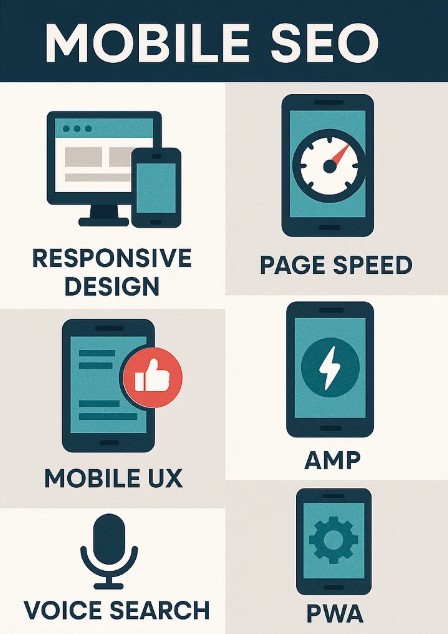
Mobile SEO encompasses a range of technical and content-related factors. To build a mobile-friendly site that ranks well, focus on these core elements:
Responsive Web Design
Responsive design automatically adjusts your website layout to fit any screen size, from smartphones to tablets to desktops. This approach is preferred by Google because it provides a consistent user experience and simplifies site maintenance.
Benefits of responsive design include:
- Single URL structure, which improves crawl efficiency and link equity.
- Consistent content across devices, ensuring no loss of SEO value.
- Improved user engagement due to easier navigation and readability.
Investing in a responsive design is foundational for mobile SEO success. Moreover, responsive design can also enhance your site’s accessibility, making it easier for users with disabilities to navigate your content. This inclusivity not only broadens your audience but also aligns with best practices in web design, promoting a more equitable online environment.
Explore Our Web Design Services >>
Page Speed Optimization
Mobile users expect fast-loading pages. According to Google, the probability of bounce increases by 32% as page load time goes from 1 to 3 seconds. Optimizing your mobile site speed can dramatically reduce bounce rates and improve rankings.
Strategies to boost mobile page speed include:
- Compressing images without sacrificing quality.
- Leveraging browser caching and content delivery networks (CDNs).
- Minimizing JavaScript and CSS files.
- Implementing lazy loading for images and videos.
Google’s PageSpeed Insights tool provides actionable recommendations tailored to your site’s mobile performance. Additionally, consider the impact of server response times on your overall speed. A well-optimized server can significantly enhance loading times, especially during peak traffic periods. Regularly monitoring your site’s performance can help identify bottlenecks and ensure a consistently fast user experience.
Mobile-Friendly Content and UX
Mobile SEO isn’t just about technical tweaks; content and user experience matter immensely. Mobile users interact differently than desktop users—they prefer concise, easily scannable content and intuitive navigation.
Best practices for mobile content include:
- Using shorter paragraphs and bullet points for readability.
- Employing larger fonts and touch-friendly buttons.
- Prioritizing above-the-fold content to capture attention quickly.
- Ensuring forms and interactive elements are easy to use on small screens.
Delivering a seamless mobile experience reduces friction and encourages users to stay longer and convert. Furthermore, integrating multimedia elements such as videos and infographics can enhance engagement, provided they are optimized for mobile viewing. This not only enriches the content but also caters to diverse learning styles, making your information more accessible and appealing to a broader audience.
See Our On-Page SEO Services >>
Advanced Mobile SEO Strategies to Outrank Competitors
Once you’ve nailed the basics, it’s time to leverage advanced tactics that give your mobile SEO an edge. These strategies focus on technical excellence, content innovation, and leveraging emerging technologies.
Implementing Accelerated Mobile Pages (AMP)
AMP is an open-source framework designed to create ultra-fast-loading mobile pages. AMP pages strip down unnecessary elements, resulting in lightning-fast load times and improved user experience.
Benefits of AMP include:
- Higher visibility in Google’s Top Stories carousel.
- Reduced bounce rates due to instant loading.
- Improved mobile rankings as speed is a ranking factor.
However, AMP implementation requires careful planning to avoid content duplication and ensure analytics tracking remains accurate. Additionally, while AMP enhances speed, it’s essential to maintain a balance between speed and rich content to keep users engaged. Brands should also consider the impact of AMP on their overall website design and user journey, ensuring that the transition to AMP does not compromise the aesthetic and functional aspects of their mobile presence.
Optimizing for Voice Search on Mobile
Voice search is rapidly growing, with over 27% of the global online population using voice assistants monthly. Mobile devices are the primary medium for voice queries, which tend to be longer and more conversational.
To optimize for voice search:
- Focus on natural language and long-tail keywords.
- Answer common questions clearly and concisely.
- Use structured data to help search engines understand your content.
- Ensure your local SEO is robust, as many voice queries are location-based.
Adapting your mobile SEO strategy for voice search can capture new traffic streams and improve user engagement. Furthermore, as voice technology continues to evolve, incorporating features like voice-activated navigation and personalized voice responses can enhance user experience. Brands should also keep an eye on the growing trend of voice commerce, where users make purchases through voice commands, and optimize their content accordingly to capture this emerging market.
Leveraging Progressive Web Apps (PWAs)
Progressive Web Apps combine the best of websites and native apps, offering fast, reliable, and engaging mobile experiences. PWAs load quickly, work offline, and can send push notifications, making them a powerful tool for mobile user retention.
From an SEO perspective, PWAs:
- Improve page speed and user engagement metrics.
- Are fully indexable by search engines when implemented correctly.
- Reduce bounce rates by offering app-like experiences without installation barriers.
Integrating PWAs into your mobile SEO strategy can differentiate your brand and enhance mobile user satisfaction. Additionally, the ability to engage users through push notifications allows brands to re-engage visitors with personalized content and updates, further driving traffic and conversions. As mobile users increasingly expect seamless experiences, investing in PWAs can position your brand as a leader in mobile innovation, catering to the demands of a tech-savvy audience while ensuring a high level of accessibility and performance.
Discover Learn Why Abstrakt is America’s Trusted SEO Agency >>
Common Mobile SEO Mistakes to Avoid
Even experienced marketers can fall into pitfalls that undermine mobile SEO efforts. Avoid these common mistakes to maintain strong mobile search performance:
Ignoring Mobile Usability Issues
Elements like small tap targets, unplayable videos, or content wider than the screen frustrate users and increase bounce rates. Google’s Mobile Usability Report in Search Console highlights issues that need fixing. Additionally, the importance of responsive design cannot be overstated; a site that adapts seamlessly to various screen sizes not only enhances user experience but also improves search engine rankings. Ensuring that text is legible without zooming and that navigation is intuitive can significantly reduce user frustration and encourage longer site visits.
Duplicate Content Between Mobile and Desktop
Having separate mobile URLs (like m.example.com) without proper canonical tags can cause duplicate content problems, confusing search engines and diluting ranking signals. This issue is compounded when content updates are made only on one version of the site, leading to inconsistencies that can confuse both users and search engines. Implementing responsive web design or dynamic serving can help mitigate these issues by ensuring that all users access the same content, regardless of the device they are using, thus consolidating your SEO efforts and improving overall site authority.
Neglecting Structured Data on Mobile Pages
Structured data helps search engines understand your content and enhances search listings with rich snippets. Failing to implement or maintain structured data on mobile pages can limit visibility. Utilizing schema markup effectively can provide search engines with context about your content, which is particularly beneficial for mobile users seeking quick answers. For instance, adding structured data for local business information can improve visibility in local searches, making it easier for potential customers to find your business on their mobile devices. Regular audits of your structured data implementation can ensure that it remains up-to-date and effective, keeping your mobile presence competitive.
Measuring and Monitoring Mobile SEO Performance
Effective mobile SEO requires ongoing measurement and optimization. Use these tools and metrics to track your progress:
Google Search Console
Monitor mobile usability, indexing status, and search performance specifically for mobile devices. Identify and fix errors promptly. This tool provides insights into how Google views your mobile site, allowing you to address issues such as mobile-friendly design and responsive layouts. Additionally, you can analyze the performance of individual pages, helping you to pinpoint which content resonates best with your mobile audience.
Google Analytics
Analyze mobile traffic behavior, bounce rates, session duration, and conversion rates to understand user engagement and identify areas for improvement. By segmenting your audience based on device type, you can gain deeper insights into how mobile users interact with your content. This data can inform your content strategy, helping you tailor your offerings to meet the preferences of mobile visitors, who may have different needs compared to desktop users.
PageSpeed Insights and Lighthouse
Regularly audit your mobile site speed and performance, implementing recommendations to maintain optimal loading times. A fast-loading site not only enhances user experience but also positively impacts your search rankings. Utilize Lighthouse to get a comprehensive report on various performance metrics, including accessibility and best practices, ensuring that your mobile site is not only quick but also user-friendly and compliant with web standards.
Rank Tracking Tools
Track your mobile keyword rankings separately from desktop to understand how your mobile SEO efforts impact visibility. Monitoring these rankings can reveal trends in user behavior and search intent, allowing you to adapt your keyword strategy accordingly. Additionally, consider using tools that provide insights into local search rankings, as mobile users often search for services and products in their immediate vicinity, making local SEO a crucial component of your mobile strategy.
SEO Drives Traffic — But Outreach Turns That Traffic Into Customers
While mobile SEO is essential for getting your business discovered online, visibility alone isn’t enough to grow revenue. Ranking well and driving qualified traffic is only the first step. To turn those visitors into real opportunities and, ultimately, closed customers, you need a strong outreach and sales enablement strategy supporting your marketing efforts.
SEO attracts prospects who are actively searching for what you offer. But without a defined follow-up process, many of those leads never convert. This is where a dedicated outreach team becomes invaluable.
A strategic outreach or BDR/SDR team acts as the bridge between marketing and sales, ensuring that:
- Leads generated through your website are contacted quickly
- Prospects receive personalized follow-up based on their interests and behavior
- Conversations are nurtured until they’re ready for a sales conversation
- Your sales team is handed qualified, sales-ready opportunities instead of cold leads
In other words, SEO fills the top of the funnel—outreach and sales support move leads through it. When your marketing, outreach, and sales teams work together, your website becomes more than a traffic driver; it becomes a predictable source of revenue growth.
Conclusion: Mobile SEO Is No Longer Optional
Mobile SEO is now a foundational piece of every growth-focused digital strategy. With mobile-first indexing, rising mobile search behavior, and shifting user expectations, optimizing for mobile is essential just to remain competitive. When businesses prioritize responsive design, fast load speeds, intuitive on-page experiences, and advanced tactics like voice search optimization and AMP, they position themselves to capture (and keep) mobile users’ attention.
But traffic alone doesn’t generate revenue. Even the best mobile SEO strategy needs the right infrastructure behind it to convert visitors into qualified opportunities. This is where many businesses fall short: they invest in attracting mobile traffic, but lack a coordinated outreach strategy to follow up, engage, and nurture those leads.
A strong SEO strategy fills the top of the funnel.
A strong outreach team moves those leads through it.
Take Your Mobile SEO to the Next Level with Abstrakt
Ready to elevate your mobile SEO and ensure your business thrives in a mobile-first world? At Abstrakt, we combine expert SEO with proven outreach and lead generation strategies to help businesses not only attract more mobile visitors—but convert them into real opportunities.
Don’t let your mobile SEO efforts stall out at the traffic stage.
Partner with Abstrakt and turn your mobile presence into a high-performing, lead-generating powerhouse.

Madison Hendrix
Madison has worked in SEO and content writing at Abstrakt for over 5 years and has become a certified lead generation expert through her hours upon hours of research to identify the best possible strategies for companies to grow within our niche industry target audiences. An early adopter of AIO (A.I. Optimization) with many organic search accolades - she brings a unique level of expertise to Abstrakt providing helpful info to all of our core audiences.