
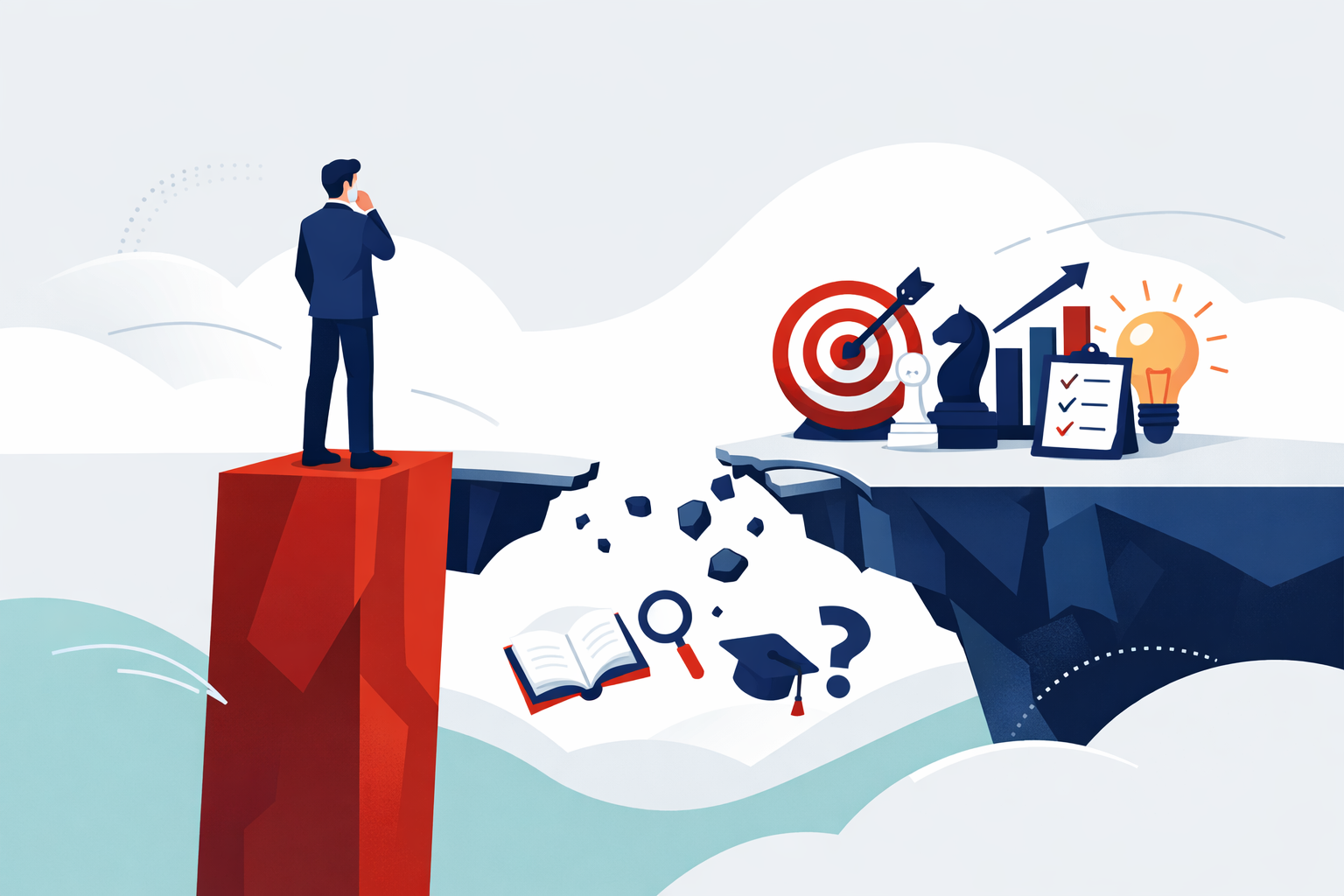
Most companies do not hit a growth ceiling because their product is weak or their service fails to deliver. More often, they slow down because the business was never built to scale beyond the founder’s personal expertise.
This is one of the most common patterns we see when working with growing organizations. Founders and leaders are deeply capable. They know their industry, understand their customers, and deliver real value. On paper, everything looks right.
And yet, growth begins to slow.
Not all at once, and not in a dramatic way. It happens gradually, almost quietly, until progress starts to feel harder to maintain than it used to.
Contents
- 1 Early Success Often Masks Structural Gaps
- 2 When Momentum Starts to Feel Harder to Sustain
- 3 The Difference Between Operational Excellence and Business Scale
- 4 Where We See Growth Break Down Most Often
- 5 Why Improving the Offering Is Rarely the Answer
- 6 What a Scalable Business Actually Requires
- 7 How Leadership Must Evolve as the Business Grows
- 8 Seeing the Business the Way Buyers and Partners Do
- 9 The Question That Signals the Next Phase of Growth
- 10 Building What the Business Needs Next
Early Success Often Masks Structural Gaps
In the early stages of a business, growth is typically driven by trust and proximity. Customers buy because they believe in the people behind the work. Sales conversations are straightforward, referrals happen naturally, and decisions move quickly because they are made by one or two individuals.
At this stage, being exceptional at the product or service really is enough.
Strong execution compensates for informal processes. Founder involvement fills operational gaps. Momentum builds even though the business infrastructure is still forming. This phase feels validating, especially for leaders who built the company on expertise.
It reinforces the belief that doing the work well is the same thing as building the business well.
Eventually, that belief gets tested.
When Momentum Starts to Feel Harder to Sustain
As demand increases, complexity follows. Sales cycles lengthen as buyers involve more stakeholders. Expectations rise around consistency, clarity, and reliability. Internal decisions take longer, and teams grow faster than alignment.
What once felt simple begins to feel heavy.
When this happens, leaders often respond by increasing effort. They stay closer to the work, get more involved in decisions, and spend more time refining the offering. The assumption is that growth has slowed because something in delivery needs to improve.
In reality, the friction usually sits elsewhere.
The Difference Between Operational Excellence and Business Scale
There is an important difference between being excellent at what your company delivers and being equipped to grow the company itself. Most founders are trained, rewarded, and validated for the first. Very few are prepared for the second.
As a business grows, new requirements emerge. Sales need to become repeatable rather than relationship-dependent. Messaging needs to remain consistent across teams and channels. Decisions need to move without bottlenecks. Operations need to support higher volume without sacrificing quality.
When these elements are missing, growth does not stop because the product fails. It slows because the business cannot support its own demand.
Where We See Growth Break Down Most Often
Across industries, the same signals tend to appear when companies outgrow their original structure.
Sales performance becomes too dependent on leadership involvement. Positioning shifts depending on who is speaking. Demand fluctuates without a clear explanation. Teams hesitate to move independently, and decisions consistently escalate upward.
These are not execution problems. They are signs of a business that still relies on individual judgment instead of shared systems.
Why Improving the Offering Is Rarely the Answer
When growth slows, it is tempting to focus on what feels most tangible. Leaders look to add features, expand services, refine delivery, or improve outcomes. Quality always matters, but this approach often misses the root issue.
Strong offerings do not scale themselves.
Growth depends on how clearly value is communicated, how reliably it is sold, and how effectively it is delivered by people beyond the founder. Without structure, even exceptional work struggles to compound.
What a Scalable Business Actually Requires
As companies mature, growth becomes less about effort and more about design. Revenue becomes more predictable when positioning is clear and consistent. Teams perform better when roles and responsibilities are defined. Execution improves when processes exist before pressure forces them.
At this stage, leadership focus shifts from doing the work to building the environment where the work can scale.
That includes clearly defining the ideal customer and buying context, establishing a repeatable sales motion, clarifying ownership and decision rights, building operational systems that reduce friction, and creating alignment across teams and functions.
These investments rarely feel urgent early on, but they become unavoidable as complexity increases.
How Leadership Must Evolve as the Business Grows
Early-stage success often requires leaders to be deeply involved in execution. As the organization grows, that same involvement can become a constraint.
When every decision runs through one person, progress slows. When teams rely on constant direction, autonomy suffers. When clarity lives primarily in someone’s head, scale becomes fragile.
Sustainable growth requires leaders to step back from execution and focus on building clarity, accountability, and trust across the organization. This shift is not about doing less. It is about doing different work.
Seeing the Business the Way Buyers and Partners Do
Internal perspective can make growth constraints hard to see. Day-to-day execution normalizes inefficiencies. Bottlenecks are tolerated, and inconsistencies are explained away.
Looking at the business through an external lens often reveals what needs attention most. Buyers care about clarity and confidence. Partners look for reliability and alignment. Investors prioritize predictability and scalability.
When the business performs well from those perspectives, growth becomes easier to manage.
The Question That Signals the Next Phase of Growth
Eventually, leadership teams face a critical question: Can this business grow without constant involvement from the same few people?
If the answer is unclear, it is often a sign that the next stage of growth depends less on improving the offering and more on strengthening the structure around it.
Building What the Business Needs Next
Strong products and services create momentum. They earn trust and open doors. Long-term growth depends on whether the business evolves to support that momentum.
Companies that scale successfully do not abandon their strengths. They build systems that allow those strengths to perform consistently, predictably, and independently.
That shift is not always comfortable, but it is necessary.

Jason Bahnak
Jason Bahnak is the Founder and Chief Marketing Officer of Abstrakt Marketing Group, a leading B2B demand generation firm based in St. Louis. With over 20 years of experience in sales, marketing, and business development, Jason has a proven track record of helping organizations grow through highly targeted outbound and inbound strategies.
Before founding Abstrakt in 2010, Jason held leadership roles at Gateway Business Development Group and Anthony, Allan & Quinn, Inc., where he specialized in leveraging digital channels to create predictable, scalable lead generation programs. His expertise spans organizational growth, sales enablement, and multi-channel marketing strategies.
At Abstrakt, he’s helped scale the business into one of the top growth agencies in the country, earning recognition on the Inc. 5000 list multiple times. Jason continues to drive innovation at Abstrakt by leading marketing strategy, exploring emerging technologies, and mentoring the next generation of sales and marketing leaders.