

Growing Lead Generation Trends for 2026: Modern Strategies to Grow Your Pipeline
This guide breaks down the most important lead generation trends shaping the year, what’s driving them, and how businesses can adapt their strategies to stay competitive in an increasingly crowded marketplace.
Why Lead Generation in 2026 Is a New Beast
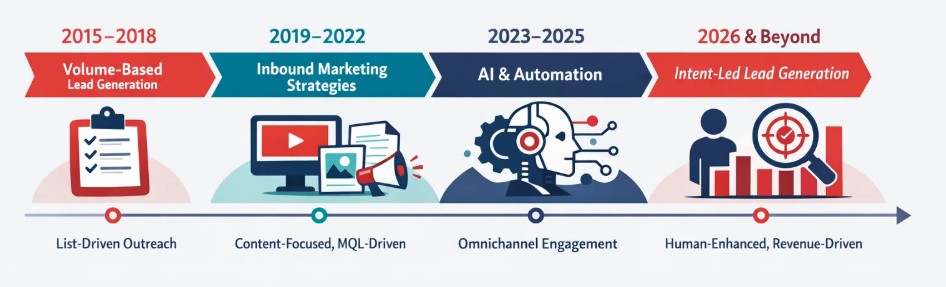
In the past, filling the top of the funnel with as many leads as possible was the primary goal. Today, that mindset is obsolete.
Modern lead generation does three things simultaneously:
- Detects buying intent earlier through digital signals.
- Engages prospects with tailored value, not generic campaigns.
- Drives measurable revenue outcomes, not just MQL counts.
High-performing teams are moving away from volume-first tactics toward data-driven, buyer-centric strategies that prioritize quality, relevance, and timing.
First-Party Data Is the New Currency
As privacy regulations tighten and third-party cookies continue to disappear, first-party data has become the foundation of modern lead generation. The organizations generating the highest-quality leads aren’t those buying the most data; they’re the ones earning it directly from their audience.
First-party data includes any information a business collects directly from prospects through owned channels. This can include website behavior, content engagement, email interactions, event attendance, product usage, and CRM activity. Unlike third-party data, first-party data is accurate, compliant, and tied to real buyer intent.
Why First-Party Data Matters More Today
Third-party tracking has become increasingly unreliable due to browser restrictions, platform changes, and evolving privacy laws. As a result, businesses that rely heavily on rented lists or external data sources often lack visibility into why prospects are engaging, or whether they’re ready to buy at all.
First-party data solves this problem by giving teams a direct line of sight into buyer behavior. Instead of guessing intent based on demographics alone, companies can observe what prospects are actually doing: which pages they visit, which resources they download, and how their engagement evolves.
This shift enables:
- More accurate lead qualification
- Better personalization without privacy risk
- Stronger alignment between marketing and sales
- Higher confidence in outreach timing
Key First-Party Data Tactics That Drive Results
High-performing lead generation teams use first-party data strategically, not passively. Some of the most effective approaches include:
Value-Driven Data Exchanges: Rather than asking for contact information upfront, businesses offer meaningful value in return. Tools like ROI calculators, assessments, templates, and industry benchmarks encourage prospects to share accurate information because the benefit is immediate and tangible.
Progressive Profiling Over Time: Modern buyers are reluctant to fill out long forms. Progressive profiling allows companies to gather insights gradually across multiple interactions, asking for minimal information initially and enriching profiles as engagement deepens.
Behavior-Based CRM Enrichment: By tracking user behavior across owned channels, teams can automatically enrich CRM records with engagement data and real-time scoring. This allows sales teams to see not just who a lead is, but how they’ve interacted with the brand.
Intent Data & Predictive Signals Drive Timing and Outreach
Generic lead lists are no longer sufficient. Modern lead generation trends are shifting decisively toward intent-led outreach: identifying prospects who are actively researching solutions and engaging at the right moment, rather than waiting for them to raise their hand.
Buyer intent data reveals where a prospect is in their buying journey and how close they are to making a decision. Instead of relying solely on firmographics or job titles, intent-based strategies focus on observable behaviors that signal real purchase interest.
In a landscape where buyers increasingly self-educate before speaking to sales, intent data provides the visibility teams need to engage earlier and far more effectively.
What Buyer Intent Signals Look Like
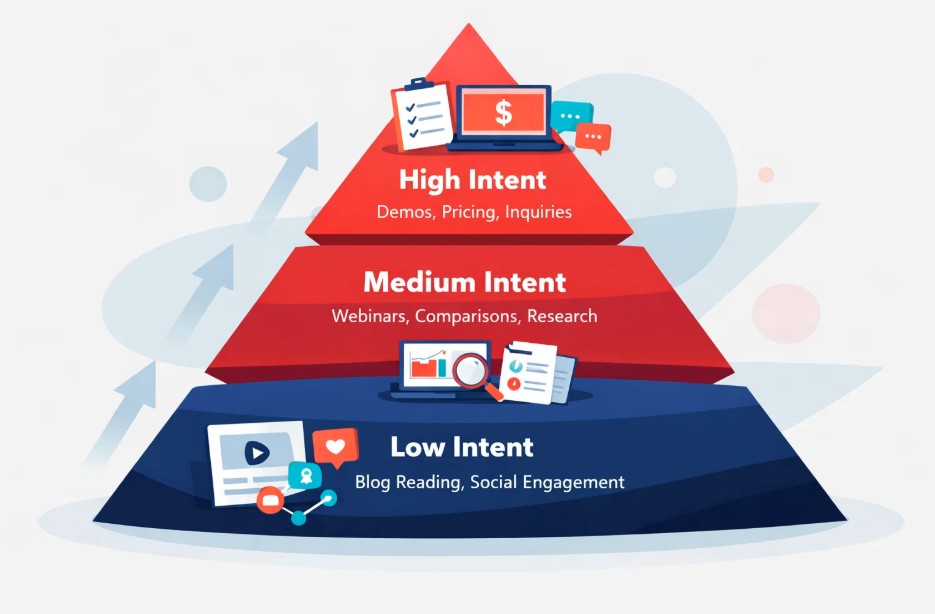
Intent signals come from a combination of behavioral, contextual, and organizational indicators. Common examples include:
- Research behavior such as repeated engagement with specific content topics or solution pages
- Product and comparison page visits, indicating evaluation activity
- Pricing page interactions, often signaling late-stage interest
- Event attendance or webinar participation tied to solution-focused themes
- Job postings, hiring spikes, or funding announcements that indicate growth, budget expansion, or operational change
Individually, these signals provide insight. When combined, they paint a clear picture of buying readiness.
Research consistently shows that buyers complete a significant portion of their purchasing journey anonymously before ever engaging directly with a vendor. Intent data helps teams identify those buyers before they fill out a form or request a demo, often weeks or months earlier.
Why Intent-Driven Lead Generation Is a Game Changer
Intent-based strategies fundamentally change how lead generation works. Instead of reacting to inbound activity alone, teams can proactively engage accounts that are already demonstrating interest.
This approach allows organizations to:
- Prioritize outreach toward accounts with the highest likelihood to convert
- Align messaging with real buyer behavior, not assumptions
- Engage prospects earlier in the decision-making process
- Reduce wasted sales effort on low-intent leads
- Shorten sales cycles by reaching buyers at the right moment
In 2026, timing is often the difference between winning and losing a deal. Intent data gives teams that timing advantage.
AI-Driven Personalization at Scale
Artificial intelligence is no longer optional in lead generation; it’s foundational to how modern teams identify prospects, prioritize outreach, and deliver relevant experiences across the buyer journey.
AI is embedded throughout lead generation workflows, from prospect identification and qualification to content personalization and engagement timing. Rather than replacing human effort, AI enhances it by processing large volumes of data and surfacing insights that would otherwise be impossible to identify manually.
How AI Is Being Used in Lead Generation
Leading organizations are applying AI in several high-impact areas:
Predictive lead scoring that analyzes behavior, engagement patterns, and historical data to surface the contacts most likely to convert
Automated personalization across channels, including email, website experiences, and paid media
Smart segmentation and clustering that groups prospects based on real behavior rather than static attributes
Conversational AI that enables real-time engagement through chat and messaging platforms
When implemented correctly, AI allows teams to scale personalization while maintaining relevance. Messaging is tailored to actual buyer behavior, not generic assumptions.
Performance Gains From AI-Powered Lead Generation
Organizations using AI-driven lead generation consistently report measurable improvements across key metrics. These include higher lead quality, shorter sales cycles, and more accurate qualification. AI enables teams to focus their time on leads that matter most while reducing manual analysis and repetitive tasks.
The real advantage of AI is not speed alone. It is precision. By identifying patterns in behavior and engagement, AI helps teams act with confidence rather than guesswork.
Where AI Adds the Most Value and Where It Falls Short
AI performs best when used to analyze data, identify trends, and recommend next actions. It excels at handling repetitive, data-intensive processes such as scoring, segmentation, and timing optimization.
However, buyers today are increasingly aware of overly automated messaging. Generic AI-generated outreach often leads to disengagement when it lacks context or insight.
High-performing teams strike a balance. AI supports research, prioritization, and personalization inputs, while humans shape messaging, build relationships, and guide strategic decisions.
The Future of Lead Generation Is AI-Enhanced, Not AI-Replaced — Learn how to use AI responsibly and effectively to support revenue growth.
Quality Over Quantity: The Shift to Revenue Metrics
For years, lead generation success was measured by raw lead volume. More leads meant better performance. That mindset is no longer effective and often actively harmful.
High lead counts do not guarantee revenue. In many cases, they overwhelm sales teams with unqualified conversations, inflate acquisition costs, and create misalignment between marketing and sales. As a result, modern lead generation trends emphasize revenue impact over activity metrics.
Today, the most successful organizations measure lead generation by how directly it contributes to pipeline growth and closed deals.
The New Metrics That Matter in 2026
Rather than focusing on top-of-funnel volume, teams are shifting toward metrics that reflect real business outcomes, including:
- Sales-Accepted Leads (SALs) that meet both marketing and sales qualification standards
- Pipeline contribution, tracking how leads influence active opportunities
- Conversion rates by segment, rather than blended averages
- Revenue per lead, which reveals true lead quality
These metrics force alignment between marketing, sales development, and revenue teams by tying lead generation efforts directly to outcomes that matter to the business.
Why Revenue-Focused Metrics Change Everything
When marketing and sales operate around shared revenue metrics, several critical improvements occur:
- Forecasting becomes more accurate because pipeline quality improves
- Deal velocity increases as sales teams spend time on better-fit prospects
- Retention improves because customers are better aligned from the start
- Budgets are allocated more efficiently toward high-performing channels
This approach also exposes inefficiencies quickly. Campaigns that generate high lead volume but low revenue impact are deprioritized, while strategies that produce fewer but higher-quality leads receive greater investment.
Omnichannel—But With Intent Orchestration
Omnichannel lead generation is not new, but today it looks very different from the broad, disconnected strategies of the past. Today’s most effective omnichannel approaches are intent-driven and intelligently orchestrated, not simply spread across as many platforms as possible.
Rather than trying to be everywhere at once, high-performing teams focus on synthesizing signals from multiple channels to form a unified understanding of each prospect. This allows them to coordinate outreach, messaging, and timing based on real behavior rather than assumptions.
What Omnichannel Lead Generation Looks Like
Modern omnichannel strategies connect data across channels and use it to guide next actions. Key components include:
- Coordinated campaigns across paid media, email, social platforms, content, events, and communities
- A unified data layer that captures engagement signals and triggers follow-up actions automatically
- Consistent messaging that adapts to where the buyer is in the journey and what they have already engaged with
The goal is not to increase channel count, but to improve relevance at every interaction.
Why Intent Orchestration Matters
Intent orchestration ensures that engagement across channels feels cohesive rather than repetitive or overwhelming. When signals are connected, teams avoid common pitfalls such as sending generic emails to prospects who just attended a webinar or serving top-of-funnel ads to buyers who are already reviewing pricing.
By aligning messaging with intent, organizations can:
- Increase engagement across channels
- Reduce friction in the buyer journey
- Improve conversion rates and sales readiness
- Deliver a more professional and trustworthy experience
Today, buyers expect brands to remember past interactions and respond accordingly.
Content That Converts, Not Just Attracts
Content remains at the heart of inbound lead generation, but the type of content that works has evolved significantly. Simply publishing blogs or gated PDFs is no longer enough. Buyers are more selective with their time and expect content to deliver immediate, relevant value.
Today’s most effective content strategies focus on helping buyers make decisions, not just driving traffic.
What Content Is Working Today
High-performing teams are prioritizing content formats that actively engage buyers and reflect real-world expertise, including:
- Interactive content (such as calculators, assessments, and configurators) that provide personalized outputs
- Insight-driven resources like industry benchmarks, original research, and detailed case studies
- Conversational content designed around search intent and real buyer questions rather than generic keywords
- Educational video content that demonstrates value, explains processes, and shows solutions in action
These formats outperform static content because they reduce friction, shorten research time, and help buyers self-qualify before speaking to sales.
Why Buyer-Intent Content Outperforms Volume Content
Content performs best when it answers specific questions buyers have at the moment they are asking them. This means optimizing around buyer intent, not just keyword rankings.
Instead of asking, “What keywords should we target?”, modern teams ask:
- What problems is our buyer actively trying to solve
- What information do they need to move forward
- What objections or uncertainties are slowing down decisions
Content that addresses these needs builds trust, positions the brand as a credible guide, and naturally attracts higher-quality leads.
Conversational Marketing Replacing Static Forms
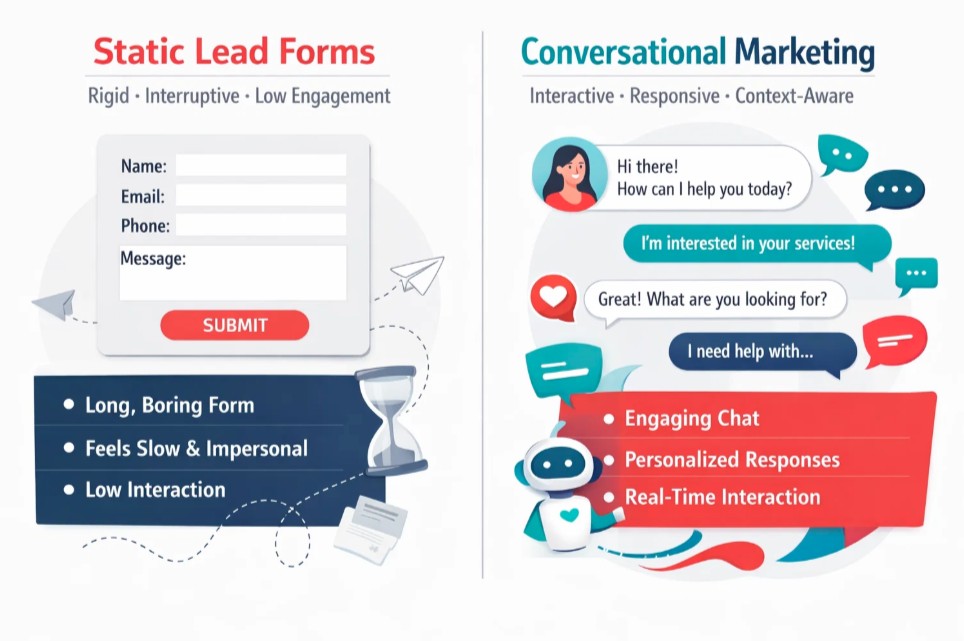
Static forms were once the foundation of lead capture, but today they are increasingly being replaced by conversational marketing experiences. Today’s buyers expect immediacy, relevance, and interaction. Lengthy forms that interrupt the research process often create friction and reduce conversion rates.
Conversational marketing meets prospects where they are by enabling real-time, two-way engagement. Instead of asking buyers to pause their journey to fill out a form, conversational tools allow businesses to answer questions, qualify interest, and capture lead data naturally during the interaction.
Conversational Tools Powering Lead Generation
Modern conversational marketing strategies use a mix of automation and human interaction, including:
- AI chatbots that qualify visitors in real time based on behavior and responses
- Live chat and messaging that support ongoing nurture and follow-up
- SMS and WhatsApp for quick, high-response engagements and reminders
- Conversation-based routing that connects prospects directly to sales
These tools transform lead capture from a passive request into an active experience.
Why Conversational Marketing Outperforms Static Forms
Conversational marketing improves lead generation performance in several key ways:
- It reduces friction by removing long forms and unnecessary fields
- It captures richer first-party data through natural dialogue
- It allows immediate clarification of questions or objections
- It adapts the conversation based on intent and readiness
Because prospects receive value instantly, they are more willing to share information and continue the conversation.
Hyper-Personalized Outreach and Human-Led Engagement
As AI takes over tasks such as scoring, segmentation, and timing optimization, the human element becomes a powerful differentiator in lead generation. Technology enables scale, but human relevance drives conversion.
Buyers are increasingly exposed to automated outreach. As a result, they are more selective about which messages they respond to. Outreach that feels generic or scripted is often ignored, regardless of how advanced the technology behind it may be.
Human-Led Attributes That Still Matter
While AI supports the process, several human-driven elements continue to separate high-performing outreach from noise:
- Account research and bespoke messaging that demonstrate real understanding of the prospect’s business
- Insightful follow-up sequences that build on previous interactions rather than repeating generic messaging
- Thoughtful responses to intent signals, such as referencing specific content engagement or recent company changes
These attributes signal effort, credibility, and respect for the buyer’s time.
Why Human-Led Outreach Outperforms Automation Alone
AI excels at identifying who to contact and when. Humans excel at determining how to engage and what to say. When these strengths are combined, outreach becomes both efficient and effective.
Prospects can quickly recognize templated messaging, even when it includes basic personalization tokens. In contrast, outreach grounded in genuine context and insight feels relevant and timely, increasing the likelihood of a response.
Hyper-personalization is not about inserting a company name or job title. It is about demonstrating awareness of the buyer’s challenges, priorities, and stage in the journey.
Trust and Privacy-First Marketing
Trust is no longer a soft brand metric. It is a measurable driver of lead generation performance. As privacy regulations continue to evolve through updates to frameworks like GDPR and CCPA, compliance is no longer optional. It is foundational.
Buyers are more aware than ever of how their data is collected and used. Organizations that fail to respect privacy expectations risk not only regulatory consequences but also reduced engagement and long-term brand damage.
What Trust-First Marketing Looks Like in Practice
Trust-first marketing prioritizes transparency and respect at every stage of the buyer journey. Key elements include:
- Clear value exchanges for data, where prospects understand exactly what they are receiving in return for sharing information
- Explicit consent and opt-in practices that give buyers control over how they engage
- Minimal tracking friction, avoiding invasive or unnecessary data collection
Rather than maximizing data capture, trust-first strategies focus on collecting the right data at the right time.
Why Privacy-First Strategies Improve Lead Generation
Privacy-first marketing improves performance because it aligns with how modern buyers think and behave. When prospects feel respected, they are more likely to engage honestly and continue the relationship.
Trust-first approaches lead to:
- Higher quality first-party data
- Stronger engagement across channels
- Lower churn during the sales process
- Increased long-term customer value
ABM and High-Value Account Focus
Account-Based Marketing continues to gain momentum as organizations shift away from mass lead volume and toward high-value, high-intent accounts. Today, ABM is less about campaign complexity and more about precision, alignment, and revenue impact.
Rather than treating every lead equally, ABM strategies focus resources on accounts with the greatest potential to convert and grow. This approach reflects a broader trend in lead generation toward quality, relevance, and long-term value.
How ABM Works Today
Modern ABM strategies are powered by data and coordination across teams. Key components include:
- Intent signals that indicate which target accounts are actively researching solutions
- Personalized orchestration across channels, including email, social, content, paid media, and sales outreach
- Tight sales and marketing collaboration, with shared goals, metrics, and account insights
ABM is less about running isolated account campaigns and more about creating consistent, relevant experiences for a defined group of high-priority accounts.
Why ABM Is More Scalable Than Ever
Historically, ABM was viewed as a resource-heavy approach reserved for large enterprise organizations. Advances in automation, intent data, and personalization tools have changed that.
Mid-market companies can now:
- Identify high-fit accounts more efficiently
- Personalize outreach without manual overhead
- Coordinate engagement across teams and channels
- Measure success based on pipeline and revenue impact
This makes ABM accessible to organizations of all sizes that want to maximize return from limited resources.
Automation and Revenue Enablement Integration
Automation in lead generation has evolved far beyond basic task execution. Automation is now about strategic orchestration that connects data, timing, and context across the entire revenue engine.
Rather than simply triggering emails or assigning leads, modern automation ensures that every interaction is informed by real buyer behavior and aligned with revenue goals.
What Lead Generation Automation Looks Like Today
High-performing teams use automation to manage complexity at scale while maintaining relevance. Common applications include:
- Real-time lead routing that assigns leads based on intent, fit, and availability
- Event-based triggers for outreach, such as content engagement, website activity, or event attendance
- Automated nurture sequences that adapt based on buyer signals rather than fixed timelines
These capabilities allow organizations to respond quickly without overwhelming prospects or sales teams.
Why Revenue Enablement Changes the Impact of Automation
Automation alone is not enough. The real value emerges when automation is integrated with revenue enablement, ensuring sales teams have the insight they need to engage effectively.
Revenue enablement focuses on equipping sales with:
- Context around buyer activity and intent
- Visibility into past interactions and content engagement
- Messaging guidance aligned with the buyer stage
When automation feeds this information directly into sales workflows, outreach becomes informed and relevant rather than reactive.
Emerging Channels and Tactics
While core channels like SEO, LinkedIn, email, and paid media remain essential, lead generation trends show growing momentum in channels that prioritize interaction, trust, and first-party engagement over passive reach.
As buyers tune out generic advertising, emerging channels offer deeper, more meaningful ways to connect with prospects earlier in the buying journey.
Emerging Lead Generation Channels Gaining Traction
Several channels and tactics are becoming increasingly valuable:
- Virtual and hybrid events that enable interactive lead capture through live sessions, workshops, and roundtable discussions
- Community-based engagement through platforms like Slack, Discord, and private forums, where peers exchange insights and build trust
- Zero-party data collection tools that allow prospects to intentionally share preferences, challenges, and goals
- Voice-activated and conversational interfaces that support hands-free research and real-time information access
These channels work because they encourage participation rather than passive consumption.
Why These Channels Matter More Than Ever
Emerging channels excel where traditional advertising struggles. They create space for dialogue, learning, and relationship building.
Benefits include:
- Richer first-party and zero-party data
- Higher engagement and longer interaction times
- Increased trust through peer and expert interaction
- Earlier visibility into buyer intent
Trust and relevance outweigh reach. These channels help brands earn attention rather than compete for it.
Putting It All Together: Lead Generation Trends That Matter Most in 2026
Here’s a summary of the 12 biggest trends shaping lead generation today:
- First-party data dominance
- Intent-led, predictive outreach
- AI-powered personalization and automation
- Revenue-focused metrics over lead volume
- Unified omnichannel with signal orchestration
- High-impact content formats
- Conversational engagement
- Human-augmented outreach
- Privacy-first strategies
- Scalable ABM approaches
- Integrated automation and enablement
- Innovative channel experimentation
These aren’t buzzwords; they’re how high-growth companies sustain pipeline velocity in an increasingly competitive landscape.
Conclusion: Lead Generation Requires a Buyer-First Mentality
Lead generation in 2026 is less about broadcasting messages and more about understanding the buyer’s context, timing, and intent.
This means:
- Listening to digital signals
- Acting early
- Delivering value at every interaction
- Aligning teams around revenue outcomes
If your strategy doesn’t reflect these trends, you risk lagging behind competitors who are already harnessing data, automation, AI, and buyer psychology as core growth engines.
Ready to Future-Proof Your Lead Generation?
At Abstrakt, we blend human insight with modern technology to help businesses convert signals into conversations and conversations into revenue. Whether you need help with pipeline orchestration, intent-based outreach, or scalable appointment setting, we’re here to partner with you.
Let’s build a lead gen system that’s not just trending—it’s winning.