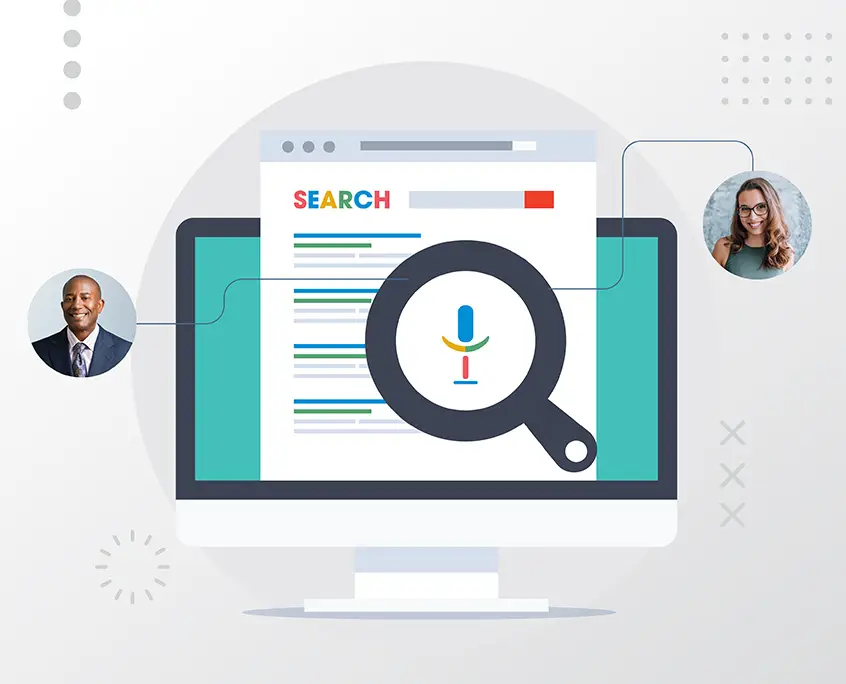
Google Voice Search is Google's way of searching by speaking instead of typing. You tap the microphone in the Google app or the search bar, ask your question out loud, and Google turns your words into a search and shows the results. For a business, a spoken search is still a Google search, so the way to show up for spoken questions is the way you show up on Google at all.
Below: how it works today, where Google's newer AI voice features fit, and what an owner of a B2B or trades company should actually do about it.
How Google Voice Search works
The basic version hasn't changed much in years. Google's help page for voice search gives three steps on Android: open the Google app, tap the microphone, and say what you're looking for. iPhones work the same way through the Google app. Speech recognition converts what you said to text, and from there it's an ordinary search.
The newer version is a conversation. Google calls it Search Live. Inside AI Mode, you can talk back and forth with Search out loud, ask follow-up questions, and point your phone camera at something for context. In March 2026 Google said Search Live is available everywhere AI Mode is, which it put at more than 200 countries and territories, and that the answers include links to pages on the web.
So a spoken search can now end in two ways. One is a normal page of results. The other is a spoken AI answer that names a few businesses or sources and links to them.
What people ask out loud
Spoken questions tend to be longer and more natural than typed ones. Nobody says "HVAC repair Tulsa" to their phone. They say something closer to "who repairs rooftop units near me" or "how long does a commercial roof coating last."
For a business that sells to other businesses, two kinds of spoken query matter most:
- Nearby searches. A property manager standing in a flooded mechanical room asks for a company close by. Here Google's local results decide who gets named.
- Plain questions. An owner asks how something works or what it should cost before calling anyone. The answer comes from whichever pages explain it clearly.
Is there such a thing as voice search optimization?
Not as a separate discipline. There's no special voice index. Google's guidance for its AI answers is blunt: there are no special optimizations needed to appear in AI Overviews or AI Mode, beyond a page being indexed and eligible to show with a snippet. Search Live sits inside AI Mode. That means the work that gets you into spoken answers is ordinary search work, done well.
In practice that comes down to four things.
Answer the question in plain words, near the top of the page
If a facility manager asks how often a cooling tower should be inspected, a page that answers in its first two sentences is easier to quote than one that makes them read four paragraphs of company history first. Write each service page and article so the main answer comes early, in words a customer would use.
Get your Google Business Profile right
For "near me" questions, Google's local results do the deciding. Google names three things that shape local results: relevance, which is how well your profile matches the search; distance from the person searching; and prominence, meaning how well known the business is. You can't move your building. You can make sure the profile lists the right categories, services, hours and service area, and that your name, address and phone number match everywhere they appear online.
Keep the site fast on a phone
Someone who asks their phone a question and taps a result lands on your mobile site, often while standing in a parking lot or a job site with one bar of signal and very little patience for a page that takes its time to load. If it's slow, they go back. The next name on the list gets the call.
Check what's being said about you
The quickest way to see where you stand is to ask. Search for your service the way a customer would say it, out loud, on your own phone. Then ask an AI assistant who to call for it in your area. Our Free AI Visibility Check runs that test for you: it looks at your website, your mobile speed, whether you come up in a local search, and what an AI assistant says when a buyer asks who to call. No email needed.
Where Inbound SDR comes in
Showing up for spoken questions takes the same ongoing work as showing up on Google: service pages that answer real questions, a Business Profile that's accurate, directory listings that agree with each other, and a steady flow of new, useful content.
That's the work Inbound SDR does. We build a website of up to 100 pages in the first month, planned around every service you sell and area you serve, and we host and maintain it. We optimize your Google Business Profile and Bing Places listing and keep your name, address and phone consistent across 65 or more directories. A new blog goes out every business day and is posted to up to 3 social platforms, and a dedicated strategist reports to you monthly. Packages start at $1,000 per month on a 12-month term.
It isn't for everyone. We don't post to your Business Profile or manage reviews, and we don't run ads. If your site is already in good shape and someone on your team keeps it current, you may only need to tighten up your profile and a few pages yourself.
Short answers
Is Google Voice Search the same as Google Assistant?
No. Voice search is the microphone in Google Search. Assistant is a separate helper that can also run searches.
Do I need a separate voice search strategy?
Not usually. A spoken search is still a Google search, and Google says its AI answers need no special optimization. Clear answers, an accurate Business Profile and a fast mobile site cover most of it.
Can I see how many people found me by voice?
Not directly. Google's reports don't separate spoken searches from typed ones, so you'll see those visits mixed in with the rest of your search traffic.
Get the next one in your inbox
New playbooks, benchmarks and guides from our sales floor, for owners and sales leaders who sell to businesses. One email a month. See past issues.